Comment creer une cryptomonnaie sans coder : guide en 5 etapes avec Smithii
Si vous vous demandez comment creer une cryptomonnaie, aujourd’hui vous pouvez le faire sans ecrire une seule ligne de code. Avec une dApp no-code comme Smithii, le processus se resume a prendre de bonnes decisions (surtout sur la blockchain) et a remplir un formulaire avec les parametres du token pour le deployer.
Dans ce guide, nous expliquons etape par etape comment creer votre propre cryptomonnaie sans ecrire de code. Mais d’abord, vous apprendrez quelle blockchain choisir (chacune differe en couts, vitesse, ecosysteme, etc.). Une fois le reseau defini, nous passerons au simple guide en 5 etapes.
Lisez jusqu’a la fin pour bien comprendre comment cela se fait.
Choisir la bonne blockchain (l’etape la plus importante)
En theorie, vous avez deux options pour creer votre propre crypto : construire une blockchain (ou forker une existante) ou creer un token sur une blockchain deja etablie.
Creer votre propre reseau vous donne un controle total pour inclure des standards personnalises, mais ce serait une tache beaucoup plus complexe. Pour vous eviter les maux de tete, nous nous concentrerons sur la creation du token sur une blockchain existante.
Choisir une blockchain definit l’ensemble de l’environnement de votre cryptomonnaie, y compris les frais, la vitesse de transaction, le type de portefeuilles utilises, les DEXs, et meme la communaute cible.
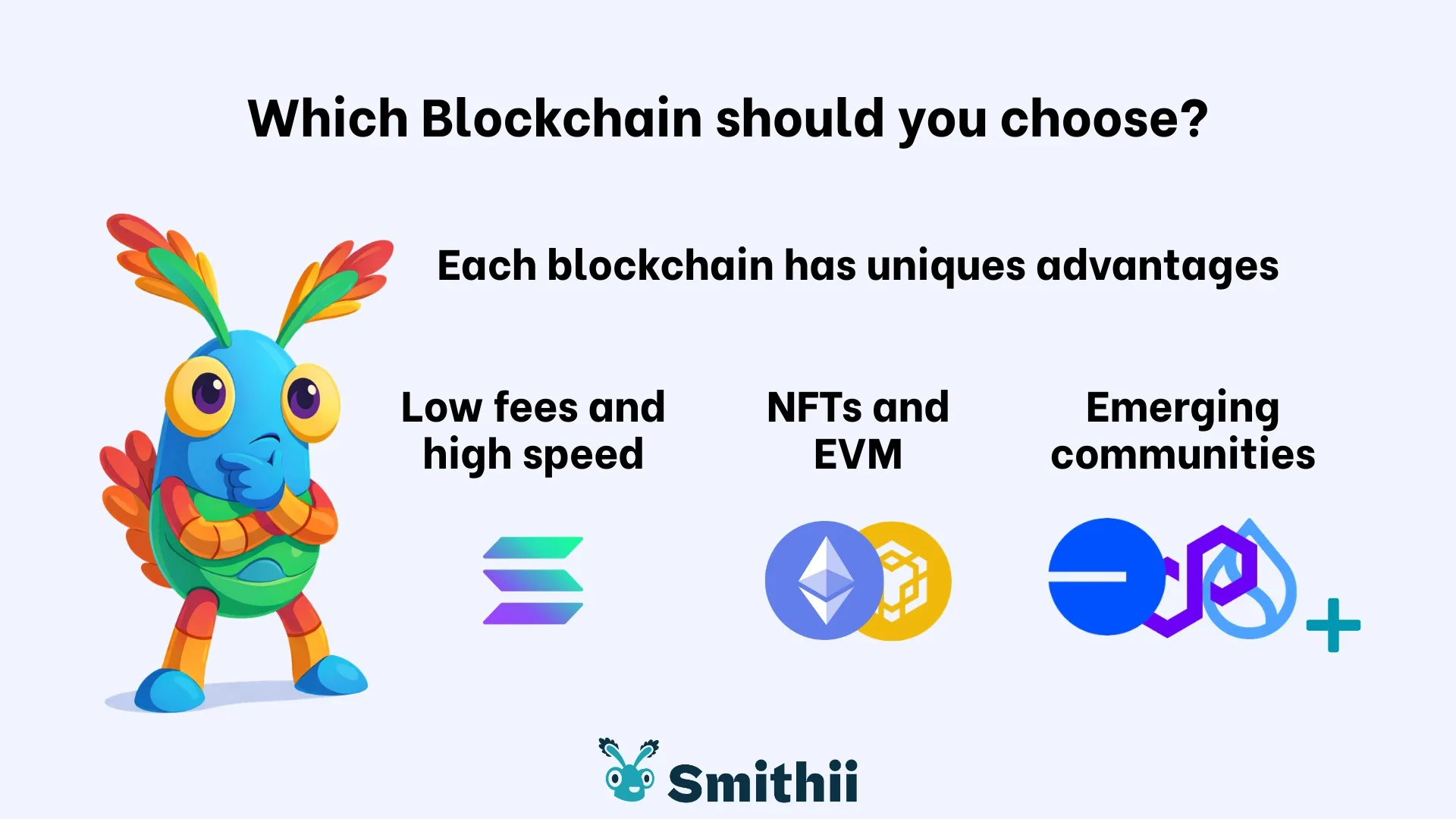
Bien que Smithii puisse etre utilise sur 11 blockchains, examinons une comparaison pratique des blockchains les plus populaires pour creer des cryptomonnaies.
Solana (Tokens SPL)
- Faibles couts et un reseau rapide (transactions confirmees en secondes)
- Ecosysteme tres actif (de nombreux utilisateurs operent simultanement)
- Environnement mixte (DeFi, NFTs et meme coins)
You can also choose whether to add a transaction tax on your cryptocurrency if you use the SPL-2022 standard. We have an article highlighting the differences between an SPL token and Token-2022.
Ethereum (ERC20)
- Outils bien etablis (compatibles avec la grande majorite des dApps)
- Plus cher en raison des frais de gas (surtout en cas de congestion, ce qui arrive plus souvent qu’on ne le pense)
- Plus attractif pour les projets NFT
BSC (BEP20)
- Frais generalement bas et transactions rapides
- Ecosysteme oriente retail (utilisateurs interesses par les tokens et leur trading)
- Parfait pour les projets tokenises
If you’re interested in learning more about the differences between Ethereum and BNB Chain tokens, we have a post about it that you can check out.
Base (Ethereum L2)
- Moins cher que le mainnet Ethereum
- Compatibilite EVM
- Ecosysteme Ethereum avec de meilleurs frais (en croissance constante)
Si vous avez deja une communaute etablie sur une blockchain, il est preferable de deployer la cryptomonnaie sur cette meme blockchain.
Conditions requises pour creer une cryptomonnaie
Avant de creer quoi que ce soit, il est important de definir les caracteristiques que votre token aura et de preparer un portefeuille avec des fonds pour couvrir les frais.
En termes de caracteristiques, nous faisons reference a :
- Name and symbol: the set of characters that identify your crypto
- Supply: how many tokens will exist
- Decimals: to define how small the minimum payment can be
- Metadata: information linking to the token’s public and communication channels
- Image: to visually identify the coin
With all of this defined, you also need to prepare the wallet so it has enough for fees. If you chose Solana, you need a Solana wallet. You’ll use its native currency ($SOL, in this example) to pay network fees, along with Smithii’s fee to create a cryptocurrency with no code.
If you’re interested in blockchain for meme coins, take a look at our guide to choosing the right ecosystem for your meme coin.
How to create a cryptocurrency step by step
On Smithii, the process is very similar across networks. As an example, here we use the Solana Cryptocurrency Creator, but the experience is equivalent on other blockchains. You select the blockchain, define the parameters, and confirm the creation.
Once you’re in the dApp, do the following:

- Choose the blockchain: select it from the dropdown in the top right corner.
- Connect your wallet: our dApp has been audited and is completely secure.
- Go to the Token Creator: click on « Token Creator » in the left sidebar to customize your own cryptocurrency.
- Customize your crypto: enter its name, symbol, decimals, supply, description, etc.
- Confirm the transaction: the last thing you need to do is click « Create Token » and confirm the transaction from your wallet.
And that’s it. In a matter of minutes or seconds, you’ll have your own cryptocurrency (depending on the network you choose). Optionally, you can take advantage of additional features like authority revokers on Solana, or the Anti-bot, Anti-whale, and Airdrop Mode options for EVM on Smithii.
What comes next after creating a crypto?
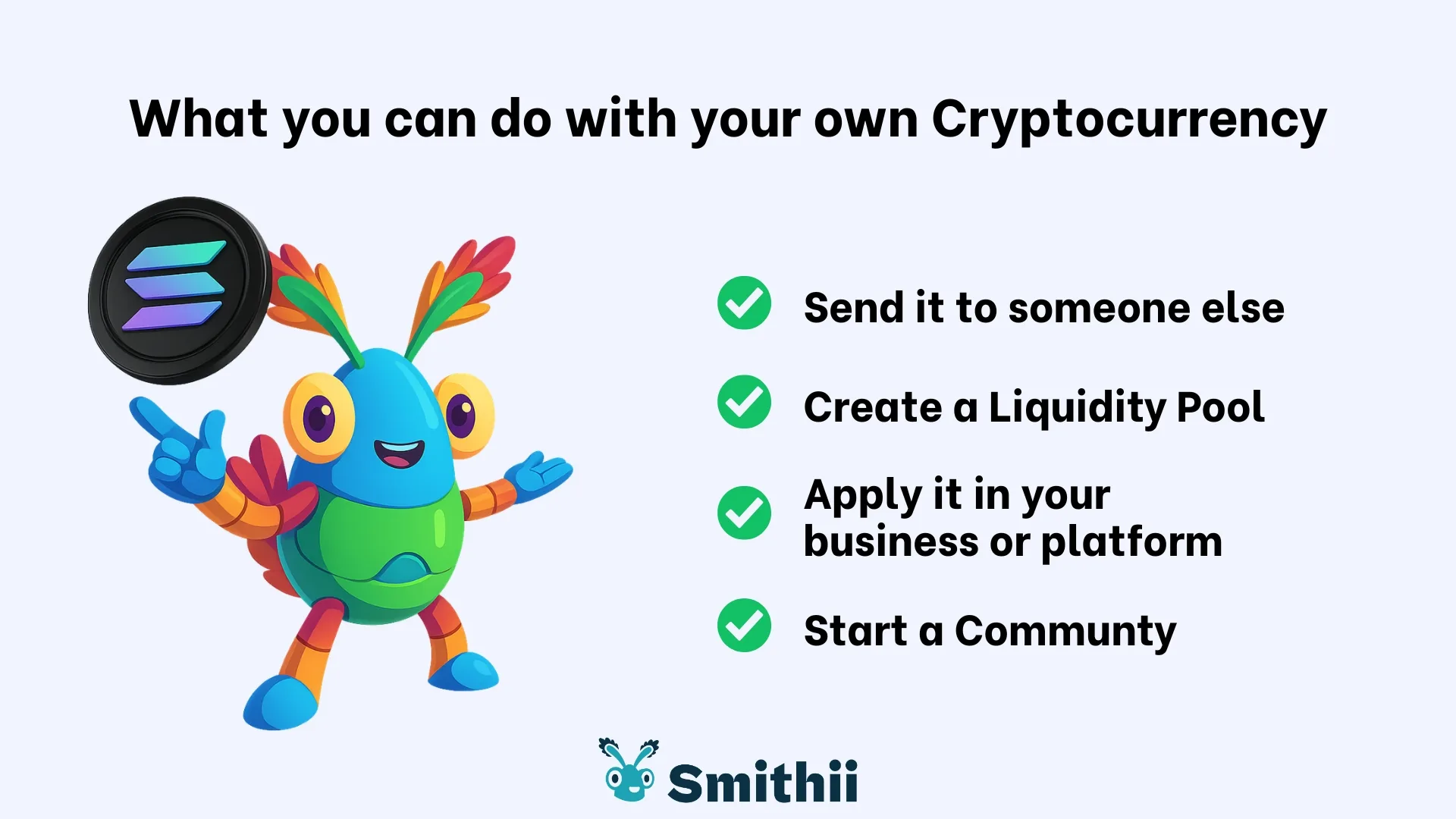
Now that you know how to create a cryptocurrency, making it is just the beginning. It’s like printing your own unique coin design: nobody knows about it, it has no use, and it’s not traded.
If you want to reach the point where your coin appears on exchanges, then you need to create a liquidity pool. This is a reserve that pairs your token with another token that already has value. Usually, the native token of the blockchain: $ETH for Ethereum and L2s, $SOL for Solana, $BNB for BSC… etc.
Without a liquidity pool, your coin won’t have value. You’ll be able to send it to another person or integrate it into a platform like token gating, but nobody will be able to buy or sell it.
We have a guide to creating a liquidity pool on Uniswap, the most recognized DEX for the EVM-compatible ecosystem, as well as the tutorial for creating a liquidity pool on Raydium. In both cases, using Smithii’s tools.
FAQ
Creating a cryptocurrency is a straightforward task, but questions often arise about the assets you’ve created. That’s why in this section we answer the most frequently asked questions.
Can you create tokens on multiple blockchains with Smithii?
Yes. You can create tokens on different networks from the dApp. The flow is similar: you choose the blockchain, configure parameters, and confirm the transaction. The asset will appear in your wallet, and you’ll be free to do whatever you want with it.
How much does it cost to create a cryptocurrency?
It depends on the blockchain and the features. On Solana, for example, the cost is 0.3 $SOL + minimal network fees. On Ethereum and several L2s, it’s 0.01 $ETH. On BSC, it’s 0.19 BNB.
How can I create a cryptocurrency for free?
You can create a cryptocurrency for free by writing code, smart contracts, and executing commands. It’s a more complicated approach that requires technical knowledge, but it’s entirely possible.
How much supply should my crypto have?
The answer depends on the type of cryptocurrency you want to create. Meme coins typically have 1-10 B tokens, while more serious projects may opt for 1-100 million. We recommend checking our guide to designing tokenomics to craft a strategy before your token’s public launch.
Conclusion
If your goal is to learn how to create a cryptocurrency in a practical way without coding, the simplest path is to follow a clear logic: choose the blockchain based on costs, speed, and ecosystem; define the token parameters; and create the crypto asset with a no-code tool like Smithii in a guided flow.
In addition to the cryptocurrency creator on Smithii, we have other useful tools that will help you launch your project, whatever it may be.

CEO & Co-Founder Smithii. Building on Solana since 2021 and passionate to share my experience on Solana projects. I also Founded Lince after years investing in DeFi.