How to create a cryptocurrency without coding: a 5-step guide with Smithii
If you’re looking into how to create a cryptocurrency, today you can do it without writing a single line of code. With a no-code dApp like Smithii, the process comes down to making good decisions (especially about the blockchain) and filling out a form with the token parameters to deploy it.
In this guide, we explain step by step how to make your own cryptocurrency without writing any code. But first, you’ll learn which blockchain to choose (each one differs in costs, speed, ecosystem, etc.). Once the network is defined, we’ll move on to the simple 5-step guide.
Read to the end to fully understand how it’s done.
Choosing the right blockchain (the most important step)
In theory, you have two options for creating your own crypto: building a blockchain (or forking an existing one) or creating a token on an already established blockchain.
Creating your own network gives you full control to include custom standards, but it would be a much more complex task. To save yourself the headaches, we’ll focus on creating the token on an existing blockchain.
Choosing a blockchain defines the entire environment of your cryptocurrency, including fees, transaction speed, the type of wallets used, DEXs, and even the target community.
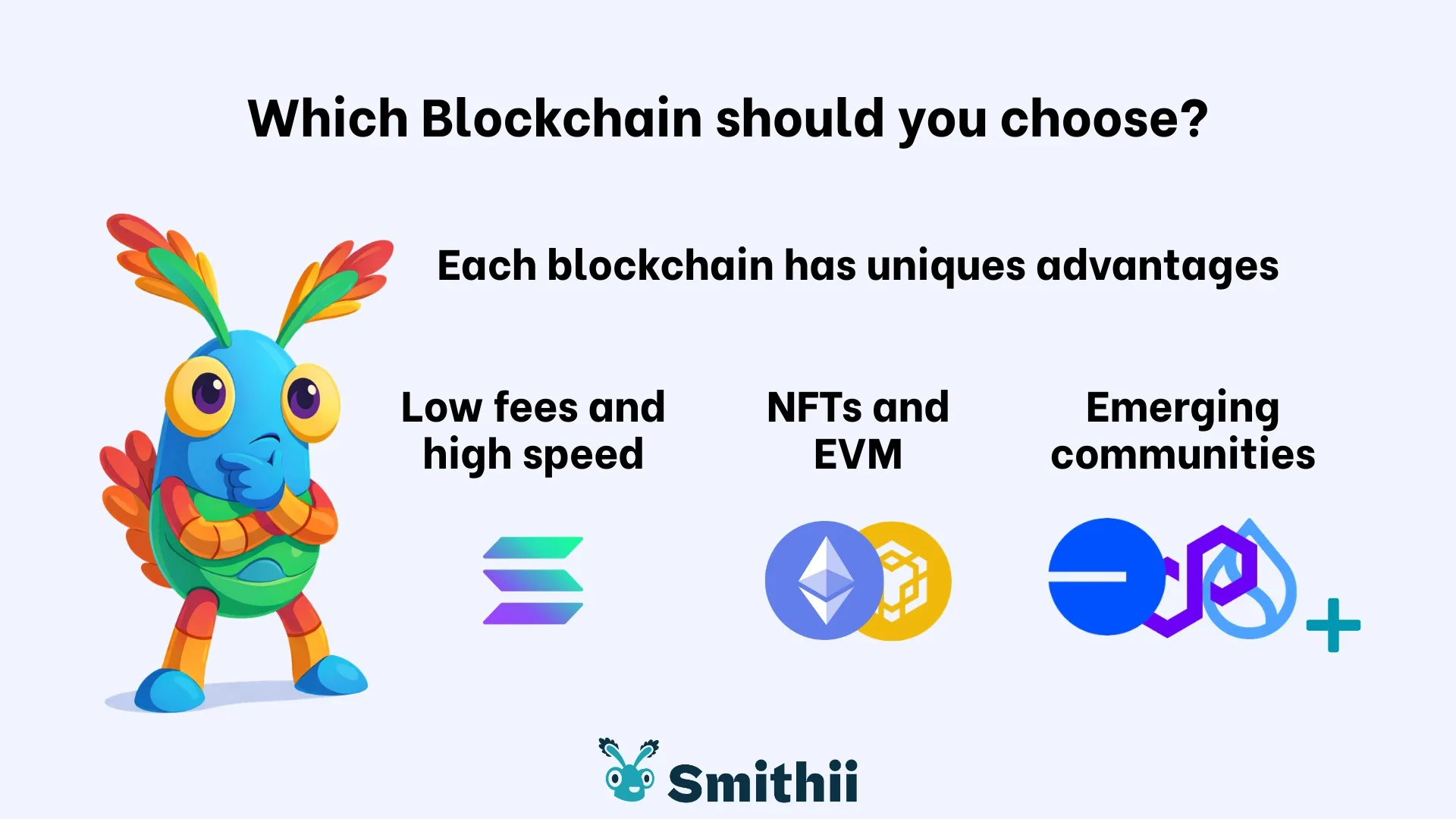
Although Smithii can be used on 11 blockchains, let’s look at a practical comparison of the most popular blockchains for creating cryptocurrencies.
Solana (SPL Tokens)
- Low costs and a fast network (transactions confirmed in seconds)
- Very active ecosystem (many users operate concurrently)
- Mixed environment (DeFi, NFTs, and meme coins)
You can also choose whether to add a transaction tax on your cryptocurrency if you use the SPL-2022 standard. We have an article highlighting the differences between an SPL token and Token-2022.
Ethereum (ERC20)
- Well-established tooling (compatible with the vast majority of dApps)
- More expensive due to gas fees (especially during congestion, which happens more often than you’d think)
- More attractive for NFT projects
BSC (BEP20)
- Generally low fees and fast transactions
- Retail-oriented ecosystem (users interested in tokens and trading them)
- Perfect for tokenized projects
If you’re interested in learning more about the differences between Ethereum and BNB Chain tokens, we have a post about it that you can check out.
Base (Ethereum L2)
- Cheaper than Ethereum mainnet
- EVM compatibility
- Ethereum ecosystem with better fees (constantly growing)
If you already have an established community on a blockchain, it’s best to deploy the cryptocurrency on that same blockchain.
Requirements for creating a cryptocurrency
Before creating anything, it’s important to define the characteristics your token will have and prepare a wallet with funds to cover fees.
In terms of characteristics, we’re referring to:
- Name and symbol: the set of characters that identify your crypto
- Supply: how many tokens will exist
- Decimals: to define how small the minimum payment can be
- Metadata: information linking to the token’s public and communication channels
- Image: to visually identify the coin
With all of this defined, you also need to prepare the wallet so it has enough for fees. If you chose Solana, you need a Solana wallet. You’ll use its native currency ($SOL, in this example) to pay network fees, along with Smithii’s fee to create a cryptocurrency with no code.
If you’re interested in blockchain for meme coins, take a look at our guide to choosing the right ecosystem for your meme coin.
How to create a cryptocurrency step by step
On Smithii, the process is very similar across networks. As an example, here we use the Solana Cryptocurrency Creator, but the experience is equivalent on other blockchains. You select the blockchain, define the parameters, and confirm the creation.
Once you’re in the dApp, do the following:

- Choose the blockchain: select it from the dropdown in the top right corner.
- Connect your wallet: our dApp has been audited and is completely secure.
- Go to the Token Creator: click on “Token Creator” in the left sidebar to customize your own cryptocurrency.
- Customize your crypto: enter its name, symbol, decimals, supply, description, etc.
- Confirm the transaction: the last thing you need to do is click “Create Token” and confirm the transaction from your wallet.
And that’s it. In a matter of minutes or seconds, you’ll have your own cryptocurrency (depending on the network you choose). Optionally, you can take advantage of additional features like authority revokers on Solana, or the Anti-bot, Anti-whale, and Airdrop Mode options for EVM on Smithii.
What comes next after creating a crypto?
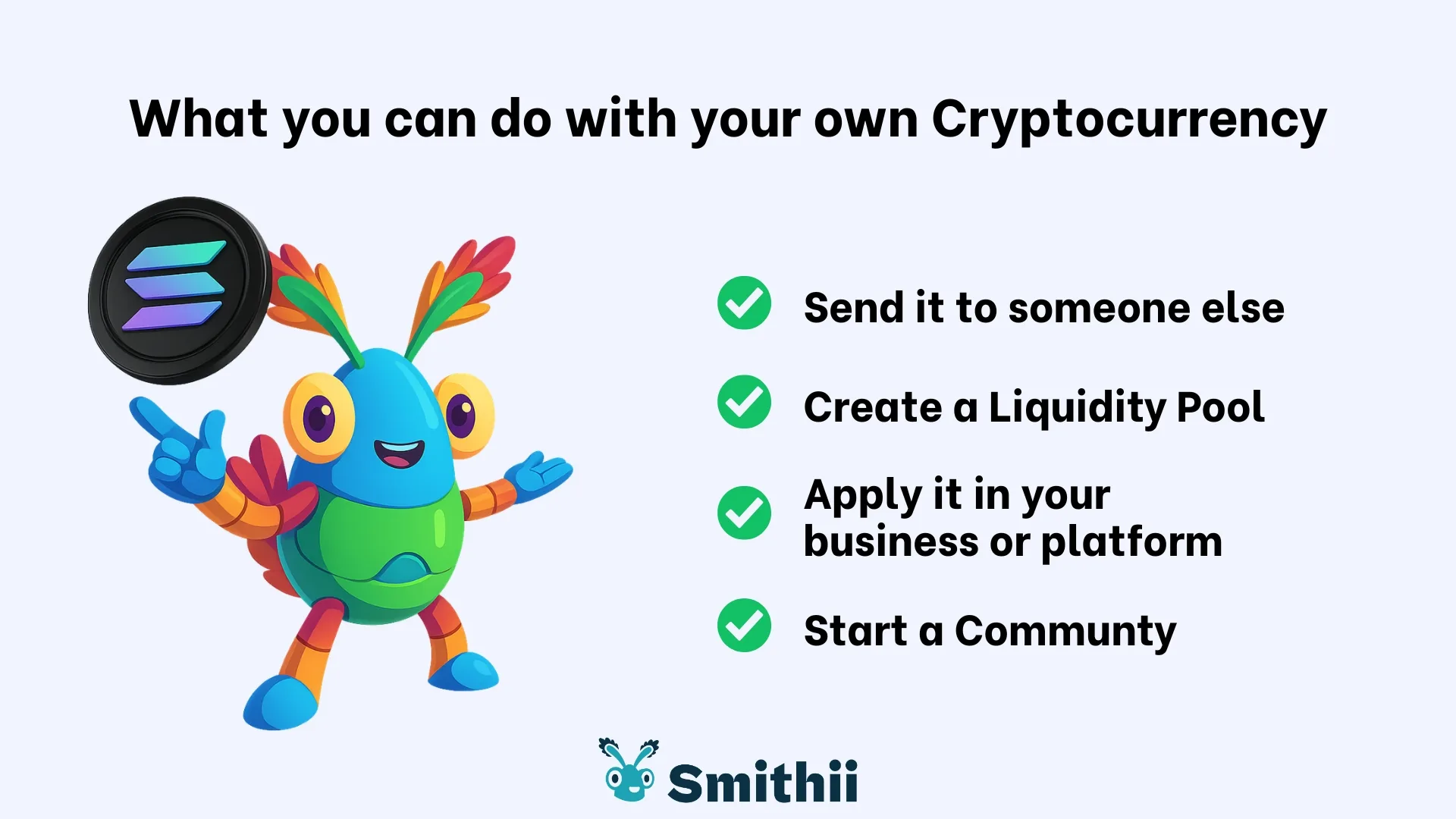
Now that you know how to create a cryptocurrency, making it is just the beginning. It’s like printing your own unique coin design: nobody knows about it, it has no use, and it’s not traded.
If you want to reach the point where your coin appears on exchanges, then you need to create a liquidity pool. This is a reserve that pairs your token with another token that already has value. Usually, the native token of the blockchain: $ETH for Ethereum and L2s, $SOL for Solana, $BNB for BSC… etc.
Without a liquidity pool, your coin won’t have value. You’ll be able to send it to another person or integrate it into a platform like token gating, but nobody will be able to buy or sell it.
We have a guide to creating a liquidity pool on Uniswap, the most recognized DEX for the EVM-compatible ecosystem, as well as the tutorial for creating a liquidity pool on Raydium. In both cases, using Smithii’s tools.
FAQ
Creating a cryptocurrency is a straightforward task, but questions often arise about the assets you’ve created. That’s why in this section we answer the most frequently asked questions.
Can you create tokens on multiple blockchains with Smithii?
Yes. You can create tokens on different networks from the dApp. The flow is similar: you choose the blockchain, configure parameters, and confirm the transaction. The asset will appear in your wallet, and you’ll be free to do whatever you want with it.
How much does it cost to create a cryptocurrency?
It depends on the blockchain and the features. On Solana, for example, the cost is 0.3 $SOL + minimal network fees. On Ethereum and several L2s, it’s 0.01 $ETH. On BSC, it’s 0.19 BNB.
How can I create a cryptocurrency for free?
You can create a cryptocurrency for free by writing code, smart contracts, and executing commands. It’s a more complicated approach that requires technical knowledge, but it’s entirely possible.
How much supply should my crypto have?
The answer depends on the type of cryptocurrency you want to create. Meme coins typically have 1-10 B tokens, while more serious projects may opt for 1-100 million. We recommend checking our guide to designing tokenomics to craft a strategy before your token’s public launch.
Conclusion
If your goal is to learn how to create a cryptocurrency in a practical way without coding, the simplest path is to follow a clear logic: choose the blockchain based on costs, speed, and ecosystem; define the token parameters; and create the crypto asset with a no-code tool like Smithii in a guided flow.
In addition to the cryptocurrency creator on Smithii, we have other useful tools that will help you launch your project, whatever it may be.

CEO & Co-Founder Smithii. Building on Solana since 2021 and passionate to share my experience on Solana projects. I also Founded Lince after years investing in DeFi.