
Blast shutdown: the Ethereum L2 is pulling the plug on October 26, and here’s what to do with your funds
The Blast shutdown now has a date. The Ethereum L2 built by Blur’s founder stops operating normally on October 26, 2026, and the team is asking every user to withdraw their funds to Ethereum mainnet before that day.
If you hold ETH, stablecoins, or your own token on the network, here’s why it’s shutting down, what the deadlines are, and how to withdraw your funds, plus what will happen to the Smithii tools for Blast. Let’s get into it.
Why Blast, the Ethereum L2, is shutting down
The announcement dropped on October 2 through the official Blast account on X. The team explains that running the network costs more than the L2 earns and that they see no credible path to make it sustainable, so they’ve decided to wind it down in an orderly way.
Blast launched with a very specific promise. Deposits opened in November 2023, months before the network even existed, and mainnet went live on February 29, 2024 with a hook no other L2 was offering: native yield. The ETH deposited earned yield through Lido staking, and stablecoins were converted into USDB, a stablecoin that generated yield automatically.
Behind the project was Pacman, co-founder of the NFT marketplace Blur, and the network pulled in capital fast thanks to a points system that peaked with the launch of the BLAST token in June 2024.
From $2.26B to $32M: the collapse of Blast’s TVL
According to DefiLlama, Blast’s TVL peaked in June 2024 at around $2.26 billion. On the day of the announcement it was hovering around $32 million, a 98.6% drop. With activity that low, the fees the network generates can’t cover what it costs to operate.
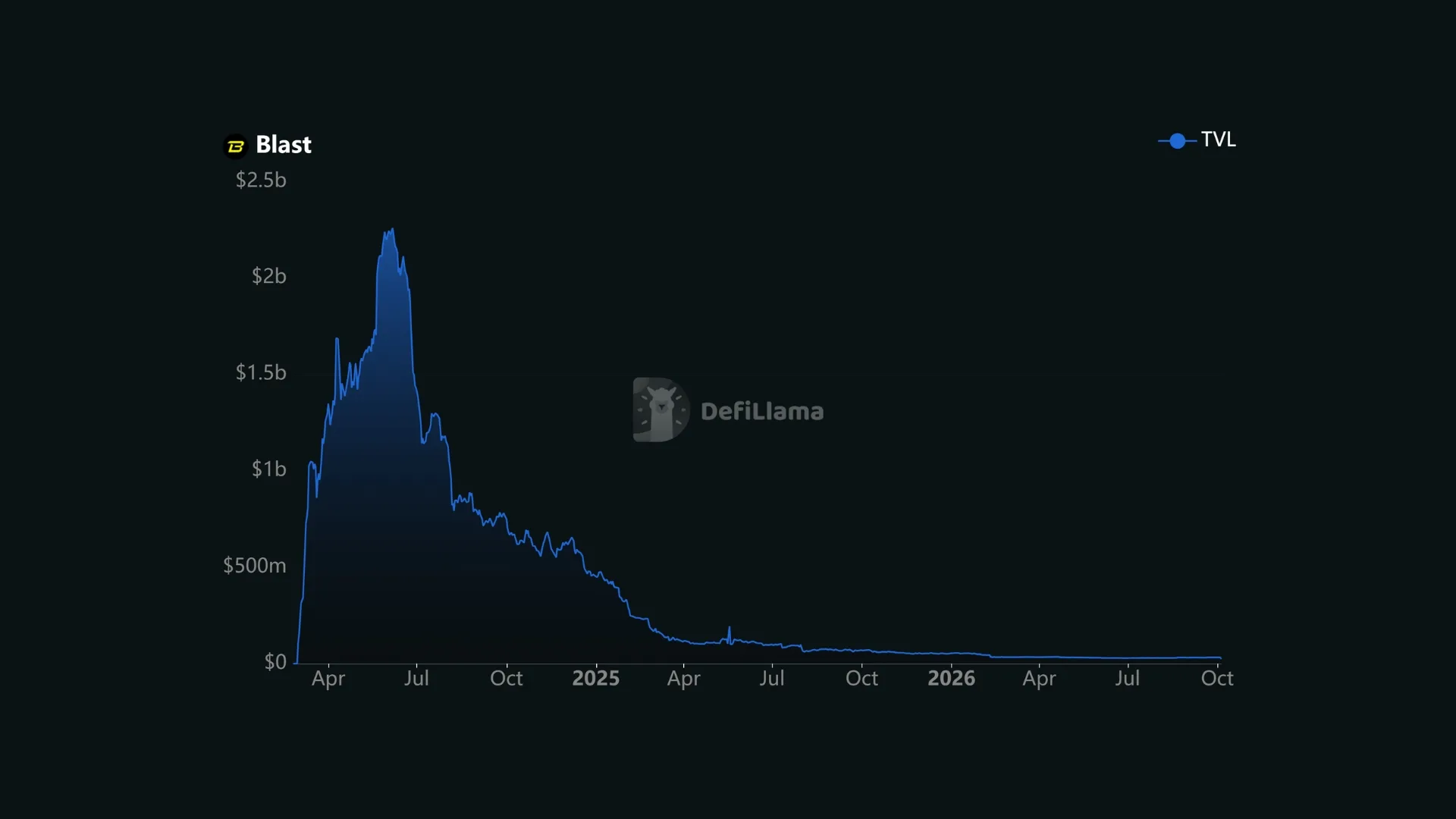
It’s a familiar pattern. A big chunk of that capital came in chasing yield and airdrop rewards, and walked out the door the moment incentives ended. Native yield worked as bait, but it wasn’t enough to keep users or projects around once the token had been distributed.
Blast shutdown timeline and withdrawal deadlines
The process runs in phases and it’s worth knowing them, because there will be a few days when nothing can be withdrawn.
- October 2, 2026: Blast announces the shutdown and asks users to move their assets to Ethereum mainnet, including any balances held in the Blast PWA.
- For about a week: the team pulls out the assets Blast has in Lido. While that’s running, withdrawals are paused.
- Once the Lido unwinding is done: withdrawals resume with the window cut down to 24 hours.
- October 26, 2026: last day to withdraw through the standard Blast interface.
- After October 26: funds will still be recoverable, but by interacting directly with the bridge contracts on Ethereum. Blast will publish instructions before that date.
The fact that funds stay recoverable past the deadline is good news, but interacting with contracts directly isn’t straightforward for most users. That’s why the recommendation is to withdraw before October 26 and not wait until the last day.
How to withdraw your funds from Blast to Ethereum
Withdrawing from an L2 to Ethereum isn’t instant. First you start the withdrawal on Blast, wait out the security window, and then finalize it on Ethereum mainnet, where the funds land back in your wallet. The general flow looks like this:
- Only use official channels: get to the Blast site through their official account, never through links sent to you in DMs.
- Connect the wallet you use on Blast: the one holding the funds, with some ETH on Ethereum to cover gas for the final transaction.
- Start the withdrawal to Ethereum: pick the asset and amount, and sign the transaction on Blast.
- Wait out the withdrawal window: it’ll be 24 hours once the Lido unwind is done. While it’s still running, the operation won’t be available.
- Finalize the withdrawal on Ethereum: sign the final transaction on mainnet to receive the funds in your wallet.
If you have a balance in the Blast PWA, the network’s web app, include that too, since the team mentions it specifically in the announcement.
Watch out for any site that pops up these days offering to migrate, claim, or withdraw funds from Blast. Network shutdowns attract scams that mimic the official interface, and the only trustworthy sources are the Blast account and their own website.
If you have liquidity in a pool, you’ll first need to remove your liquidity on Blast to get the pair tokens back.
What happens to the Smithii tools for Blast
On Smithii we have tools to create, manage, and provide liquidity to tokens on Blast, from the Token Creator to the Multisender and the holders snapshot. With the network shutting down, we’ll be pulling them from Smithii Tools as October 26 approaches, and until then they’ll stay live so you can close out your operations.
Our recommendation lines up with Blast’s own team: pull your funds off the network as soon as possible and don’t wait until the last day. If your project lives on Blast, use these weeks to pull liquidity and take a snapshot of your holders while you figure out where to move next.
To preserve your community list, here’s how to take a holder snapshot on Blast before the shutdown.
If you want to keep building, the same tools are available on other chains. Robinhood Chain has caught serious traction with devs using Smithii, and it has its own Robinhood Chain tools hub, including launchpads, bundlers, and volume bots. Solana is still the go-to chain for launching tokens and meme coins, and our definitive guide for devs on Solana walks you through the whole process end to end.
With the snapshot in hand, you can relaunch the token on another network and distribute it to your holders via a airdrop, so your community doesn’t get lost along the way.
What Blast’s shutdown leaves behind for token launchers
Networks shutting down is rare, but not impossible, and Blast is proof. For a dev, there are three lessons that apply on any chain.
- Real activity matters more than incentives: a network that grows on points and airdrops can empty out once those dry up. Look at real usage and sustained TVL, not just the peak.
- Always have an exit plan: knowing how to pull liquidity and move your treasury to another network saves you from scrambling when conditions change.
- Keep your community data on file: a regular holder snapshot lets you rebuild the distribution on another chain if you need to.
None of this means you should avoid new chains. It means choose based on data and keep your project portable enough to move it if the network it lives on stops making sense.
FAQ
When does Blast shut down?
Blast’s shutdown happens in two phases. Up to October 26, 2026, you can withdraw your funds through the normal interface, and after that date it will only be possible by interacting directly with the bridge contracts on Ethereum.
Can I withdraw my funds from Blast after October 26?
Yes. Assets will still be withdrawable, but you’ll have to operate directly with the bridge contracts on Ethereum L1. Blast has said it will publish detailed instructions before that date.
Why can’t I withdraw from Blast right now?
Because the team is first pulling the assets Blast holds on Lido, a process that takes about a week. In the meantime, withdrawals are paused, and after that they resume with a 24-hour window.
What happens to the tokens I created on Blast?
Blast hasn’t spelled out what will happen to tokens created on the network itself. The smart move is to pull liquidity out of your pools, move the ETH to Ethereum, and keep a snapshot of your holders in case you decide to relaunch on another chain.
Will Smithii’s tools for Blast keep working?
Yes, up until October 26 approaches. After that, we’ll pull them from Smithii Tools, and you’ll be able to keep using the same tools on other chains like Robinhood Chain or Solana.
Conclusion
Now that you know Blast’s shutdown timeline, you know that the window is tight. There’s a week-long pause for the Lido withdrawal and a bit over two weeks after that to withdraw through the normal interface.
Move your funds to Ethereum mainnet as soon as possible, pull liquidity out of your pools, and save your holder list. If you’re going to keep building, our tools are waiting for you on any other chain.

Content creator and SEO contributor at Smithii. Systems Engineering student and crypto-tech enthusiast.