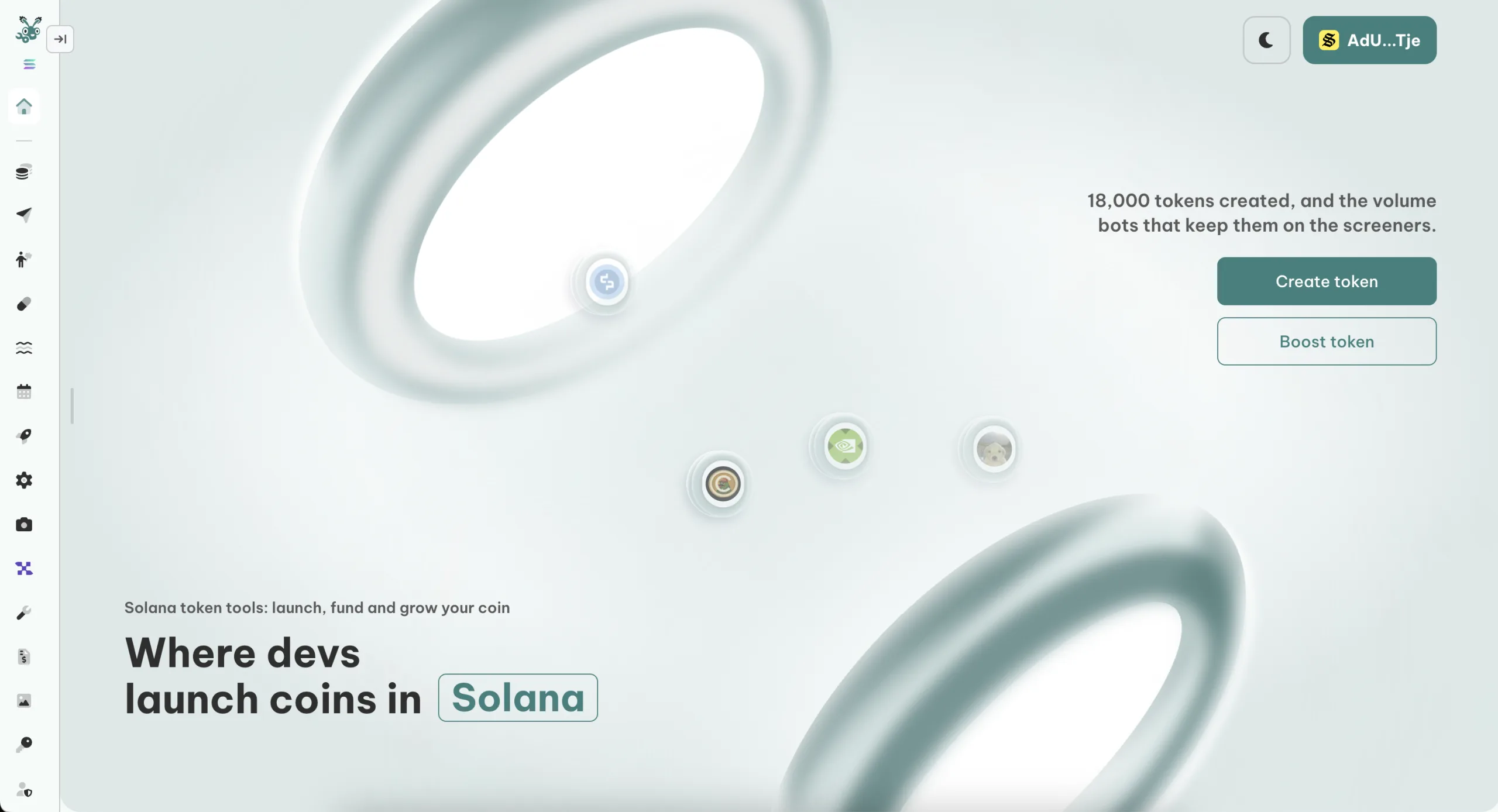

Web3 Tools: the definitive guide to the best tools

The Best Web3 Tools Roundup
At Smithii, we offer a wide range of tools to help you create and manage your Web3 projects across multiple blockchains, use cases, and every stage of your idea. This is your complete guide to using the Web3 Tools we provide.

Which Stages Can You Use a Web3 Tool For?
- Create your token: use any of our Token Creator tools on the networks you choose. Need a meme coin or a token? You can create either one, or both, with our token creator.
- Create a liquidity pool: the Liquidity Pool Creator is easy to use and lets you set up liquidity before going public. This is where you create the pair between your token and any stable coin or governance token.
- Web3 marketing tools: boost your project’s performance with a tool-powered marketing strategy using options like the Snapshot and the Multisender (Airdrop tool).
- Volume Bot: once your token is listed on DEXes, it is time to simulate volume, add makers, and push the price as needed to improve its performance. You can do it with a Market Maker Bot or a Volume Bot.
- (Recommended) Other useful Web3 tools: beyond the standard tools we will cover, you can also use options like volume bots. We cover those tools in their own section.
Why Use Web3 Tools?
Web3 Tools let you manage your project from start to finish without touching code. That means you can deploy faster through an easy-to-use interface built for every type of user, from experienced builders to complete beginners.
No Code, No Hassle, 24/7 Support, Secure, and Affordable
We mapped out the tools you need to launch a Web3 project in a simple, direct way. In this guide, we walk you step by step through turning your ideas into reality across the most widely used blockchains: Solana, Ethereum, BSC, Base, Polygon, Arbitrum, Avalanche, Blast, and Sui.
Smithii is built by a doxxed team committed to top quality and full transparency for every user. It has been around since 2023 and has a well-established base of users. Still have questions? Join our community to ask anything, or check the results of our audits.
This article is designed to show you the most complete set of Web3 tools, grouped by function, use case, and project stage. Whether you have technical experience or not, you can bring your project to market without writing a single line of code.
Explore a new level of autonomy in Web3.

1. Token Creators, core Web3 tools
Token Creators: the first step to launching your Web3 project
The first thing to cover in this guide is creating a token. No matter which blockchain you choose for your project, you will use one of the token creators. This means setting every attribute that defines your project: name, symbol, decimal count, supply, description, image, social links, and other features that Smithii gives you to gain a stronger edge and protect your upside. Once you finish, the new token goes straight to your wallet, so you can start distributing or using it however makes the most sense.
If you prefer, choose any blockchain below to open the dedicated guide for creating a token:


Token protocols: which one should you choose?
A protocol is the set of standard rules that defines the attributes and behavior a token will have on a blockchain. These rules apply to practically every token, so you’ll need to choose the protocol that fits your use case. To make that decision easier, here’s a breakdown of the most widely used standards:
- SPL: this is the standard for the Solana network. Its variant is SPL Token 2022, which allows creators to add a tax on each transaction, one of the most important differences between SPL and SPL Token 2022. Unlike the other standards on this list, it is handled through a “Token Program” rather than a separate smart contract for each token.
- ERC-20: in this case, it is the standard not only for Ethereum, but for every EVM chain (Base, Polygon, Arbitrum, Avalanache, Blast, and even BSC). That makes it far more adaptable for dApps, DeFi, and similar use cases.
- BEP-20: this is the BSC or Binance standard, and it is very similar to ERC-20. While it is much more scalable and cheaper to transact with, it runs on a centralized network. That last point matters most, especially when looking at the differences between BEP-20 and ERC-20.
- Sui standard: in practice, Sui does not have one fixed standard, which makes its token ecosystem much more flexible. All tokens still follow a base “schema,” but their properties can be customized, opening the door to a wider range of use cases.
Mint in one click, without the hassle
From customization and creation to managing the other key pieces of your web3 launch, Smithii gives you more than a wide range of Token Creators for the most popular blockchains. You also get features built to help you hit your launch goals. Each tool has a clean, beginner-friendly interface so anyone can create a token without technical or advanced knowledge.
Instant scanner links
Instead of digging through every coin in your wallet, creating a token with a Token Creator also lets you view the transaction and Token Address instantly. No waiting around to see your live coin on wallet, so you can share it right away or update metadata if you want to.


Full Control After Launch
The Web3 toolset from Smithii never holds your assets under any circumstances and has no hidden fees. Once you add the token to your wallet, you are free to do whatever you want with it. You can also use it to update information or add any of the features we covered earlier.

2. Create Liquidity Pool with Web3 Tools
Liquidity Pool Creator: launch your token on the public market
Once the token you created is in your wallet, it is time to use the Liquidity Pool Creators so other people can trade it. That is why you still cannot see a valid pair to check its chart on sites like Birdeye or Dexscreener. Besides creating the Liquidity Pool, you also need to make a transaction. The whole process is handled automatically by any of these Web3 Tools, so once you create the liquidity pool, the token can be bought or sold at any time.
What are the most important DEX on each blockchain?
Each blockchain has a main DEX where your liquidity pool should be listed so more people can trade your token freely. If you are not sure which ones matter, these are the main DEX on the blockchains where Smithii works:
- DEX on Solana: Raydium, Jupiter, Orca, Meteora, and PumpSwap (recently launched by Pump.fun).
- DEX on Ethereum, Base, Polygon, and other EVM chains: Uniswap and SushiSwap.
- DEX on BSC: PancakeSwap.
- DEX on Sui: Cetus.
If you want to quickly see how to create a Liquidity Pool on the main DEX of each blockchain, click any of these buttons:




How does a Liquidity Pool work?
A liquidity pool runs on an algorithm or protocol, with the best-known model here being the Automated Market Maker (AMM). Its job is to keep the relationship between two tokens in a pool balanced and constant. That way, when a user buys or sells tokens, they do not run into a situation where liquidity runs out for either side of the pair. At the same time, an AMM calculates the value of the token in base based on available liquidity, so when a token is bought frequently, its market value increases. The opposite happens when it is sold.
In the same context, it is worth noting that the more liquidity funds a token has, the more stable its value will be. When the funding balance is low, each buy or sell can cause a sharp move in the asset’s price, which can create losses and uncertainty for other investors.
Liquidity Providers (LP)
Likewise, creating liquidity is not the only way to generate returns from taxes or value. You can also join an existing liquidity pool by adding your funds and allowing a token to be traded against another pair. Users who participate this way become Liquidity Providers, or LPs. This is another advantage of Web3 because it enables greater decentralization. When you compare an AMM with a Liquidity Provider by structure and methodology, the latter depends more on third parties than on a DEX.
If you are the original creator of an asset, having other users add liquidity as LPs is a strong signal for your project, since it adds much more liquidity to the pool and reduces the gap between the market’s “real value” and “expected value” (a term known as Slippage).

How much liquidity to add to a liquidity pool
There is no single or absolute answer here, because there is no proven formula for how much liquidity you should add. What is clear is that the more liquidity your Quote Token has (the asset that gives value to the coin you created), the more stable the pair becomes and the more attractive it looks to the market. With low liquidity, the opposite usually happens: an extremely volatile asset does not just discourage buyers, it becomes a real risk for investors. That is why, when it comes to the Quote Token, more is always better.
Now, when it comes to the Base Token (the token that will receive a value), allocating the entire supply to a liquidity pool is not recommended, because it leaves you with no room to run other strategies with your token, such as an Airdrop, Claim Site, Pre-Sale, or claiming creator rewards. For that reason, the liquidity amount for the Base Token usually sits between 60% and 75%. This is part of the tokenomics plan you want to implement for your project.

How much liquidity to add
We show you how much liquidity you should add to your liquidity pool on each blockchain

Remove liquidity from a liquidity pool
Just as you can create a liquidity pool or add liquidity, you can also withdraw funds from a pool at any time. Of course, doing so immediately drains value from your token, which can damage the credibility of the project and the team behind it. Still, there are situations where you may need to remove liquidity from the funds, including:
- Security risk: the wallet holding the LP Tokens may have been compromised in some way, so you decide to remove liquidity before someone else does in order to protect holders.
- Migration: if you made a mistake when creating the liquidity pool, want to roll out contract improvements, or plan to migrate liquidity to another project after notifying the community, you need to withdraw the funds.
- Financial strategy: while you should generally leave the initial liquidity untouched, you may have other liquidity pools where it makes sense to cash out and rethink your strategy after capturing tax-driven gains (for example, by creating a liquidity pool from a SPL Token 2022).
In any of the cases above, or for any other reason, you can withdraw the liquidity pool through the links below:
Security and risks of a liquidity pool
Creating a liquidity pool calls for a few key steps to tighten security and reduce risk as much as possible, especially in a market full of rug pulls, where investors and DEX are getting better at spotting these fraudulent plays. That means you need to meet certain security standards so people feel confident joining your project. It will also build trust with your community, so this is something you should stay focused on at every stage.
Here is what you can do to raise the security level of your liquidity pool.
Avoid sniper bots
When you create a liquidity pool, there is a strong chance a sniper bot will make an early buy to sell as soon as other people buy the token. That creates immediate volatility and can derail your plan to build momentum from the start. To avoid this, you need to Auto-Snipe your token (for Solana) or use Anti-Bot (for the rest of EVM).

Anti-Bot on Ethereum
How to use the Anti-Bot system available on Ethereum (the same setup works for other EVM chains)
Set Up Vesting
When creating the liquidity pool, you can set up vesting on Solana to lock the tokens, so they cannot be transferred or used until a target or time period is reached. This gives other investors more confidence, and those tokens will appear in the holder list if the setup fits your project.
Burn Liquidity or LP Tokens
On EVM chains, liquidity can be burned. In practice, that means sending the LP Tokens to a dead address so no one can access the liquidity reserve for that asset. This is one of the most recommended steps, because once the LP Tokens are burned, there is no way to move the liquidity assigned at launch.

Burn liquidity on Solana
Step-by-step guide to burning LP tokens on Solana after creating a liquidity pool

3. Marketing Tools: Snapshots and Airdrops
Why Web3 advertising matters
Getting your project noticed helps you reach people who are ready to back your plans. Here, the goal is simple: get people to buy your coin and keep adding more value to it. To get there, you need a marketing strategy backed by Web3 Tools so you can reach the audience your launch needs. That is why you will need a Snapshot & Airdrop Tool.
What is Snapshot?
Snapshot is a tool that gives you a complete list of every wallet holding a specific NFT or Token. From there, you can copy all wallet addresses or download a CSV and reuse it in another Web3 Tools feature.
For example, if you want to run a giveaway for the community you have already built around a token, or send a quick bulksend, this tool makes those workflows much easier to execute. You can continue with a dedicated guide for any of these blockchains:
What Is Airdrop?
A Airdrop is a bulk token distribution sent to multiple wallets, usually as a marketing move for a user base. In these cases, it is worth targeting wallets from projects that are genuinely relevant, either because they are similar or because the project will expand into other tokens. That way, you make sure the people receiving the Airdrop are actually likely to value it.
Inside Web3 Tools, you will find the Multisender to run Airdrops easily, with the option to customize the token amount for each wallet.
Why create a Snapshot and a Airdrop?
If you want to identify the community you are targeting, the fastest way is to get the list of wallets holding a project similar to yours. Whether it is a token, meme coin, or NFT, getting that list quickly is key to launching a campaign that involves whitelists or rewarding a community through airdrops.
This strategy matters if you want to drive usage of your tokens or meme coins and get the word out about your new project. Still, you should support it with more common communication channels like social media and forums. For meme coins, for example, this can be a core part of promotion.

4. Volume Bots to Generate pump for Your token
Make Your token More Attractive with a Volume Bot
This tool is automated software that generates buys and sells at random, using a base of funds you provide at the start. Once you press “Start Bot”, it begins running by creating multiple wallets and placing staggered buy and sell orders on the target token.
If you want to learn how to use these tools individually for each blockchain, click any of the buttons below:
Almost every project uses a volume bot (Market Maker Bot)
New tokens and meme coins launch every minute, so any push for traction can get buried by the competition. That is why most teams choose to use a volume bot or a bump bot. In both cases, Market Maker Bot covers both needs and can fit any setup, since it is fully customizable, especially in its advanced version.
As part of building a complete Web3 tool suite, Market Maker is now available across every blockchain supported inside Smithii.
Volume Bot parameters that fit each project
When you start the bot to simulate transactions, you can configure each option around your needs. Some of the configurable parameters include:
- Number of makers you want to create: this is the number of wallets the bot will manage to run buys and sells. In analytics, a “maker” is a market participant who either buys or sells the token.
- Amount of money you want to invest: based on base, the bot will split the funds across the wallets for each buy. These funds will decrease slightly because of each network’s gas fee.
- Bot runtime: the number of minutes the bot will run, regardless of its purpose.
- Delay per transaction: this helps simulate more organic traffic and makes it less obvious that a bot is executing the transactions.
- What happens to the tokens bought: you can choose whether the bot sells the tokens to keep spreading funds across the wallets, or sends the tokens to your wallet once the operations are finished.
- Size of each buy: you can set a variable range that the bot will maintain throughout its runtime.

5. Other Web3 Tools You Might Find Useful
Pump.fun Zone: volume bots, comment bots, and bundles
There are other tools you can use to give your Web3 projects more traction on any blockchain. If you are leaning into meme coins on Solana, you can use volume bots, comment bots, and bundle bots on Pump.fun, one of the most widely used platforms for listing meme coins. In this case, it is worth using platforms that let you boost meme coin without unnecessary friction.

Graduate Token: guide
In this guide, we explain what Graduate Token means and how to reach that milestone


PumpSwap Zone: Market Maker bot and Bundles
PumpSwap is an AMM and DEX on Solana, and it is becoming a major hub for meme coin launches in this ecosystem. That is why we are committed to building useful tools for this platform, just as we do for many others. The Market Maker helps you generate the right amount of transactions to convince more people to buy your token. You can also protect yourself from sniper bots with bundle buy and bundle sell.


Final Thoughts on Web3 Tools
Make the Web3 build path easier and bring your project to life
With this toolkit, you can turn your ideas into something real without writing code, in the cheapest and fastest way possible. But it does not stop there. Every blockchain has its own features for improving your chances of turning your token into an exchange gem. In the same way, Smithii helps keep you safe with cutting-edge Web3 Tools, available worldwide and backed by 24/7 real-time support.
If we break down what you need to do to create a crypto asset from start to finish using only these tools, the whole process comes down to these steps:
- Use the Token Creator to mint your asset: it will appear in your wallet, or in whichever wallets you choose to diversify the initial supply.
- Create a Liquidity Pool: you will go to the tool to create a liquidity pool, add the initial liquidity, and open the tradeable pair. From that point on, other users will be able to buy and sell the token across multiple platforms.
- Get holder wallets: there are likely established projects that fit your web3 project closely, so you can mirror the addresses of people holding amounts of that token.
- Run an Airdrop: with multisender, you can create an Airdrop to reward your community or distribute tokens among the holders pulled from the Snapshot. That gives people a reason to use it.
Smithii has the easiest Web3 Tools to use (and some of the cheapest)
Smithii supports you at every stage with easy-to-use web3 tools, built for users at any skill level who want to launch their own meme coin or token across multiple blockchains. The team behind Smithii is doxxed, provides full guides and tutorials for every tool, and ships constant updates to give every user more flexibility. On top of that, its tool suite has been audited and is used by hundreds of users every day.
Stay up to date with every Smithii update
Become a Smithii Giga Chad by joining our online community on X, Telegram, Discord, and YouTube, and by subscribing to the Newsletter. You’ll find all those links in the footer.
We offer some of the best Web3 Tools on the market, and we’re still expanding. Check out our official website to learn how every tool works and give your token the push it needs to moon. This is your moment to build the next web3 project that changes the game.