
Solana Alpenglow Update: a recap of what just happened on the network
If you use Solana daily, the Solana Alpenglow Update changes something you’ll feel on every single action: a transaction now becomes final in about 150 milliseconds, down from 12.8 seconds. And it ships without you having to touch your wallet or your SOL.
In this article I’ll walk you through what Alpenglow is, how Solana used to validate blocks, and what changes if you buy, launch tokens or stake, without diving into jargon or long theory. Let’s get into it.
What is the Solana Alpenglow Update?
Alpenglow Solana is the new network upgrade that introduces a series of changes at the block validation layer. It went live on October 21, 2026, with the start of epoch 1064 (around 13:36 UTC), and is one of the most ambitious milestones in Solana’s history, because it changes the consensus layer: the way validators agree on which blocks are valid.
If you’re a regular user, you don’t need to do anything to benefit from the new changes. If you’re a developer in the ecosystem (like us, with the dApp for Smithii), you also don’t have to make major changes, but you should know that there are new ways to query or verify data inside transaction blocks.
On the other hand, if you’re running a network validator, you do need to be on top of every change Alpenglow brings to Solana. Validators are core to how Solana works as a blockchain, so this update reworks the voting and validation process to make it much more efficient.
What changes if you stake SOL with Alpenglow
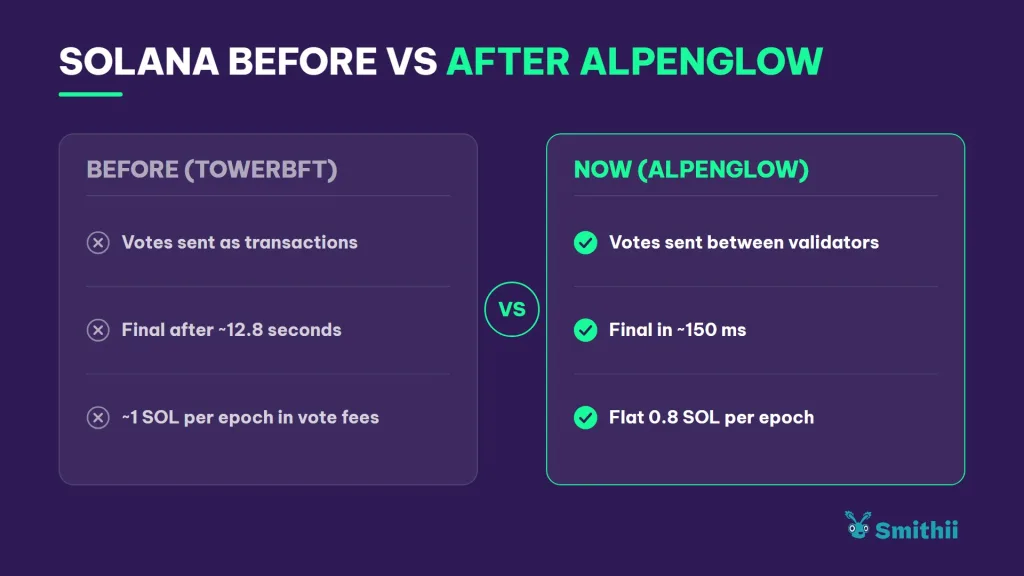
If you have SOL delegated to a validator, Alpenglow affects you too, even though you don’t have to do anything. Before, each validator paid around 1 SOL per epoch in fees for its vote transactions. Now those transactions are gone and instead each validator pays a fixed fee of 0.8 SOL per epoch to be able to vote and produce blocks in the next one.
If a validator doesn’t cover that fee, it won’t take part in consensus during the next epoch and loses its rewards, along with the rewards of everyone delegating to it. Your SOL is not at risk, but it’s worth checking every now and then that the validator you picked is still active.
If you’re not earning yield on your SOL yet, here’s how to stake on Solana.
How Solana validated blocks before Alpenglow
Every time you make a transaction on Solana, it goes into a block alongside a bunch of other transactions. A validator is an “entity” in the ecosystem that signs off on a block being recorded. The thing is, there isn’t just one validator, there are hundreds of them (around 650). So whenever a validator voted to confirm a block, that vote itself was a transaction. In other words, its vote got written directly onchain, eating up a significant chunk of the network’s capacity.
To give you an idea, a large portion of each block’s transactions (more than half, in many cases) were validator votes. Since user transactions also need their space on the network, during congested moments there was a real chance that yours wouldn’t make it into a block, which meant resending it from your wallet.
A transaction always has to happen somewhere, so whether you were creating a token SPL, sending SOL to another wallet, buying memecoins, or interacting with DeFi, each action needed a slot on the network to execute. The moment validators got bogged down with heavy demand, any of those operations could have failed.
How validation works with Alpenglow
What used to happen onchain now happens off-chain, which means validators can validate blocks without individually posting a signature directly on the network. Instead, votes are aggregated into a certificate proving that the majority of the stake approved the block, and that certificate rides along in the following blocks. The protocol that handles this is called Votor.
Alpenglow will have a second component, Rotor, which will change how each block’s data gets distributed across validators, but there’s no date for it yet. What’s already live is Votor, the piece that changes how voting works.
This drops the time needed for a transaction to become valid and irreversible from 12.8 seconds down to around 150 milliseconds (nearly a 99% reduction). On top of that, it’s far less likely the network gets saturated because of validators, since validating blocks now happens off-chain. As Solana users, we’ll notice these changes in the following ways:
- Transactions take way less time to confirm.
- Blocks no longer dedicate space to votes, so there’s more room for user transactions.
- RPCs will need to update their query timings, so we’ll likely see in our wallets that transactions take less time to show up.
Confirmed and finalized: what you’ll see in your wallet
Wallets and explorers use three states for a transaction: processed, confirmed, and finalized. Under TowerBFT there was a real gap between the last two, because finalization took about 12.8 seconds to kick in. With Alpenglow, confirmed and finalized now describe the same thing, and Solana will retire the confirmed state in a later version.
For you, that means when your wallet marks a transaction as finalized, it’ll happen almost the instant it appears, without that in-between wait where a payment looked done but wasn’t actually irreversible yet.
What Alpenglow changes for users and traders
Let me get to what we actually care about: whether this upgrade helps us or hurts us in any way. The degen community, devs, and traders can rest easy or even feel bullish, because Solana now comes with a lot of upsides, especially when it comes to executing transactions.
When Donald Trump announced his $TRUMP memecoin, thousands of users rushed in to buy at the same time, rewarding whoever got in before everyone else. When that happens, the network can get congested and automatically reject the buy orders of many users. Well, now that the validator load is lifted and transactions confirm much faster, this should happen less often, especially with blocks now being produced every 200 milliseconds too.
The millisecond-level transaction confirmation Alpenglow brings to Solana is also catching the eye of financial institutions in a big way, which could make the network much more attractive for RWA. The more capital flowing into the ecosystem, the stronger it gets, and pulling liquidity into one place also benefits the dynamics of launchpads and DEXes.
On the other hand, Alpenglow isn’t designed to fight MEV: Sandwich Attacks happen inside each block, before it’s finalized, so the new confirmation speed doesn’t prevent them. To protect your trades, tools like our Anti-MEV bot for generating volume are still useful.
Why explorers show lower TPS on Solana
If you compare Solana’s transactions per second before and after October 21, you’ll see the number drop. It’s not that the network is processing less: validator votes no longer travel as transactions, and in many blocks they made up more than half of everything recorded. Some explorers, like Solana Compass, already separated votes from non-votes, but any chart that lumped both together now reflects only user activity.
Alpenglow lands alongside 200 ms blocks
In October 2026, Solana also cut block time from 400 to 200 milliseconds, a separate improvement that was rolled out in four phases. It’s not part of Alpenglow, but you’ll feel both at once: twice as many blocks per second, with each one finalized in about 150 ms. For anyone launching a token or buying in the first few minutes, the network responds faster right when demand peaks.
FAQ
Alpenglow changes how Solana validators reach consensus, but the questions it raises are mostly practical: whether you need to do anything, whether it costs more, or whether it affects your tokens. Here are the most common questions and their answers.
Does Alpenglow make Solana less secure?
No. Even though validation happens off-chain, that doesn’t mean block validation has been handed off to some other entity or anything like that. Alpenglow is designed to keep running even if up to 20% of the stake acts maliciously and another 20% goes offline, so no single malicious validator can harm the ecosystem on its own. If you want to dig deeper, I’d recommend reading the Solana article announcing the upgrade.
Do I need to do anything with my wallet or my SOL because of Alpenglow?
No. Signing, sending, and approving transactions works just like before, and your tokens are still in the same accounts. The upgrade applies at the validator level, not on user wallets.
Does Alpenglow change transaction fees on Solana?
No. Alpenglow replaces the consensus layer, but execution stays the same: programs, transactions, and the fees you pay don’t change. What changes is how long it takes a transaction to become final.
Does anything change when creating or launching a token on Solana?
SPL tokens and programs work exactly the same way, so you can create, distribute, and trade your token like always. The difference is that each transaction finalizes in about 150 ms instead of around 12.8 seconds.
What happens to my staking if my validator doesn’t pay the Alpenglow fee?
That validator won’t vote or produce blocks during the following epoch and loses its rewards, so your delegated SOL won’t earn yield in that period either. Your funds aren’t at risk, but it’s worth picking a validator that stays active.
Why does Solana show fewer transactions per second since Alpenglow?
Because validator votes are no longer recorded as transactions inside blocks. User activity is the same; the vote traffic that used to inflate the number simply drops out of the count.
Final thoughts
Alpenglow is one of the biggest changes Solana has gone through: transactions become final in about 150 milliseconds, the network stops dedicating part of its blocks to validator votes, and all of it happens without you having to touch your wallet. For anyone using Solana daily, the experience is faster and more predictable.
For builders, it’s a great moment to get started. A network that finalizes almost instantly makes it smoother to launch a token, open its liquidity, or distribute it across a community. If you want to build your own Web3 project on Solana, with Smithii Tools you can do it without writing a single line of code: from creating the token to managing its market, all from the same suite.

Content creator and SEO contributor at Smithii. Systems Engineering student and crypto-tech enthusiast.