

Can Crypto Be Traced? The Complete Guide to Blockchain Traceability
Yes, crypto can be traced on most public networks, and it’s far easier than most people think. Bitcoin, Ethereum, Solana, BNB Chain, and virtually any non-private blockchain leave a public record of every transfer, one that anyone with a block explorer can query at any time.
That’s where the confusion starts: crypto isn’t anonymous by design, it’s pseudonymous. A wallet doesn’t carry your name, but it does carry a unique identifier, and everything it touches is recorded on-chain forever. With the right tools, linking a wallet to a real identity is a fairly straightforward process.
This guide covers why public blockchains are traceable by default, what tools analysts and firms use to follow the money, when crypto does offer real privacy, and how you can make untraceable crypto transactions using privacy protocols like Mixoor for Solana, Ethereum, BNB Chain, and Sui.

Can Crypto Be Traced? The Short Answer
The short answer is yes, and in most cases with far more precision than you’d expect. Every transfer on Bitcoin, Ethereum, Solana, or any public blockchain is written to a ledger that anyone can query, filter, and analyze. You don’t need to be a government agency to do it. Open Etherscan, Solscan, or Blockscout, paste an address, and you’re in.
Traceable doesn’t mean the owner is automatically identified. What it does mean is that an analyst can see every move tied to that wallet: what it bought, how much it sent, which exchanges it touched, and which other wallets it interacted with. From there, cross-referencing that activity with off-chain data (exchange KYC, leaks, social media) is usually enough to attribute the wallet to a real person.
That’s why asking whether crypto is traceable is the right starting point. The more useful question is: what level of traceability can your use case tolerate, and what tools exist to reduce it.
If you want to understand why on-chain privacy matters, check out our article on Solana privacy, where we go deeper on this.
How Blockchains Work and Why They’re Traceable by Default
A public blockchain is, at its core, an append-only distributed database. Every node on the network holds a full copy of the history, and every transaction includes three minimum pieces of information: the sending address, the receiving address, and the amount. That record is permanent and immutable, which is exactly what makes it possible to audit the network without relying on a third party.
The tradeoff is obvious: if the ledger is public, anyone can read it. There’s no ‘private mode’ you can toggle on in Bitcoin or Ethereum. What you see as a user in your wallet is exactly what anyone else sees through an explorer.
Public Addresses: Pseudonymous, Not Anonymous
A wallet is an alphanumeric string with no name attached, which is why many people assume it’s anonymous. In practice it works as a pseudonym: it doesn’t reveal who you are, but it uniquely identifies everything you do. The moment you link that address to your identity (say, withdrawing to a KYC’d exchange), that pseudonym effectively becomes your real name for anyone analyzing the network.
On-Chain Tracing Tools Analysts Actually Use
The blockchain analytics ecosystem has been mature for years, and today it covers everything from free tools to enterprise-grade forensic analysis platforms. These are the ones you’ll see most often when the topic is tracing crypto transactions:
- Public explorers: Etherscan, Solscan, Bscscan, and Blockscout. Free to use; they show every inbound and outbound tx, tokens, approvals, and contracts the wallet interacted with.
- Professional forensics platforms: Chainalysis, TRM Labs, and Elliptic, used by exchanges, banks, and regulatory agencies to cluster wallets, attribute addresses to known services (mixers, exchanges, markets), and flag suspicious patterns.
- On-chain analytics tools: Nansen, Arkham, Dune Analytics, and Bubblemaps. Great for tracking whales, spotting wallets connected by behavioral patterns, and visualizing relationships between addresses.
With any of these tools, a patient analyst can follow the money flow multiple hops in either direction from the target wallet. Bottom line: yes, crypto can be traced, and in most cases the barrier isn’t technical, it’s motivation.
If you want to go deeper on a specific ecosystem, check out our guide to private transactions on Sui and how on-chain privacy works on a confidentiality-first network.
Is Crypto Anonymous? Pseudonymity vs. Real Privacy
The ‘anonymous’ vs ‘pseudonymous’ confusion is probably the most costly misconception in crypto. When someone asks whether crypto is anonymous, the honest answer is: almost none of it is by default.
Bitcoin, Ethereum, Solana, and BNB Chain are pseudonymous: they record everything under an identifier that doesn’t carry your name but can still be linked back to you. A much smaller group of networks was built from the ground up for anonymity:
- Monero (XMR): uses ring signatures, stealth addresses, and confidential transactions. Sender, receiver, and amount are all hidden on every transfer.
- Zcash (ZEC): applies zero-knowledge proofs (zk-SNARKs) to enable ‘shielded’ transactions where nothing is revealed beyond the fact that the transaction is valid.
- Dash (with PrivateSend): runs native coin mixing via CoinJoin.
That said, the vast majority of liquidity and DeFi activity lives on public networks. If you’re operating on Solana, Ethereum, BSC, or Sui and want a privacy layer for your transfers, the practical move isn’t switching blockchains; it’s using a mixer or a confidential transfers tool.
Transparent vs. Private Blockchains: Comparison Table
| Blockchain | Type | Traceable? | Privacy Method |
|---|---|---|---|
| Bitcoin | Public / pseudonymous | Yes | CoinJoin, external mixers |
| Ethereum | Public / pseudonymous | Yes | Mixers, private rollups |
| Solana | Public / pseudonymous | Yes | Mixers |
| BNB Chain | Public / pseudonymous | Yes | BSC Mixer |
| Sui | Public with confidential transfers in beta | Yes | Confidential transfers, mixers |
| Monero | Private by default | No | Ring signatures + stealth addresses |
| Zcash | Optionally private | Only if using shielded tx | zk-SNARKs |
Privacy in crypto isn’t binary. It depends on the network you use, the method you apply, and whether you stack multiple layers (for example, moving funds from a KYC exchange to a fresh wallet and running them through a mixer before touching DeFi).
How to Make Untraceable Crypto Transactions with Mixoor
Mixoor is a tool built by the Smithii team for making untraceable cryptocurrency transactions on public blockchains. The core idea is simple: if the ledger is transparent, the only practical way to break the link between sender and receiver is to introduce an intermediate layer that obscures it.
What Is Mixoor and How It Breaks On-Chain Tracking
Mixoor is built on a Merkle Tree structure combined with privacy protocols. When you send funds, the transaction doesn’t show up as a direct transfer between your wallet and the recipient’s in the standard ‘transactions’ list on the block explorer. Instead, it flows through the protocol and reaches the destination without leaving the obvious link an analyst would look for.
Worth being clear on what Mixoor does and doesn’t do. It breaks basic on-chain tracking, the kind anyone can run with a block explorer or an analytics tool like Nansen. It’s not an absolute anonymity system: transactions remain auditable by the protocol itself if needed, and it doesn’t erase the trail from the step before (how those funds arrived at your originating wallet).
How to Use Mixoor: Step by Step
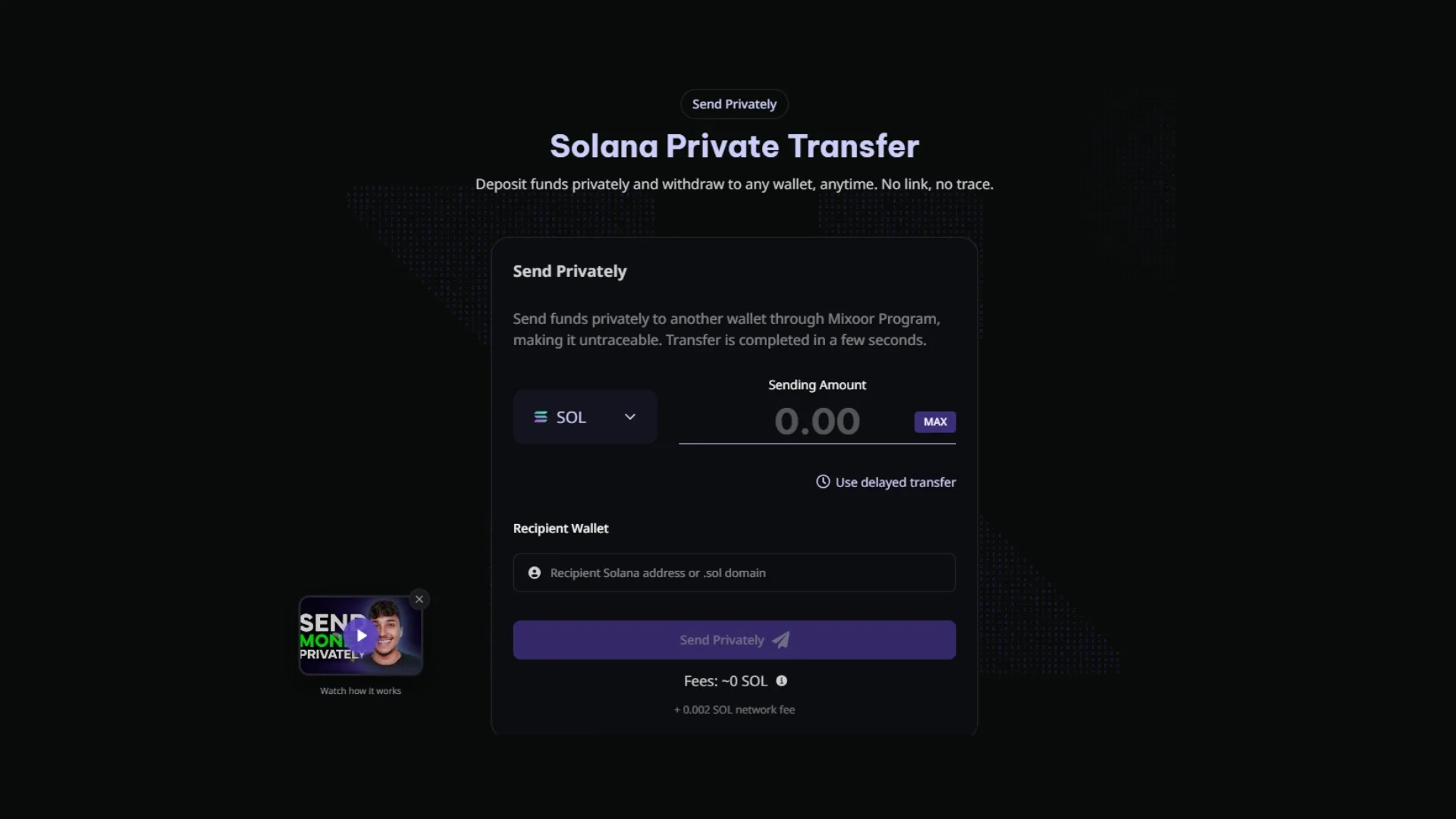
- Connect your wallet: go to mixoor.fun, select the network, and connect the wallet you want to send from.
- Select token and amount: currently supports SPL tokens, native tokens, and USDC. No minimum or maximum per transaction.
- Add the destination wallet or wallets: send to a single address or split across multiple in one step, useful for bulk payments or fund distribution.
- Click ‘Send’ and sign the transaction: funds go out instantly. Mixoor’s fee is 0.15% (on Solana) or 0.25% (EVM) per operation, plus the network’s gas fee.
It has two key advantages over the alternatives: no deposit/withdrawal flow (you connect and send, no upfront balance lock) and the fee is roughly half what other privacy solutions like Privacy Cash charge (0.35%).
If you want to compare it with other options in the same ecosystem, check out our breakdown of the Privacy Cash alternative on Solana and the Tornado Cash alternative on Solana.
Mixers and tumblers by blockchain: Solana, Ethereum, BNB Chain, and Sui
Each blockchain has its own quirks when it comes to gas fees, supported tokens, and wallet ecosystem. To help you reduce crypto tracking and better protect your activity, Smithii has put together network-specific guides:
- Solana: the most traceable network by default, since tracking wallets with Solscan is fast and cheap. Our guide on the Solana tumbler covers how the privacy solution works on this network and how it stacks up against other options.
- Ethereum: the biggest DeFi network and the most scrutinized by forensics firms. See how to apply on-chain privacy with our Ethereum Mixer.
- BNB Chain: high memecoin volume and heavy bot activity make traceability especially sensitive for builders. Our guide on how to use a BSC Mixer covers implementation on this network.
- Sui: Sui has announced native confidential transfers in public beta, and Mixoor Sui is the practical option for operating with privacy right now.
Each guide goes into the details: costs, per-transaction limits, supported tokens, and network-specific best practices. The takeaway is the same across all of them: if you operate on a public blockchain and want to reduce your tracking surface, a mixer is the most accessible tool available.
Best practices for reducing your on-chain footprint
A mixer is a useful layer, but it doesn’t replace basic operational hygiene. If you care about reducing how much your crypto transactions can be traced, these habits add up more than you’d think:
- Separate wallets by purpose: one for trading, one for long-term holdings, one for operational payments. Don’t let a single address concentrate all your activity.
- Break the link from KYC exchanges: moving funds directly from Binance to your main wallet DeFi wallet permanently ties your identity to that address. Route through intermediate wallets or a mixer before you start operating.
- Don’t post addresses on social media: any address that shows up on Twitter, Discord, or Telegram gets tagged in tools like Arkham within hours.
- Watch out for repetitive patterns: sending the same amounts, at the same times, or between the same wallets creates a fingerprint that analytics tools pick up without effort.
- Use mixers as a layer, not a silver bullet: on-chain privacy is cumulative, not absolute. Combining good habits with Mixoor or your network’s mixer gets you far better results than either one alone.
FAQ: Crypto Traceability and Privacy
Can Bitcoin transactions be traced?
Yes. Bitcoin is a public blockchain and every transaction is permanently recorded. Tools like Chainalysis and TRM Labs specialize in reconstructing BTC flows between wallets and linking them to exchanges or other services whenever there’s an identifiable touchpoint.
Is Ethereum more traceable than Solana?
Both are equally traceable by design. The practical difference is that Solana generates far more transactions per second and is especially easy to explore with Solscan, while Ethereum handles more economic volume per transaction, which draws more scrutiny from forensics firms.
Does a mixer make my funds 100% anonymous?
No. A mixer breaks the direct link between sender and receiver in the explorer, but it doesn’t erase your wallet’s prior activity or any off-chain signals you leave behind. It’s a strong obfuscation layer, not a full anonymity system.
Is it legal to use a crypto mixer?
It depends on your jurisdiction and how you use it. Generally speaking, using a mixer for personal financial hygiene (avoiding exposure, doxxing, or repetitive patterns) is not illegal in most countries. What is regulated and penalized in many jurisdictions is using it to conceal the origin of illegally obtained funds. Check your local regulations if you’re unsure.
What’s the difference between a mixer and a tumbler?
In practice, they’re used interchangeably. Both terms describe tools that pool funds from multiple users and redistribute them in a way that makes it hard to link the incoming wallet to the outgoing one. ‘Tumbler’ is the older term (inherited from the Bitcoin ecosystem); ‘mixer’ is the more common one today.
Conclusion
Crypto can be tracked on virtually every public blockchain, and the tools to do it are getting more accessible and more precise. Asking whether crypto is traceable is step one; step two is deciding what level of privacy you actually need for your specific situation.
If you’re operating on Solana, Ethereum, BNB Chain, or Sui, you don’t need to switch to Monero to get a useful privacy layer. A mixer like Mixoor gives you the practical path: direct transfers, no upfront deposits, and a 0.15% fee. Pair it with Smithii’s network-specific guides and basic wallet hygiene, and you’ve got an effective layer for cutting your on-chain footprint without leaving the ecosystem you already work in.

Content creator and SEO contributor at Smithii. Systems Engineering student and crypto-tech enthusiast.