
Privacy Cash Alternative on Solana
If you use Solana often for trading, payments, treasury management, or token launches, sooner or later you run into one reality: Solana is public by design, and anyone can track movements, balances, and usage patterns with on-chain tools. That is why more and more people look for a Privacy Cash alternative: not to hide, but to reduce exposure, avoid financial doxxing, and maintain operational hygiene when moving funds between wallets.
In this context, privacy is not a bonus. It is a practical security layer: it helps prevent third parties from easily linking wallets, spotting amounts at a glance, or copying strategies just by watching public activity.
If you want to jump straight into using the alternative, here is this video. If you want to understand the real differences between both privacy protocols, keep reading.
Why does Solana need privacy?
Solana’s transparency comes at a real cost: traceability is too easy. This leads to common situations like fund flow analysis, wallet tracking, and unnecessary exposure of your on-chain behavior. In practice, anyone with an explorer can try to connect wallets through patterns and repeated movements.
On top of that, the lack of privacy on Solana does not just affect advanced users: if you pay contributors, move funds between wallets, or manage a treasury, the lack of privacy can create operational friction such as weaker negotiation, supplier exposure, or correlation between personal and project wallets.
Privacy Cash alternative on Solana
If you want to find a Privacy Cash alternative on Solana to expand your options, Mixoor.fun is a direct fit.
Mixoor is an independent tool built by the Smithii team and designed to enable private transfers on Solana with a simple experience: connect your wallet and send.
What matters here is not a guide on making private transactions on Solana, but what changes compared to Privacy Cash and in which scenarios Mixoor may be the better option.
Differences between Privacy Cash and Mixoor.fun (+ comparison table)
To simplify the differences between Privacy Cash and Mixoor, we prepared a comparison table:
| Feature | Privacy Cash | Mixoor |
|---|---|---|
| Percentage fee | 0.35% | 0.15% |
| Deposit required | Yes | No |
| Send to multiple wallets | Up to 10 wallets | Up to 8 wallets |
| Supported tokens | SOL, USDC, USDT, stORE, ORE, ZEC | SOL, USDC |
| Private swap | ✅ | ❌ (coming soon) |
| Bridge | ✅ | ❌ (coming soon) |
| Approach | Privacy with a deposit/withdraw flow | Privacy with a direct flow, no deposits |
Now, in practice, these are the main differences you’ll notice between Mixoor as an alternative to Privacy Cash.
Usage fees
Privacy Cash charges more than 2x the percentage fee compared to Mixoor.
- Mixoor charges a 0.15% fee per transaction.
- Privacy Cash charges 0.35% on withdrawal.
User experience approach
Ease of use differs here, since with Privacy Cash you deposit funds and withdraw them later, while with Mixoor you just connect your wallet to send funds.
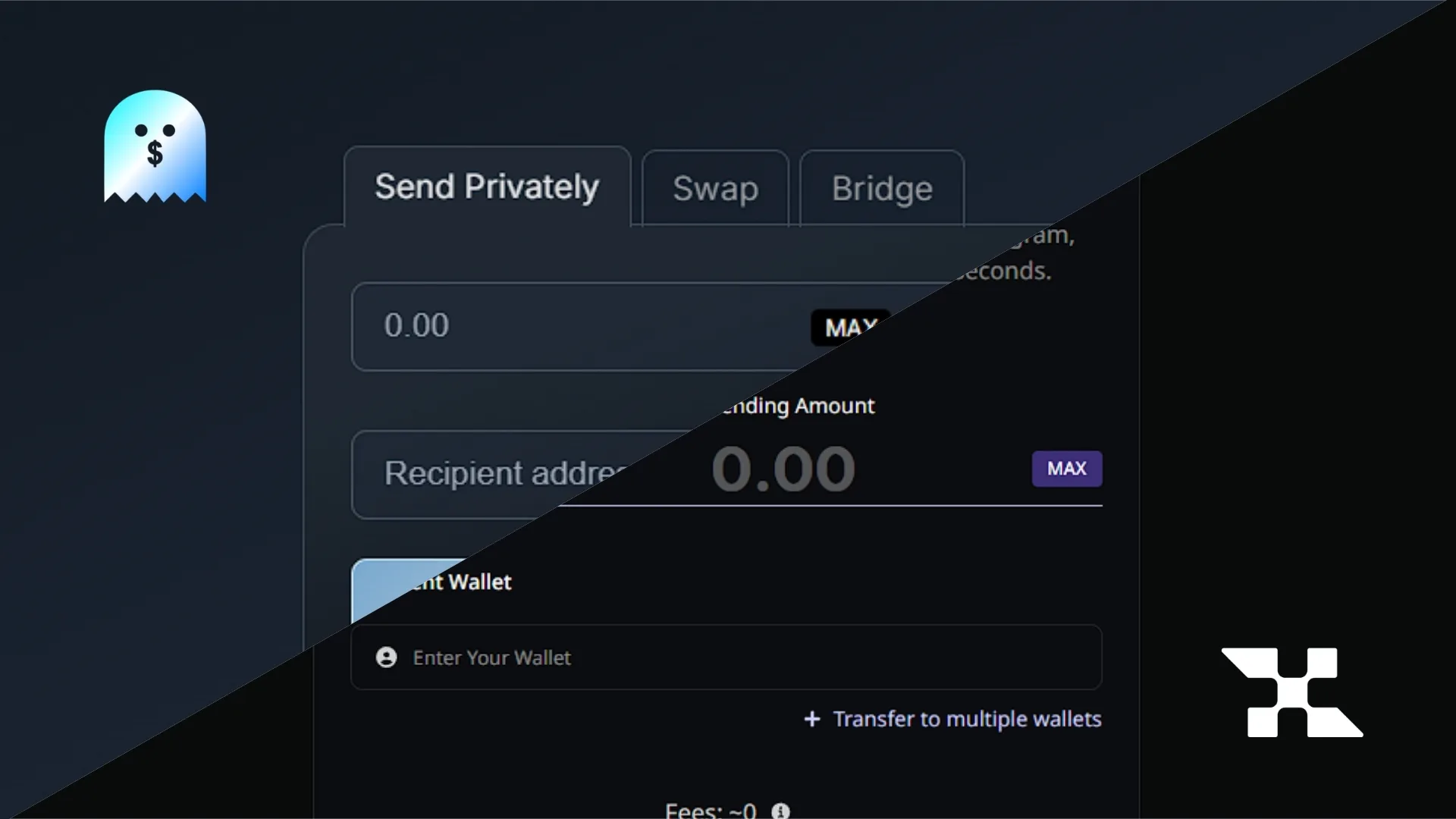
- Privacy Cash uses a deposit/withdraw flow to mask transactions.
- With Mixoor, there is no need to deposit funds: you connect your wallet and send to any address.
Obfuscation
Both platforms work to hide or break simple tracking that other users use to link wallets. As a result, operations do not appear under “transactions” (for example, in Phantom or Solscan), and add an extra layer of obfuscation to make quick connections between source and destination harder.
Transfers to multiple wallets
If you need to distribute to multiple addresses:
- Privacy Cash supports up to 10 wallets at once.
- Mixoor supports up to 8 wallets.
If your use case rarely goes beyond 8 recipients, Mixoor covers most standard scenarios. If you do large-scale distribution, Privacy Cash can give you a bit more room.
Supported tokens and extras
Let’s now look at the additional sections, such as supported tokens and other features that make the platform more usable.
- Privacy Cash offers a broader suite (private swap and bridge to other networks), so it supports more assets.
- Mixoor is more focused on simplicity within Solana today: private transfers with fewer steps. Bridge functionality and support across more blockchains are not available yet (although work is underway).
Is it safe to use a privacy protocol on Solana?
Yes, it is completely safe, both Mixoor and Privacy Cash. On our side, we have an audited toolsuite, and we were also recognized in the Solana Privacy Hackathon in February, alongside Privacy Cash.
As for untraceable transactions, there is never a total disconnection between wallets. A privacy protocol reduces trivial tracking, but it is still an on-chain environment where more advanced analysis may try to correlate activity, although with a very high level of difficulty.
This is how malicious users are kept out, while people who genuinely want privacy within Solana benefit.
There are three sensible criteria that will convince you to use a tumbler on Solana when evaluating on-chain security:
- User control model (with on-chain or off-chain balances)
- Fee transparency and how it works (avoid surprises)
- Anonymity (to avoid being identified through transaction patterns across multiple wallets)
Conclusion
If you’re looking for a Privacy Cash alternative on Solana, the practical comparison comes down to two things: cost and friction. Mixoor.fun charges 0.15% per transaction, while Privacy Cash charges 0.35% (more than double on the percentage fee), and Mixoor also removes the “deposit/load balance” step before withdrawing: you connect your wallet and send directly to another wallet.
If your priority is making private transfers on Solana at the lowest cost and with the simplest possible flow, Mixoor is a clear alternative. If, on the other hand, you need extra features like private bridge or swap, Privacy Cash may have the edge thanks to its broader suite, until we add new features.
To go deeper on this topic, check out our guide on traceability vs privacy across the main blockchains.

CEO & Co-Founder at Smithii. Building on Solana since 2021 and sharing playbooks from the trenches. Also founder of Lince after years investing in DeFi.