

How to Make Private Transactions on Robinhood Chain Without Overcomplicating It
Making private transactions on Robinhood Chain isn’t something the network supports by design. As a public EVM-compatible blockchain, every transfer gets written to a ledger anyone can look up with an explorer. If you want to move funds without your wallet chain, amounts, and counterparties being visible to everyone, you need an extra privacy layer.
The native solution for this on Robinhood Chain is Robin Hide. It’s a standalone platform built specifically to add privacy to transfers within the network, with a simple flow: connect your wallet, define the send, and execute. No pre-deposits, no complicated flows, no leaving the ecosystem.
This guide covers why transactions on Robinhood Chain are traceable by default, what Robin Hide is and how it works, how to use it step by step, how it differs from mixers like Mixoor, and what best practices to follow so your privacy doesn’t rely on a single tool.
If you want the general network context before getting into privacy, check out our guide on what the Robinhood blockchain is.
Why Transactions on Robinhood Chain Are Public by Default
The reason is structural: Robinhood Chain inherits the data model of Ethereum. Every transaction includes three minimum pieces of data (sender address, receiver address, amount) written permanently to the ledger. There’s no alternative design to hide those pieces, so anyone with an explorer can see:
- Full history of any wallet: every buy, sell, transfer, and contract approval.
- Fund trail: where the money came from, which other wallets it passed through, and which exchanges it’s touched.
- Behavior patterns: active hours, recurring counterparties, wallets linked by tx proximity.
This isn’t a Robinhood Chain-specific issue; it’s a property of public blockchains across the board. What’s different is that on a young network like Robinhood Chain, with less traffic volume than Ethereum mainnet, patterns are especially easy to isolate. A wallet with regular activity can be identified with far less cross-referencing than you’d need on L1.
For a deeper look at how on-chain tracking actually works, check out our guide on whether crypto can be tracked.
Robin Hide: the practical way to send private transactions on Robinhood Chain
Robin Hide is an independent platform built specifically for private transactions on Robinhood Chain. It breaks the direct on-chain link between sender and receiver, so a basic explorer analysis can’t connect the source wallet to the destination.
The underlying logic is the same one used by privacy protocols on other networks, like Mixoor: introduce an intermediate layer that obfuscates the direct flow, using constructions like Merkle Trees and on-chain privacy protocols. In practice, the transfer doesn’t show up as a direct tx between A and B in the standard explorer view.
Key points about Robin Hide:
- Built for Robinhood Chain: not a generic mixer ported over, but a tool designed for the Robinhood ecosystem from day one.
- Streamlined flow: connect the wallet, set the send, and sign. No pre-locked deposit waiting to be withdrawn.
- Compatible with standard EVM wallets: MetaMask and Backpack are the only supported ones for now.
- Breaks basic tracking: the layer you need to stay off the radar of routine explorer analysis and standard analytics tools.
How to send private transactions on Robinhood Chain with Robin Hide: step by step
Here’s the full flow for making a private transfer from your wallet on Robinhood Chain:
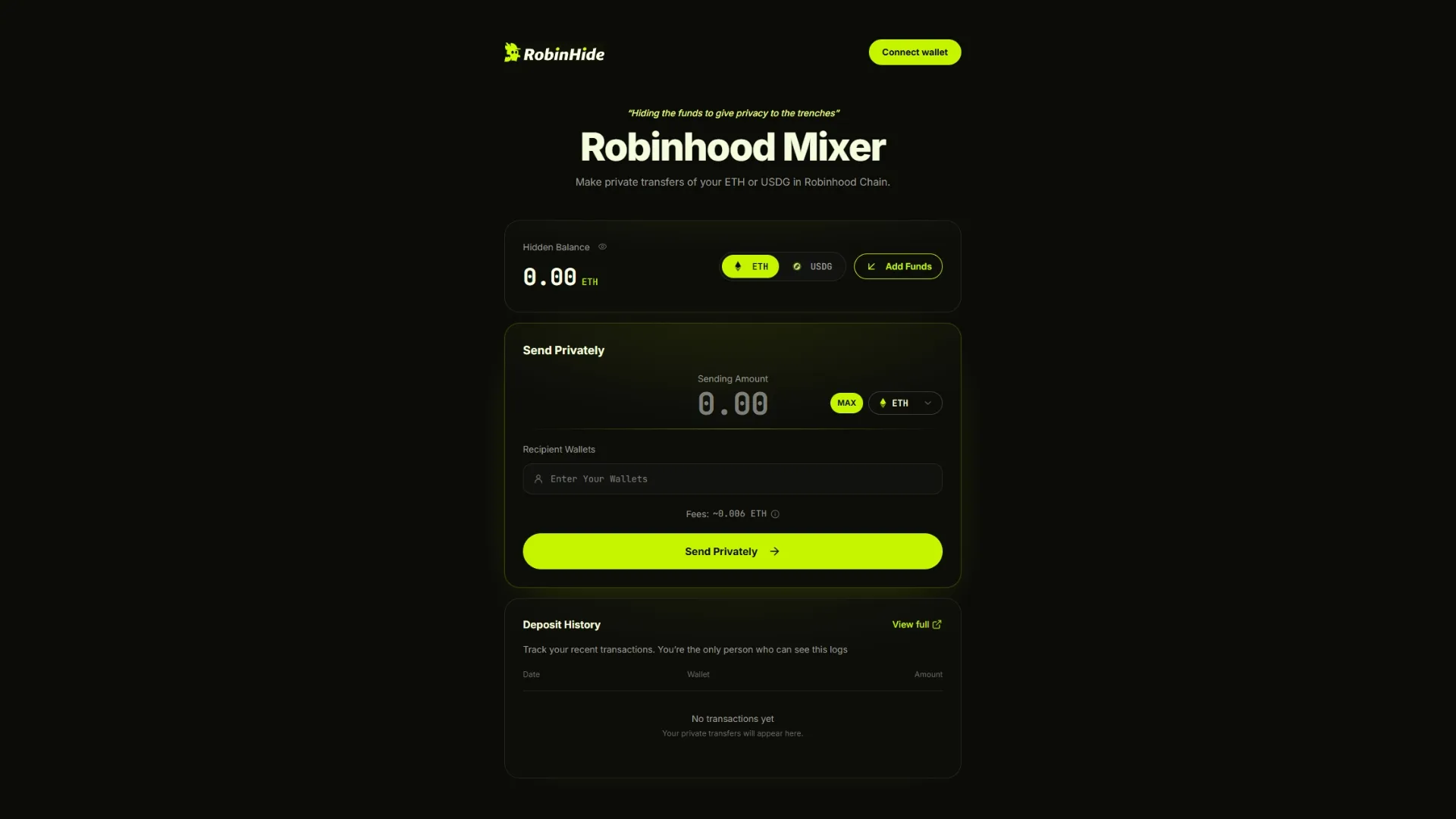
- Open Robin Hide and connect your wallet: currently compatible with MetaMask, just select the Robinhood network.
- Choose the token and amount: pick which asset you want to send (ETH native to Robinhood Chain or USDG) and how much.
- Enter the recipient wallet: paste the receiver’s address as the single destination.
- Confirm and sign the transaction: review the summary (fee, Robinhood Chain gas fee, destination address) and sign in your wallet. Funds land at the recipient without leaving a visible sender-receiver link in the explorer.
The whole operation takes a few seconds. The recipient may see a slight delay depending on network load, but your side is done the moment you sign.
Robin Hide vs Mixoor: which one to use depending on your network
If you’re coming from another ecosystem, you probably know Mixoor, the Smithii tool for private transactions on Solana, BSC, Ethereum and Sui. The obvious question is: why Robin Hide and not Mixoor on Robinhood Chain?
Simple answer: each network has its own best-fit privacy layer. Robin Hide was built from the ground up for Robinhood Chain, with the network’s flow and tokens natively integrated. Mixoor covers Robinhood too, but if you want a dedicated, network-exclusive tool, Robin Hide is the right call.
| Tool | Supported Networks | Focus | Flow |
|---|---|---|---|
| Robin Hide | Robinhood Chain | Built for Robinhood’s L2 | Direct, no deposit required |
| Mixoor | Solana, BSC, Ethereum, Sui | Multi-chain | Direct, no deposit required |
| Privacy Cash | Solana, Ethereum, Base | Includes swap/bridge support | Deposit and withdrawal |
Quick rule of thumb: if you’re operating within Robinhood Chain, Robin Hide is the obvious choice. If you’re moving funds across networks or want a privacy layer on Solana, Ethereum, BSC, Sui, and Robinhood, Mixoor covers that better.
If you need the Ethereum version, check our guide to Ethereum Mixer; for BSC, the BSC Mixer tutorial; and for Sui, how to make private transactions on Sui.
Best practices for maximizing privacy
Robin Hide breaks the direct link between sender and receiver on the explorer, but it’s not a full anonymity system. On-chain privacy is cumulative: the more layers you stack, the harder it becomes to reconstruct your activity. Habits that add up:
- Separate wallets by purpose: one for trading, one for long-term holdings, one for payments. Don’t let a single address concentrate all your activity on Robinhood Chain.
- Break the link with KYC exchanges: withdrawing directly from an exchange to your main wallet ties your identity to that address permanently. Use intermediate wallets or a privacy layer before you start operating.
- Watch out for repetitive patterns: sending the same amounts at the same times or between the same wallets creates a detectable fingerprint with any analytics tool.
- Don’t post addresses on social media: any address you expose on Twitter, Discord, or Telegram gets tagged in tools like Arkham within hours.
- Use Robin Hide as a layer, not a silver bullet: combine on-chain privacy with basic operational hygiene and don’t assume a single tool covers everything.
FAQ: Private Transactions on Robinhood Chain
Does Robin Hide make my transfers 100% anonymous?
Robin Hide breaks the direct link between sender and receiver on the explorer, which blocks basic analytics-level tracking. It doesn’t erase your wallet’s prior activity or any off-chain signals you leave behind, and it won’t hold up against deep forensic analysis if there’s enough motivation and external data.
How much does a private transaction with Robin Hide cost?
The cost is Robin Hide’s fee plus Robinhood Chain’s gas fee at the time of sending, along with the platform fee of 0.15%. As an L2 built on Arbitrum Orbit, gas is typically much lower than on Ethereum mainnet. You’ll see the exact amount in the interface before signing the transaction.
Is it legal to use Robin Hide for private transactions?
It depends on your jurisdiction and how you use it. Generally, using a privacy layer for personal financial hygiene (avoiding unnecessary exposure, doxxing, or identifiable patterns) isn’t specifically regulated in most countries. What is penalized is using privacy tools to conceal the origin of illegally obtained funds. Check your local laws if you’re unsure.
Do I need a special wallet to use Robin Hide?
No. Any EVM wallet compatible with Robinhood Chain works, though for now that’s limited to MetaMask and Backpack. You just need Robinhood Chain added to your wallet and enough balance in the token you’re sending, plus a small buffer for gas.
Can I send to multiple recipient wallets in the same transaction?
It depends on the current Robin Hide version and the token you’re using. The platform generally supports multi-destination transfers for the network’s main assets, which is useful if you need to batch multiple private payments in one go or spread supply across project wallets. The interface will show you whether a given transaction supports multiple destinations at that point.
Conclusion
Private transactions on Robinhood Chain are doable, but they require an active privacy layer on top. The network is public by design and has no native confidential transactions built in, so the practical path runs through tools like Robin Hide, built specifically to introduce privacy into the transfer flow without leaving the ecosystem.
Robin Hide breaks the direct link between sender and receiver with a simple flow: connect wallet, define the transfer, sign. Paired with solid wallet hygiene practices, it works as an effective layer for reducing your on-chain footprint on Robinhood Chain, without relying on magic anonymity or closed systems.

Content creator and SEO contributor at Smithii. Systems Engineering student and crypto-tech enthusiast.