What Happened to BONK.fun: The Incident and What’s New Since Its Return
Last week was a rough one for the Solana ecosystem and memecoins, and BONK.fun was at the center of it. The launchpad was offline for just over a week and has since come back, bringing some notable updates with it.
In this article, I’ll break down what happened to Bonk, why it went dark for a while, and what it’s done since to get back in the memecoin wars.
What Happened to BONK.fun: Hijacked and Drained
On March 11, an incident was reported targeting Bonk’s site directly. This wasn’t a smart contract failure; it was a domain hijack pulled off through social engineering against their domain registrar.
That gave a malicious actor full control of the site, letting them serve prompts designed to trick users into signing harmful transactions (a classic drainer pattern, but deployed straight from the frontend).
To understand exactly how this went down, here’s a quick breakdown of how this type of attack plays out and what it means for users:
- Bonk’s frontend was replaced by a malicious actor who had taken control of the domain.
- Users thought they were on the real site and connected their wallets as they normally would.
- They signed a fake contract, which triggered the drainer.
- The wallet funds were moved to separate accounts to cover their tracks.
Once the team behind Bonk spotted the anomaly, they temporarily suspended the domains while the issue was resolved. That’s why the launchpad stayed offline for just over a week.
How Did the Recovery Go, and What Did the Team Say?
In a follow-up update, BONK.fun explained that the domain had been transferred to an external registrar as a direct result of the provider attack, and that internal systems, code repositories, and team accounts remained uncompromised.
On the impact side, multiple reports covering the announcement cite estimated losses of around $30,000 and a 110% refund plan for affected users (they compensated everyone with an extra 10% for the trouble). Domain control over the main site was also confirmed as recovered.
It was also clarified that users who had previously connected their wallet were not necessarily exposed, and those interacting with Bonk-related tokens through external platforms were reported as unaffected in that context.
Bonk has been up and running since March 20, so you can head to the launchpad and use all its features without any issues.
Bonk.fun Updates
What’s worth noting is that, after stabilizing operations, BONK.fun rolled out an update focused on aligning incentives with Balanced Mode. The announcement breaks down a two-part mechanism:
- For traders: 0.75% of post-bonding volume is automatically compounded into the liquidity pools, targeting deeper LPs (~4x is mentioned) and improving the longevity of the token.
- For deployers/creators: 0.25% of the bonding curve’s volume flows into a reward pool and gets distributed every 24 hours to anyone who hit successful bonds in that window.
A successful bond simply means graduating the token from Bonk or clearing the bonding curve.
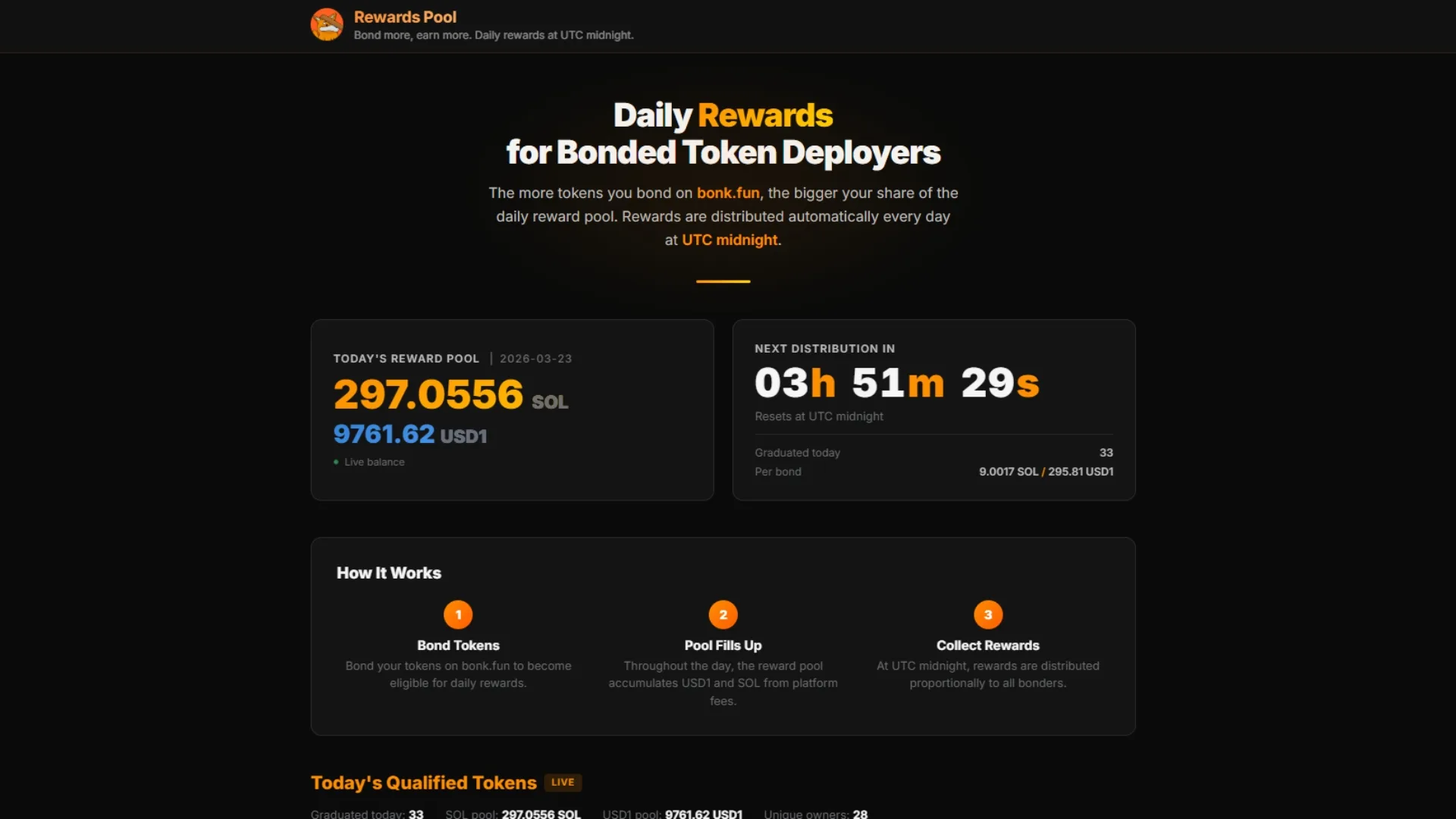
This update matters because it directly tackles two friction points that plague most launchpads: thin liquidity after graduation and no ongoing upside for creators once the token hits the open market. It doesn’t promise specific results, but it’s a design change aimed at giving the token better market conditions (LP depth) while giving creators an operational incentive tied to real execution (bonds).
If you’re looking to get involved in the BONK.fun ecosystem, check out this guide on how to create a memecoin on Bonk.
Turning a memecoin into a Successful Bond
Now more than ever, graduating the bonding curve on Bonk matters. The reward pool is split equally among every creator who pulls it off, within a 24-hour window.
These funds are perfect for funding growth campaigns and expanding your reach. It sounds simple, but the reality is that launching successful memecoins is genuinely hard. Fewer than 3% of memecoins ever make it past the bonding curve.
That’s why I recommend checking out our guide to using BONK’s volume bot. A tool that gets your token ranked among the most traded and puts you first on the homepage.
More exposure = more reach with potential investors
What Can You Do to Reduce Your Risk from Hijacked Sites?
Front-end spoofing through domain configuration is a threat that can hit anyone. It’s not about compromising protocols or smart contracts; it’s about temporarily replacing access to a platform.
To protect yourself from future incidents like this, here are a few tips:
- Use bookmarks and never click links sent to you via DM.
- Before signing anything on ecosystem platforms, ignore unusual transaction signing prompts like “sign to continue” or “sign to accept terms of service”.
- If you notice anything off on the platform, like misplaced buttons or unfamiliar fonts, that’s a red flag the page may have been hijacked.
- Keep an eye on official social channels. Bonk issued a report once they detected the issue and contained the damage.
FAQ
I’ve been tracking every Bonk update from the moment the incident started through the full recovery. Below, I’ve compiled the most common questions and answered them.
What happened to BONK?
On March 11, a domain hijack was reported, carried out via social engineering against a third-party provider. This allowed attackers to inject a malicious interface with wallet drainer behavior. The platform is now back up and running.
Were BONK’s smart contract Hacked?
Official communications were clear: this was not an on-chain protocol failure, but a domain/frontend incident. Internal systems and repositories were not affected.
What Did BONK.fun Do After Recovering the Site?
They refunded affected users at 110% (an estimated $30,000 was drained). An alternative domain was made available, and the team confirmed that anyone who used alternatives to Bonk during the incident was out of harm’s way.
What Is Balanced Mode and What Does It Change?
A mode that routes 0.75% of post-bonding volume to the LP to deepen liquidity, and 0.25% of the bonding curve to a pool distributed every 24h among creators with successful bonds.
Conclusion
What happened to BONK.fun was a reminder that in Web3, security doesn’t stop at the smart contract: the domain and frontend can be the weakest link. The recovery came with transparent public communication, a compensation plan, and continuity through an alternative domain. The post-incident period also brought something worth noting: Balanced Mode, designed to reinforce liquidity and align incentives between traders and creators.
Get Our Free E-Book: How to Launch a +1M meme coin on Bonk.fun
Step-by-step walkthroughs, must-have tools, how to scale, best practices, and more

Content creator and SEO contributor at Smithii. Systems Engineering student and crypto-tech enthusiast.