
How to Create a Liquidity Pool on Base: The Final Step to Get Your token Trading
If you want to create a Liquidity Pool for a Base token on Uniswap, this post is for you. We’ll show you how to create a Liquidity Pool in just 5+1 steps.
Uniswap is a decentralized exchange (DEX) that uses the EVM (Ethereum Virtual Machine) standards, so you can create a liquidity pool for any ERC20 token layer 2 like Base. Once a token is live inside a liquidity pool on a DEX, anyone can buy and sell it.
A Base token is a Layer 2 ERC20 asset because it uses the ERC20 standard, but adds perks like low transaction costs.
How to create a Base liquidity pool: two options
You’ve got 2 options here: use the Create Base Liquidity Pool dApp from Smithii or head straight to Uniswap. Our interface is simpler and audited, so that’s what we recommend, but we’ll walk you through both options.
1. Create a Liquidity Pool Base Token on Uniswap with Smithii
Head over to the online Create Liquidity Pool on Base tool, make sure the Base blockchain is selected, and connect your preferred wallet.
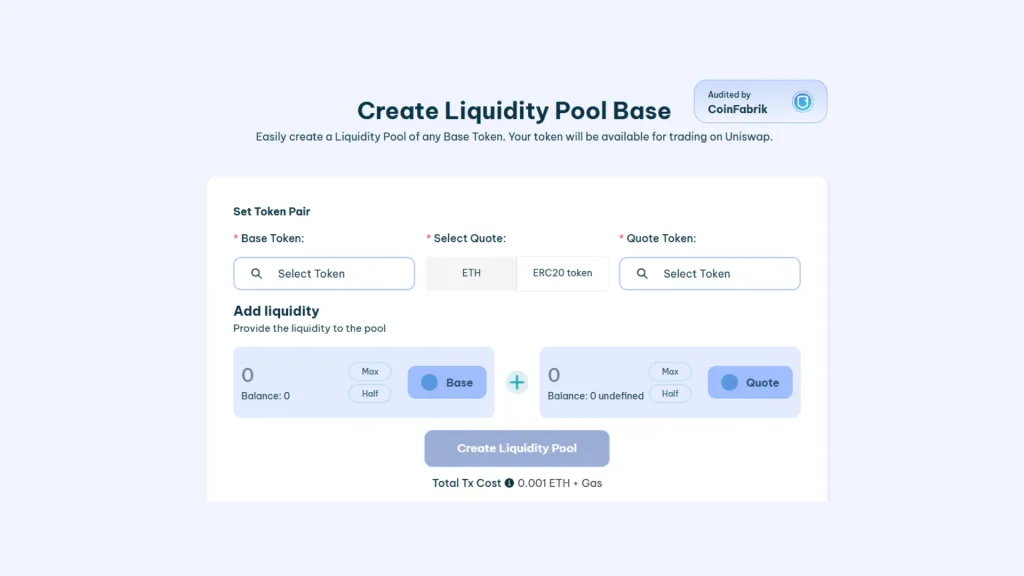
- Connect your wallet on the Create Liquidity Pool on Base dApp
- Pick the ‘Base Token’ (this is the one that sets the price, usually $WETH, $USDT, $USDC, etc.)
- Pick the ‘Quote Token’. This is your token ready to hit the market.
- Add Liquidity: choose the amounts of Base Token and Quote Token to pair up. This sets the initial price of your token
- Click ‘Create Liquidity Pool’ and approve the transactions.
A few seconds later your Liquidity Pool will be live on Uniswap and you can head there to check it. The cost to create a Base liquidity pool on Smithii is 0.001 WETH, which covers the fees for creating the token pair and the liquidity pool.
Si aún no tienes tu token, aquí te explicamos como crear tu propio token de Base sin programar
2. Create a Base Liquidity Pool on Uniswap
To kick off the setup of our Liquidity Pool, we’ll go straight to the Uniswap app and connect our wallet. From there, in the main menu you’ll see the ‘Pools’ tab (remember to select the Base network from the dropdown in the top right).
In this section you can manage the liquidity pools you already have and also create a brand new liquidity pool on Uniswap.
So click the ‘New Position’ button to get started.

2.1 Create a Token Pair on Uniswap
To spin up our liquidity pool, the first step is creating a token pair. In this case we first pick the token that holds ‘value’ in dollars. Based on what we mentioned earlier, I’ll go with USDT since it’s a stablecoin.
Next up, select your token. To do this, copy the token address and paste it into the search bar, then you can select it. It’s normal for a warning to pop up, since it’s the first time a liquidity pool is being created with your token.


2.3. Pick the fee for your liquidity pool
Our next step is to pick the fee percentage that every transaction through our liquidity pool will pay. To do this, click ‘Edit’ Fee Tier.
You’ll see 4 options to choose from. The most common and recommended one per Uniswap is 0.3%.

2.4. Set the starting price and price range
Since this is the first time we’re creating a liquidity pool for the new token pair, we need to set the starting price. That’s the price users will trade at through our liquidity pool. On top of that, we can set the price range.
For the starting price, just pick whatever you think makes sense. It’s a good idea to have full tokenomics ready so you can follow a proper strategy.
When it comes to the price range, keep in mind that our liquidity pool will ONLY be active within the range we set. In other words, if the token price moves above or below the range you define, your liquidity pool will sit inactive and won’t be doing anything.
Remember that the starting price has to fall inside the price range you set.

2.5. Deposit liquidity
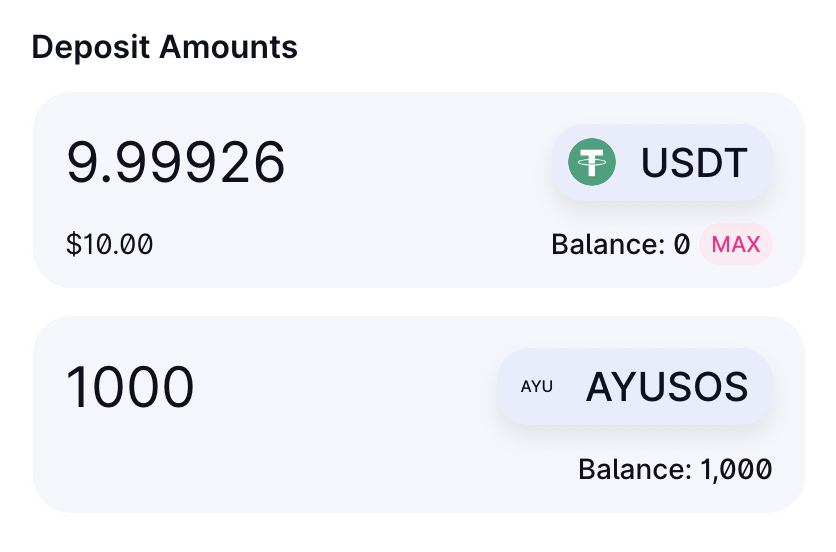
Once the price range is set, it’s time to deposit liquidity for the token pair. We get to decide how much to add. Just make sure you add enough so users can trade normally without hitting an unreasonably low limit.
If you’re launching a token from scratch and don’t want to add much liquidity, the standard move is to start with a VERY low price, so the liquidity scales alongside the token price.
FAQ about creating a liquidity pool on Base
Which DEX can I use to create a liquidity pool on Base?
Uniswap v3 on Base is the go-to choice for liquidity. Aerodrome is the native DEX on Base and usually has better depth for tokens with a native Base narrative.
How much does it cost to create a liquidity pool for a Base with Smithii?
Using the dApp Create Base Liquidity Pool from Smithii costs 0.001 WETH plus gas. That covers the pair creation and the deploy on Uniswap over Base. You also need to factor in the initial liquidity you provide (WETH, USDC, USDbC).
What’s the difference between creating the pool with Smithii and doing it directly on Uniswap?
Smithii boils the whole flow down to a single form: you enter tokens, amounts and sign the transaction. Uniswap makes you manually configure the pair, the fee tier (0.01% / 0.05% / 0.3% / 1%), the price range and deposit liquidity in separate steps.
Which fee tier should I pick on Uniswap V3?
0.3% is the most common and the one Uniswap recommends for most tokens. 0.01% is for stablecoin pairs, 0.05% is for liquid pairs like WETH/USDC, and 1% is for highly volatile tokens or new launches.
What happens if the price moves out of the range I set on Uniswap V3?
The pool goes inactive until the price comes back into range, and you stop earning fees. For highly volatile tokens or new launches, it’s a good idea to use a wide range or Full Range so you don’t get left out.
Conclusion
Knowing how to create a liquidity pool on Base natively or with Smithii Tools lets you make your token tradable through Uniswap. But your token journey doesn’t end here. Now you need to keep your project alive so people can find you and ape in before anyone else. To help you keep positions fresh on DEXes and Screeners, we recommend using our volume bot for Base.
When the pool starts feeling thin, there’s no need to rebuild it: you can top it up with more funds anytime without touching the price.

Crypto writer focused on the Web3 space. Former contributor to the Smithii editorial team.