

How does a crypto volume bot work? Mechanics, use cases, and best practices
A crypto volume bot is one of those pieces of infrastructure plenty of people use without really knowing what’s happening under the hood. The base idea is simple: automate buys and sells on a DEX to generate measurable volume. The actual execution, though, has several layers (smart contract, distribution wallet, makers, fund returns) that are worth breaking down.
In this post we cover what a volume bot actually does, why it gets used and when it makes sense, how it’s built under the hood (with the concrete example of the Smithii Volume Bot), and where the line sits between responsible use and market manipulation.
The angle here is practical: a volume bot used well helps you refresh visibility on DEXs and screeners while your organic marketing does its job. Used badly, it turns into wash trading that doesn’t even fool modern DexScreener algorithms. Let’s break it down.
For a data-backed view of how teams configure these campaigns, see Smithii Research’s anonymized study of 712 Solana Volume Bot configurations. It separates requested settings from completed execution and publishes the aggregate CSV.
What is a crypto volume bot?
A crypto volume bot is an automated system that runs repeated buys and sells against a liquidity pool to generate measurable transactional volume. It’s not a tool that prints money or pushes the price up in any sustained way: what it produces is visible on-chain activity, which is exactly what the main DEX rankings and screeners like DexScreener track.
The core component is the makers: wallets that execute the swaps. The more unique makers the bot generates, the more natural the flow looks on block explorers. The quality of a volume bot depends, to a large extent, on how it handles creation and rotation of those makers.
Why use a volume bot?
The main reason is visibility. DEX screeners and rankings sort tokens by recent volume, and a token with low volume stays invisible even if the project behind it has a roadmap, a community, and a real product. For a lot of smaller projects, this becomes a trap: no volume means no new traders, and no new traders means no volume.
These are the typical use cases:
- Refreshing visibility on screeners: pushing or holding the 24h volume ranking on DexScreener, GMGN, Birdeye, and similar platforms.
- Keeping on-chain activity alive: covering low-organic-activity windows (late night, weekends) where the pool drops out of “trending” filters.
- Backing real traffic during a marketing push: when you run a campaign on X or Telegram, bot volume adds to the outside read that “this token has activity”.
- Sustaining visibility during strategic windows: the days leading up to a listing, before an announcement, or during an AMA.
How a crypto volume bot works, step by step
The general mechanics of any volume bot can be summed up in three stages: setup, multi-wallet distribution, and on-chain execution with fund returns. Every implementation has its own twists, but the underlying logic is the same.
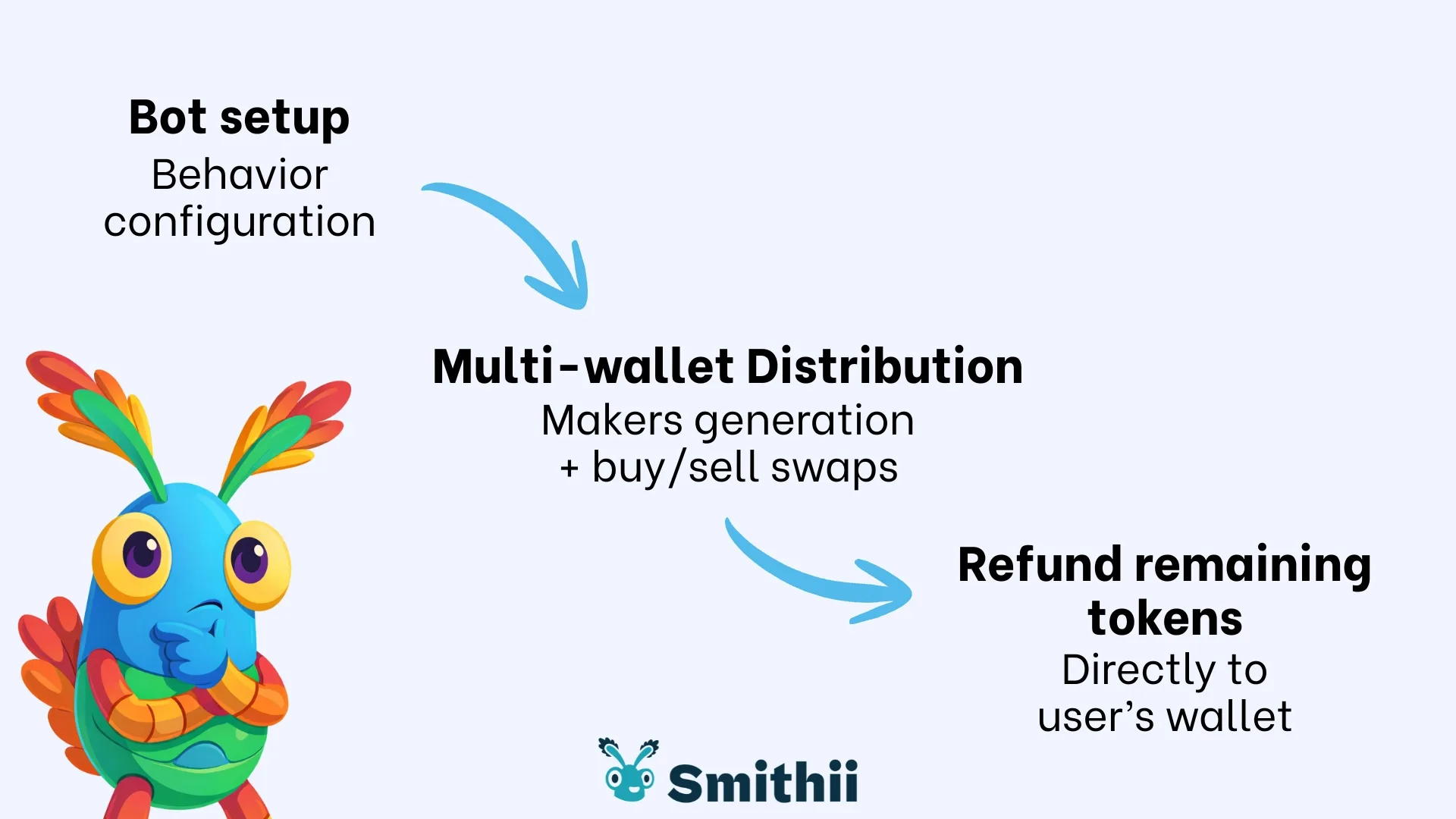
1. Behavior setup
The user sets the bot’s parameters: how many makers to generate, buy/sell ratio, average size per operation, frequency, max slippage, and total duration. You can also configure the behavior to focus on keeping volume active, or as a holding + token distribution strategy.
2. Multi-wallet distribution
A single wallet running a lot of swaps gets flagged immediately on any explorer and marks that wallet as a “bot”. That’s why volume bots spread the capital across multiple maker wallets, each with its own keypair. These wallets can be auto-generated on the fly or pulled from an older pool.
3. On-chain execution and fund returns
Each maker runs its scheduled swap against the token’s liquidity pool. Once the operation is done, the remaining funds flow back into the system (to the distribution wallet, in more sophisticated architectures) to feed the next makers. When the configured maker target is reached or the funds run out, the bot stops and sends the remainder back to the user.
How the Smithii Volume Bot works under the hood
Let’s take the Smithii Volume Bot for Pump.fun as an example, since it follows a similar architecture across the other versions of the market maker bot. This tool is built on a smart contract and a funding wallet that coordinates the distribution of funds to the makers. These are the six steps of the full flow:
- The user configures the bot’s behavior: target number of makers, buy/sell ratio, sizes, and duration. All the setup happens off-chain before signing anything.
- The user signs a transaction: a single signature from their main wallet, sending the funds to the Volume Bot’s smart contract along with the configured parameters.
- The smart contract receives the funds and forwards them to the funding wallet: this master wallet is in charge of funding every maker generated during the operation. It’s the central control point of the flow.
- The funding wallet distributes funds to the makers: each maker receives the amount needed to run its operation. Makers can be freshly generated wallets or wallets locked to a single reuse, which gives the flow a less identifiable profile.
- Each maker runs its buy/sell operation and returns the remainder: the swap is executed against the token’s liquidity pool according to the configured behavior. The remaining funds flow back to the funding wallet, which keeps feeding later makers as long as there’s capital left and makers still to generate.
- Flow closeout: once the target maker count is hit, the funding wallet closes and sends the remaining funds back to the user’s wallet. If the funds run out before reaching the target, the funding wallet stops its activity and ends the operation.
Below, you can watch a video of the Smithii Volume Bot in action across both of its interfaces.
This architecture has two useful properties. First: the user never custodies the makers’ keys, which cuts down the operational attack surface. Second: the flow is deterministic and auditable on-chain, so you can verify that the bot did what it promised and, if anything fails, exactly why.
If you want to see how this mechanic plays out in the concrete flow of a launch, the full tutorial for launching a meme coin on Pump.fun with the Bundler shows how the tools fit together inside a real operational flow.
Backing real traffic vs. price manipulation
The most common misconception about volume bots is thinking they’re used to pump price. They’re not. By design, the bot’s operations are balanced (buys and sells that cancel each other out), so the net effect on price is marginal and often invisible. What moves is the volume counter, without touching the price.
That’s why responsible use and fraudulent use of a volume bot look very different:
| Aspect | Responsible use | Manipulation / wash trading |
|---|---|---|
| Goal | Refresh visibility on screeners and DEXs | Trick investors into thinking a token is worth more |
| Effect on price | Marginal: operations net out close to zero | Coordinated with targeted buys to push the price |
| Connection to real marketing | Complements community, content, and narrative | Replaces the lack of community or product |
| Promises to investors | None about returns or price | Implied returns through “visible activity” |
| Detectability | Pattern blended with real organic traffic | Pattern flagged as wash trading by modern screeners |
A volume bot is a visibility support tool, not a replacement for real traffic, a community, or narrative. If there’s no real project behind the token, the volume bot only delays the fall.
Best practices and recommendations
If you decide to run a volume bot, these are the recommendations that deliver the most operational value:
- Pair it with real marketing: follow a strategy to promote your token with content, AMAs, community on X and Telegram, partnerships. The volume bot adds to how the project reads from the outside, but only if there’s something behind it.
- Use it in strategic windows: the days before a listing, during a major announcement, or in a promotional campaign. Keeping a volume bot running 24/7 for no reason burns capital and adds nothing to the project’s profile.
- Match the volume profile to comparable tokens: if your market cap has a $50k market cap, generating $5M of daily volume screams wash trading. Look at similar organic tokens and size the bot accordingly.
- Measure cost vs. benefit: track how many new visitors/holders show up during a window with the bot on versus a window without it. If it isn’t moving the metric that matters, adjust or pause.
- Combine tools by phase: bundler at launch for a controlled entry, volume bot post-launch to sustain visibility while the community grows.
If your launch is running on Solana, the Volume Bot guide for Pump.fun goes into the operational details of how to set it up for that specific ecosystem.
FAQ
These are the questions we get most often about how a volume bot works:
Is it legal to use a volume bot?
The short answer: it depends on the jurisdiction and the use case. Running a volume bot to refresh visibility on screeners and sustain activity on your own token usually sits within the accepted range in decentralized crypto markets. Using it to coordinate wash trading aimed at misleading investors about a token’s value does cross into market manipulation territory and can be prosecuted.
Will a volume bot pump my token’s price?
Not in any sustained way. The bot’s operations balance between buys and sells that net out close to zero, so the price moves marginally while it runs and snaps back to its level once the bot stops. If your goal is to push the price up, a volume bot isn’t the tool. What it does move is the volume counter visible on DEXs and screeners.
What’s the difference between a volume bot and wash trading?
Technically, wash trading is any coordinated activity that creates artificial volume with the intent of misleading the market about an asset’s real activity. A volume bot can be used for wash trading (if its sole purpose is to deceive) or as legitimate support for a marketing operation (if it complements, rather than replaces, real activity). The difference comes down to intent and whether the project behind it has substance.
What happens to leftover funds when the bot finishes?
In the architecture of the Smithii Volume Bot, when the target maker count is hit, the funding wallet closes and returns the remainder to the wallet of the user who signed the initial transaction. If funds run out before the maker target is met, the funding wallet stops without a refund (because there’s nothing left to return). In both cases the flow is deterministic and auditable on-chain.
Do I need to code to use a volume bot?
No. Modern implementations are no-code: you connect your wallet, configure the parameters from a UI, sign a transaction, and the smart contract handles the rest. You don’t need to touch Solidity, run nodes, or manage maker keys.
Conclusion
Understanding how a crypto market maker bot works to generate volume matters if you want to add this kind of tool to your strategy for growing your token. You need to think about timing, intent, and the real organic traffic you’re already pulling in, so you don’t end up creating activity that’s hollow or pointless.
Keep in mind that everything you need for your token is on Smithii Tools.

CEO & Co-Founder at Smithii. Building on Solana since 2021 and sharing playbooks from the trenches. Also founder of Lince after years investing in DeFi.