
Pons Volume Bot: Keep Your token’s Volume Alive on Pons
The Pons Volume Bot is the tool you fire up once your token is live and you need to keep transactions flowing so you don’t drop off the DEX screener rankings. In this guide we’ll walk you through how to run it on Pons, the launchpad built for Robinhood Chain, generating controlled volume in your token pool at whatever frequency and size you set.
Two names, one tool: volume bot and market maker bot. The first puts the emphasis on output (volume), the second on the technical role (providing order flow). In practice, both do exactly what you need post-launch: automated buys and sells to keep activity from going to zero.
This guide walks through what the Pons Volume Bot (Market Making Bot) does, how to use it step by step, what to expect from price, when to activate it in your token’s lifecycle, and key things to keep in mind.
What Is a Volume Bot and What Is a Market Maker Bot?
A volume bot is a program that runs automated buys and sells on your token in a liquidity pool to generate continuous on-chain transactions. The goal is not to move the price (though there can be side effects); it is to ensure there is measurable, visible activity on the chart.
A market maker bot does the same thing but is framed from a market making perspective: providing order flow on both sides (bid/ask) so there is always a counterparty available in the pool. In the memecoin and young-token world launching from launchpads like Pons, the two terms are used interchangeably.
Why consistent volume matters:
- DEX screener rankings: DexScreener, DexTools, and similar platforms reward tokens with active transactions. Without volume, your token drops out of the featured sections.
- First impressions for organic traders: a chart with no recent activity signals a dead project, even if the fundamentals are solid.
- Discoverability on aggregators: DEX aggregators prioritize pools with consistent flow. Less volume means less exposure.
Before running a volume bot, you’ll want to know how to launch a token on the Pons launcher for Robinhood using our dedicated guide.
What is the Pons Volume Bot and what does it actually do?
The Pons Volume Bot from Smithii is built specifically for ERC-20 tokens deployed through the Pons launchpad on Robinhood Chain. It runs buys and sells against your token pool at the frequency and size you configure, staying within the gas range and target volume you define upfront.
The main parameters you can control:
- Target volume: the total amount (in Pons’ base asset) you want to move over the bot’s run.
- Campaign duration: hours, days, or whatever time window you pick.
- Average size per transaction: the mean amount for each buy/sell, with random variation so the pattern doesn’t look too obvious.
- Number of rotating wallets: spreading trades across multiple wallets makes the flow look more organic and less concentrated.
How to use the Pons Volume Bot step by step
Head to the bot for Pons and set it up from the interface by following these steps:
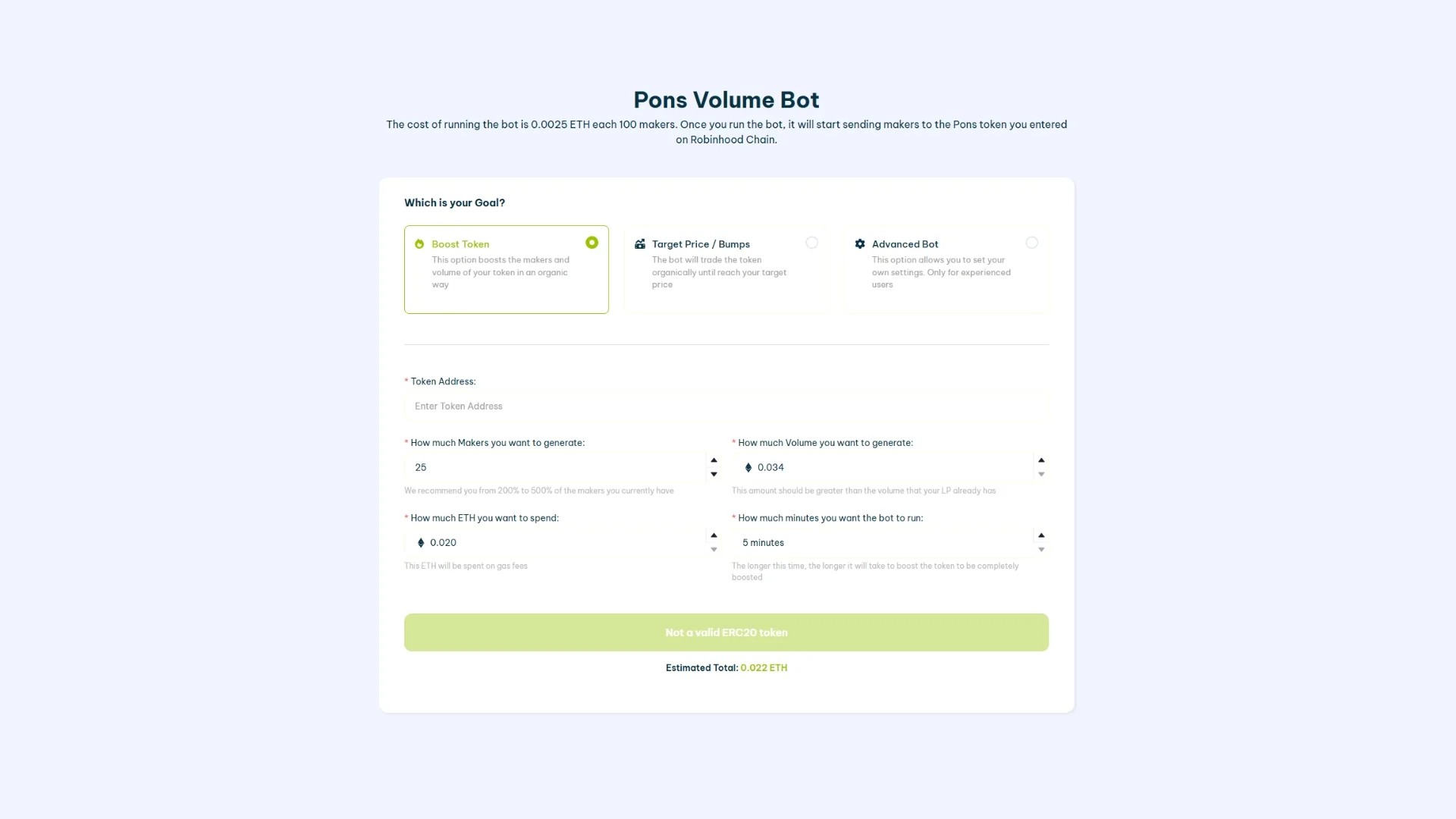
- Paste your token contract address: the tool automatically detects the active token pool, whether it’s still on Pons’ internal bonding curve or has already graduated to the DEX.
- Set the number of makers to generate: this is what drives the bot’s cost. 0.005 ETH per 100 makers is the base cost (not counting gas fees per transaction).
- Start the bot: hit the ‘Start Bot’ button to get it running. You’ll see every transaction in the logs below.
Once the campaign wraps up, check the results on the DEX screener and on the Pons explorer: 24h volume up, transactions spread out, and active wallets showing in the token ranking.
Does the token price go up when you run a volume bot on Pons?
The honest answer: not directly. The volume bot buys and sells against the same pool, so the net effect on price tends to be small (leaving aside the impact of gas and trading fees, which shave off a small percentage on each rotation).
What can happen is an indirect price effect through discovery: if your token starts showing up in DexScreener’s featured sections thanks to high 24h volume, it pulls in organic traders who actually buy, and that flow does move the price. But the bot itself isn’t a pump tool.
You can pick ‘Target Price’ mode so the bot doesn’t sell back everything it buys and instead routes it to a wallet (by default, the connected wallet). This can nudge the price, but it’s more of a way to lock in volume plus holdings, since you’d need serious funds to actually move the price in any meaningful way.
Rule of thumb: use the volume bot for discoverability, not for price manipulation. The first is a reasonable, sustainable goal; the second is a short-term play that rarely ends well.
Is it legal to run a volume bot on Pons?
It depends on your jurisdiction and how you use it. Broadly speaking, running a volume bot to generate traffic and keep discoverability alive for your own token on a DEX, without misrepresenting the project’s fundamentals, isn’t specifically regulated in most countries.
What is regulated (and penalized in most jurisdictions with formal markets) is wash trading with intent to deceive investors about the asset’s liquidity or real interest. The line between ‘I’m keeping activity in my pool’ and ‘I’m manipulating signals to attract buyers under false pretenses’ is ethical, not technical, and you’re the one who draws it.
Check the rules that apply in your jurisdiction if you’re unsure. Robinhood Chain’s on-chain decentralization doesn’t shield you from legal liability if your project has identifiable investors or ties to regulated markets.
When to fire up the Volume Bot in the token lifecycle?
Timing matters. These are the typical scenarios where it makes sense to turn it on:
- Right after launch: if you used the bundler to lock down the first blocks, turning on the volume bot over the next 24–48 hours keeps activity alive while the first organic holders start showing up.
- Before a major announcement: if you have news lined up (partnership, listing, roadmap update), warming up the token with visible activity beforehand keeps the announcement from landing in a dead pool.
- During marketing campaigns: if you’re paying for traffic or exposure, the volume bot makes sure anyone who lands on the DEX screener doesn’t see a dead token on the chart.
- During slow market periods: when sentiment is weak and meme coins lose traction, keeping a baseline volume prevents you from dropping off the rankings entirely.
If you haven’t launched yet, start with the Pons Bundler Bot to control the first blocks of the token, and turn on this volume bot right after so you don’t lose the launch momentum.
Pair it with the rest of the Pons stack
The volume bot works best as part of an integrated strategy. Here are the natural companions inside the Robinhood/Pons ecosystem:
- Before the launch: create the token with the guide to creating token on Robinhood Chain or specifically a meme coin on Robinhood Chain.
- At launch: coordinate the creation and first buys with the Pons bundler so you don’t hand the first blocks to external bots.
- After the launch: grow your holder base with the airdrop on Robinhood Chain guide while the volume bot keeps the flow active.
- Network context: understand the infrastructure you’re building on with the what is the Robinhood blockchain guide.
FAQ about the Pons Volume Bot
Is the Pons Volume Bot the same as the Pons Market Maker Bot?
Yes, in the context of tokens launched with Pons they’re the same tool. The terms are used interchangeably in the ecosystem. The difference is one of framing: ‘volume bot’ emphasizes the output (24h volume) and ‘market maker bot’ emphasizes the technical role (providing order flow).
How much volume can I generate with the bot?
As much as you want, scaled to your budget. The tool scales with the capital you commit to the campaign. You can start small to test, then ramp up once you’ve validated the impact on your DEX screener ranking.
Do DEX screeners detect artificial volume?
It depends on how the campaign is set up. Screeners apply basic filters against obvious wash trading (the same pair of wallets bouncing back and forth, perfectly regular patterns). The bot uses multiple rotating wallets and randomized size variation to stay under those filters. Even so, there’s no absolute guarantee: the more natural the setup, the better.
Should I use it before or after a airdrop?
After. A airdrop distributes supply to wallets, but on its own it doesn’t generate trading transactions. Turning on the volume bot right after the airdrop makes sure that jump in holders comes with visible on-chain activity.
What happens when the campaign ends?
The transactions stop. Your token’s 24h volume goes back to depending on organic flow or a new campaign. That’s why many projects schedule staggered campaigns: leaving natural gaps between bursts instead of running the bot non-stop, which also looks more credible to an outside observer.
Conclusion
The Pons Volume Bot, also known as the Pons Market Maker Bot, is the tool that keeps your token relevant on the DEX screeners once the launch buzz dies down. Automated buys and sells, rotating wallets, variable sizes, configurable duration, all from a no-code interface.
It’s not a pump tool or a price guarantee: it’s a discoverability layer. Combined with a solid initial bundle, a thought-out airdrop and a community strategy, it rounds out the practical stack for a token that wants to hold its ground on Pons beyond the first few hours.

Content creator and SEO contributor at Smithii. Systems Engineering student and crypto-tech enthusiast.