

Privacy on Arc chain: why every payment is readable in dollars and how to send USDC without exposing yourself
Privacy on Arc chain is the first thing you lose the moment you start moving real money, because anyone with the explorer open can read how much you earn, how much you pay a supplier and how much you keep in the treasury. Fixing this lets you pay a team without publishing each person’s salary, sell your token to a large buyer without showing the price, and keep the wallet you operate with separate from the one that receives the funds.
In this guide, I’ll break down why the network’s ledger exposes far more than it looks, what privacy Circle is still working on in the lab, and how to send USDC privately with Mixoor, step by step and with the numbers. Let’s get into it.
Why privacy on Arc chain hits so hard
Arc is the chain built by Circle, the company behind USDC, and its mainnet has been live since September 16, 2026. It has one quirk that sets it apart from every other EVM network: the asset you pay with and the token that covers gas are the same USDC. No volatile native coin in the middle.
That convenience comes with a trade-off almost nobody talks about. On Ethereum, anyone watching sees that 0.4 ETH left your wallet and they still have work ahead, because they have to decide how to price it and at what moment. On Arc they read 482.50 USDC and they’re done. It’s $482.50 today, it was $482.50 on the day of the transfer, and it’ll still be $482.50 two years from now, so the number doesn’t need converting and it doesn’t age. The network’s ledger looks less like a block explorer and more like a bank statement published for everyone to see. Just look at the latest transactions to confirm it:
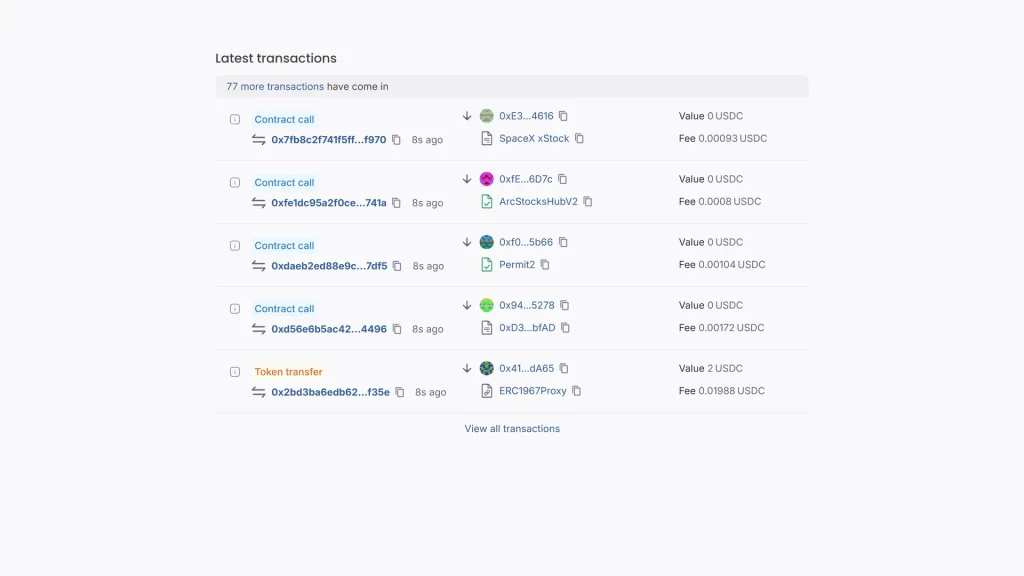
On top of that, the use cases Circle puts front and center are business-to-business payments, payroll, FX, and treasury. Exactly the operations where the amount is the confidential part, not a technical detail. And all it takes is someone tagging a single one of your addresses for the rest to fall into place, because from there anyone can map counterparties, amounts, and how often you move money, without asking permission.
If you don’t have a balance on the network yet, start with our guide on how to move your USDC to the Arc chain.
How to run a private transaction on Arc step by step
Mixoor on Arc is a non-custodial protocol that breaks the direct link between the wallet that deposits and the one that receives. Instead of storing your address it stores a cryptographic commitment, and releases funds against a zero-knowledge proof generated in your own browser. It works with native USDC, so there’s no wrapping and no prior approval to sign. When you open the interface you’ll see something like this:
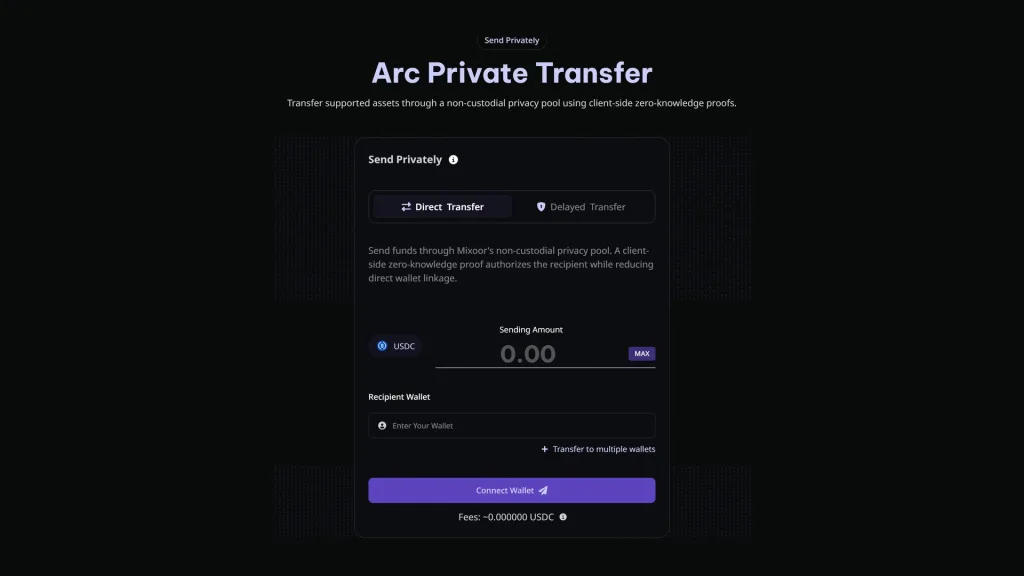
If you already hold at least 20 USDC on the network and have a fresh wallet ready to receive, here’s the flow:
- Connect an EVM wallet: MetaMask or similar, with the network set to Arc mainnet (chain ID 5042). The USDC you send also pays for gas.
- Pick the mode: Direct handles deposit and withdrawal in one go. Delayed keeps the funds in the pool so you can pull them out whenever you want.
- Enter the amount: the minimum is 20 USDC and the MAX button fills in your available balance.
- Set the receiving wallet: ideally a fresh address with no history tied to the sending one. You can also split the send across several.
- Sign the operation: your browser generates the proof, the contract verifies it, and the relayer delivers the USDC to the destination.
There’s no token approval step and no intermediate wrapping, and the receiving wallet can sit completely at zero, because the relayer is the one paying for the withdrawal. If you go below the minimum, the interface itself warns you before you even sign.
Direct or Delayed: what changes between the two modes
The difference between them isn’t in the cryptography, which is identical, but in the time gap between the deposit and the withdrawal. And timing correlation is the cheapest tell for anyone analyzing the chain, because if a deposit goes in and a withdrawal of the same size comes out ninety seconds later, pairing them takes zero skill.
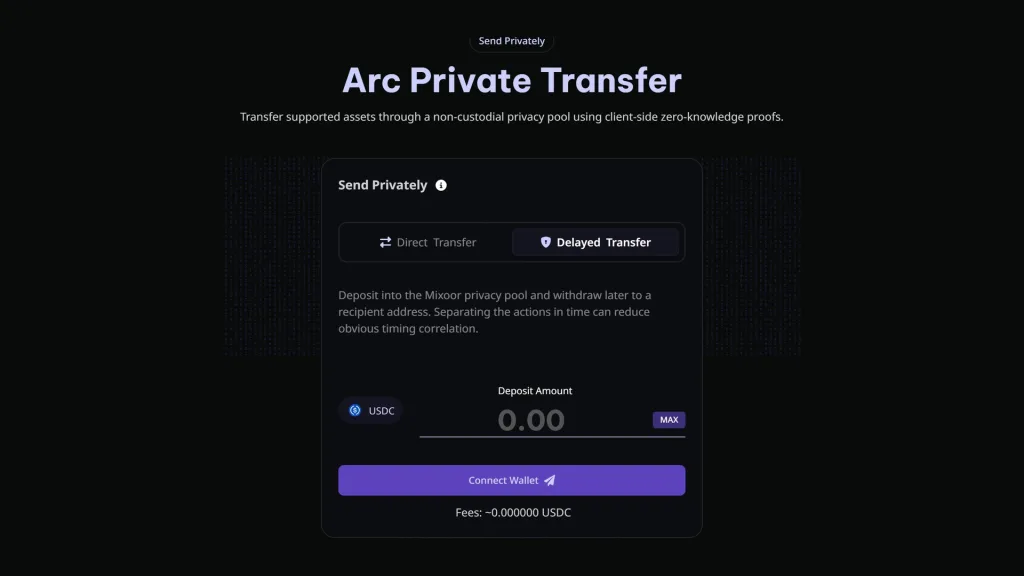
In Delayed mode you only deposit. The USDC sits listed as funds pending withdrawal and you decide when and where to pull them, whether it’s a bit later or next week. Direct pays off when the amount is modest and there’s enough movement in the pool to blend into. Delayed pays off when the amount stands out or when the payment is predictable on the calendar, like a paycheck that always lands on the same day of the month.
How much it costs to send USDC privately on Arc
Mixoor charges a 0.25% relayer fee and only applies it on the withdrawal. On a 20 USDC transfer that’s 0.05 USDC. There’s no deposit fee, so the amount you leave in the pool goes in whole and the cut shows up on the way out.
Network gas works the same as everything on Arc: it’s paid in USDC from the same balance. This is where the chain plays in your favor, because on any other network you’d have to fund the destination wallet with the native token so it could operate at all, and that funding transfer is what gives away a freshly created address. On Arc you don’t need it, since the relayer handles it and the new wallet can come to life on its first receipt.
The last number to keep in mind is that every new withdrawal has to be at least 20 USDC and can’t leave a private remainder below that figure. If your balance inside the pool falls short, the play is to deposit a bit more and pull the total out in one go.
This same protocol works on other networks: here’s how to run a private ETH transfer and how the cost changes.
What disappears from the explorer and what stays visible
Worth clarifying: Mixoor obfuscates transactions so a random observer can’t see a connection between two wallets. The deposit is visible, the withdrawal is visible, and the pool contract is out in the open, but what stops existing is the edge linking the two ends. Anyone can see your wallet dropped in 300 USDC and that the pool paid out 300 USDC to another address, with nothing published tying that withdrawal to that deposit.
From there you can figure out what actually matters: how many people are inside the pool while you’re using it. On a protocol with barely any traffic, two operations close in time and with identical amounts almost pair themselves up. Mixoor massively raises the cost of that analysis, enough to knock most of the usual tracing tools out of the game, but it doesn’t make it impossible for anyone with resources and motivation.
| What an observer can read | Standard USDC transfer | Mixoor, Direct mode | Mixoor, Delayed mode |
|---|---|---|---|
| Payment amount | Yes, in exact dollars | Yes, in each leg separately | Yes, in each leg separately |
| Sending Wallet | Yes | Only against the pool | Only against the pool |
| Receiving Wallet | Yes | Only against the pool | Only against the pool |
| Link between the two wallets | Explicit in a single line | Broken by the zero-knowledge proof | Broken by the zero-knowledge proof |
| Time gap | None | However long the operation takes | Whatever you decide |
| Prior balance in the destination wallet | Required to operate | Not needed, the relayer pays | Not needed, the relayer pays |
The opt-in privacy Circle hasn’t switched on yet
Circle isn’t ignoring the issue. The mainnet announcement lists optional privacy among the planned features, described as confidential transactions and balances with viewing keys, and right there it clarifies that it’s still in development, pending a general rollout on the network.
The viewing keys idea is exactly what you’d expect from a regulated company. The amount stops being public, but the holder can hand a key to an auditor, a bank or a supervisor so they can read what they need. It’s designed so a company can meet its obligations without publishing its numbers to the whole world, and it makes complete sense in the context of Arc.
That said, it solves a different layer. What Circle is building hides the number and leaves the addresses in plain sight, while what Mixoor does is the opposite: breaking the link between the two wallets. When both coexist they’ll complement each other nicely, but for now only one of them is available and the other has no public release date.
Wallet hygiene on a payments chain
No tool makes up for sloppy usage. These habits cost almost nothing and are what actually hold the result together:
- Use a fresh wallet for incoming funds: if you get paid to an address that has already interacted with the sender, the whole point of the zero-knowledge proof gets blown in the most obvious way possible.
- Skip the round numbers: on Arc the amount is denominated in exact dollars, so a 500.00 deposit and a 500.00 withdrawal get matched up effortlessly. Nudge the amounts off by a bit or split the send.
- Break the rhythm: moving the same figure on the same day every month draws a pattern that gets spotted immediately, no matter how private each individual operation is.
- Don’t fund the new address from the same source: on Arc you don’t even need to, because the relayer covers the withdrawal and the destination can sit at zero until it gets paid.
- Split roles across wallets: one for daily activity, one for receiving payments and one for storage. It’s the foundation of any serious privacy setup and doesn’t depend on any specific tool.
For a look at how the same problem plays out in another ecosystem, check out the privacy weak spots that Solana carries with it.
FAQ
What privacy does Arc chain offer on its own?
Right now, none. Arc is a public chain and every USDC transfer is logged with its amount, source and destination, readable by anyone from the explorer. The optional privacy with viewing keys that Circle described at mainnet launch is still in development, so any confidentiality you need right now has to come from an external layer.
What’s the minimum Mixoor deposit on Arc?
The native USDC pool works with a minimum of 20 USDC per operation, and a new withdrawal also can’t drop below that figure or leave a smaller private remainder. If the balance you have inside the pool falls short, top it up a bit and withdraw the full amount in one go.
Do I need a separate gas token to use Mixoor on Arc?
No. On Arc, gas is paid in USDC itself, so the balance you deposit and the one that covers the network fee are the same. The receiving wallet needs absolutely nothing, because the relayer is the one that broadcasts the withdrawal.
Does Mixoor custody the USDC while they’re in the pool?
No. The funds sit in a smart contract and are only released against a zero-knowledge proof that only the depositor can generate. The contracts, circuits and SDKs are open source under Apache 2.0 and published on GitHub.
Is it legal to use a mixer on Arc?
Depends on the jurisdiction and, above all, on the use case. Protecting the confidentiality of a payroll, a negotiation or a project’s treasury usually falls within what’s accepted, while using the same tool to dodge legal obligations or launder funds does not. The documentation you keep off-chain matters just as much as the tool itself.
Wrap-up
Once you understand that on Arc every move gets published in exact dollars, you can actually decide what you show and what you don’t, instead of finding out when someone else shows it to you. The network still ships nothing native to prevent this and Circle’s optional privacy has no release date, so for now the only option available is an external layer.
Mixoor covers that specific layer, the one that keeps who paid whom off the record, for a 0.25% fee and without taking custody of your funds. Combine it with clean wallets and no repeating patterns, and you’ll get a reasonable level of discretion on a chain that, by design, tells everything. You can also see how this gets handled on Robinhood’s network, where the approach shifts quite a bit.

Content creator and SEO contributor at Smithii. Systems Engineering student and crypto-tech enthusiast.