

How to bridge USDC to Arc (multi-chain guide)
Knowing how to bridge USDC to Arc is the first thing you need if you want to operate on this network, and for one very specific reason: on Arc, gas is paid in USDC. Without USDC in your Arc wallet you can’t deploy a contract, sign a transaction, or move anything.
The classic chicken-and-egg problem: to bring funds in you need gas, and gas is exactly what you don’t have. The Arc Bridge from Smithii solves this by leaning on Circle CCTP, so a freshly created wallet on Arc receives the USDC without paying anything on the destination side. The full walkthrough is below.
What you need before moving the funds
- Native Circle USDC on the source network. It’s the only kind supported: bridged or wrapped versions from other protocols won’t work.
- Gas on the source network, not on Arc. That’s where you’ll actually pay the transaction, in the native coin of that chain.
- A destination address on Arc. It can be a brand-new wallet with zero balance, which is the whole point.
How to bridge USDC to Arc step by step
The Arc Bridge from Smithii moves your USDC to Arc through Circle CCTP, the transfer protocol run by the coin’s own issuer. That means what lands on the destination side is native USDC minted by Circle, not a wrapped token backed by a liquidity pool. Here’s the interface you’ll see:
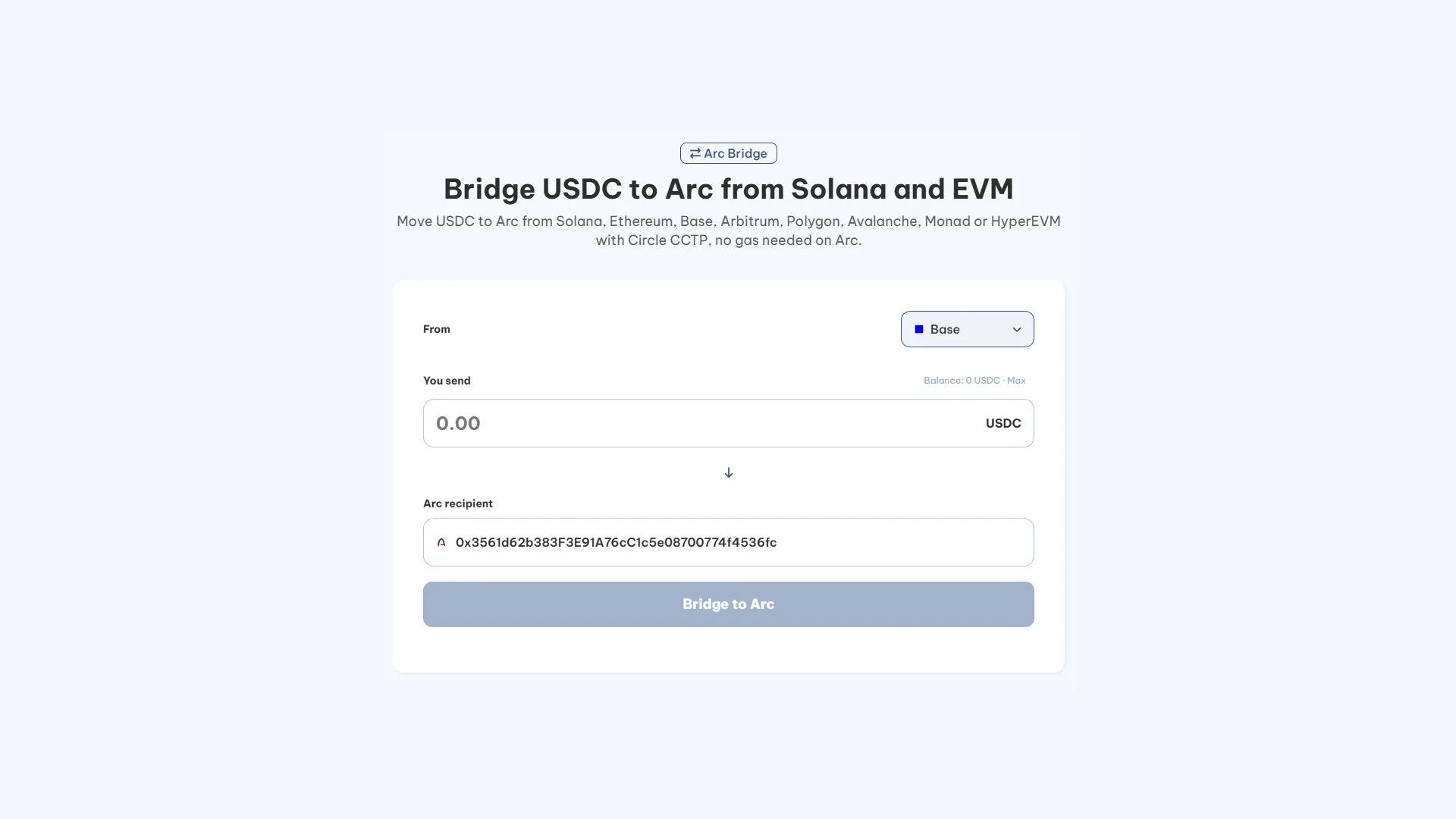
With USDC sitting on the source network, the flow goes like this:
- Pick the source network in the From dropdown, the chain where your USDC currently lives (Solana, Ethereum, Base, Monad, Hyperliquid, Arbitrum, Polygon and Avalanche).
- Connect the wallet for that network. The button adapts to the chain you selected, so if you’re leaving from Solana it will ask for a Solana wallet.
- Enter the amount in You send. Your balance shows right below, along with a Max shortcut to send the whole thing.
- Set the destination address in Arc recipient. Double-check it: this is the one field you can’t fix afterwards.
- Confirm the transaction after clicking ‘Bridge to Arc’.
If you close the tab halfway through, nothing is lost: once the transfer is sent, Circle finishes it on its own and the status will be waiting for you when you come back to the page.
Which networks you can bridge USDC from to Arc
The bridge supports eight source chains and covers both the EVM ecosystem and Solana, which uses a different wallet format.
| Source | Available networks |
|---|---|
| Established Layer 1s | Ethereum, Solana, Avalanche |
| Ethereum Layer 2s | Base, Arbitrum, Polygon |
| Newer chains | Monad, HyperEVM |
The condition is the same across all of them: it has to be native USDC issued by Circle. If what you’re holding is a version bridged by another protocol, the bridge won’t take it, and it’s worth checking beforehand rather than finding out after you’ve already signed the transaction.
The quick way to confirm this is to look at the contract address of the token you hold and compare it with the one Circle publishes for that network. If they don’t match, what’s sitting in your wallet is a different asset, no matter how much the wallet labels it as USDC with the same icon.
What changes when you bridge through Circle CCTP
Most bridges work by locking your token on the source chain and handing you a wrapped representation on the destination, backed by a liquidity pool. That model has two well-known weak points: the contract holding the funds and the depth of the pool.
CCTP doesn’t do that. It burns the USDC on the source chain and Circle mints native USDC on the destination, so what you receive is the exact asset Circle issues, not a third-party-backed version. No wrapped token and no pool to depend on.
The second piece is Circle’s forwarding service, which is what solves the gas problem. Circle sends the mint transaction on Arc for you and deducts its cost from the transfer itself, so you don’t need to hold anything on Arc to receive the funds. A wallet created that same morning works just the same.
How much it costs to move your USDC to Arc
There are three items and it’s worth keeping them separate, because they’re paid in different places:
| Item | How much | Where it’s paid |
|---|---|---|
| Smithii fee | 0.1% of the amount | On USDC, inside the same transaction |
| Circle fees | Transfer and forwarding | Deducted from the amount, shown before you sign |
| Network gas | Depends on the chain | On the source chain, not on Arc |
The 0.1% scales with what you move, so one large transfer works out better than several small ones. And since gas is paid on the source, the total cost depends a lot on which chain you’re leaving from: starting from Ethereum isn’t the same as from Base or Solana.
None of the numbers come as a surprise: the full breakdown shows up on screen before you sign, so you can compare what leaves your wallet with what will land on Arc and decide with that figure in front of you.
What you can do once you move funds to Arc
With a balance on wallet you’re ready to operate, and that USDC pulls double duty: it’s both the asset you work with and the currency you pay gas in. No need to set aside a second token for fees.
The usual next step is deploying your token, setting up the liquidity pair, or distributing it to a community in a single send, all with the same wallet and without swapping currencies.
With the funds on the network, follow the guide on how to deploy your ERC-20 on Arc
Now that your funds are on the network, it’s worth knowing what Arc exposes about every payment and how to avoid it
FAQ
Do I need to already hold USDC on Arc to receive the transfer?
No, and that’s the most useful part of the flow. Circle’s forwarding service handles the mint on Arc for you and deducts its cost from the transfer itself, so a brand-new wallet with zero balance receives the USDC directly. No need to source gas somewhere else first.
How much does bridging USDC to Arc cost?
Smithii charges 0.1% of the amount you move, in USDC and within the same transaction. On top of that, Circle’s transfer and forwarding fees are shown before you sign, plus gas on the source network, which you pay in that chain’s native coin.
What happens if I close the page halfway through?
Nothing gets lost. Once the transfer is sent, Circle completes it on its own without you doing anything, and when you come back to the tool you’ll see the progress again. Closing the tab doesn’t interrupt the process.
Can I bring USDC bridged through another protocol?
No. Only native USDC issued by Circle is accepted. Wrapped or bridged versions from other protocols are different tokens, even if the name looks similar, and the bridge won’t recognize them. Check which version you’re holding on the source network before you start.
How long does it take to arrive?
Most transfers land in under a minute, and you can track the status of each one right on the page. The exact time depends on confirmation on the source network, so leaving from a fast chain shortens the wait.
Wrap-up
Bringing USDC to Arc is the step that unlocks everything else, because on this network balance and gas are the same thing. And going through CCTP, you don’t drag along the two usual headaches of a bridge: no wrapped token, and no liquidity pool to depend on.
The only thing worth a second look is the destination address, since it’s the one field that can’t be corrected afterward. The rest is handled by the protocol itself in under a minute. If you want the details on how it works under the hood, they’re in Circle’s CCTP documentation.

Content creator and SEO contributor at Smithii. Systems Engineering student and crypto-tech enthusiast.