
Most token devs want to learn how to graduate a token on Pons Launcher, since it’s a practically ‘free’ way to land a liquidity pool on Uniswap. The moment you go to create a token on Pons Launcher, you’ll spot a ‘Graduation’ attribute right there in the token Preview section.
In this guide I’ll walk you through what graduating a token actually means and the practices that push you closer to pulling it off. We’ll also cover how the bonding curve works and what you get out of graduating your Pons token. Either way, it’s worth being upfront: these tips don’t guarantee you’ll graduate a token, they just stack the odds in your favor.
Without dragging out the intro any longer, let’s jump straight into answering these questions.
What is ‘Graduation’ on the Pons launcher?
When you create a token on Pons, you’re really handing control of a token’s supply and liquidity over. In turn, Pons, as the launch protocol, lets anyone buy and sell that token from the very first moment.
Compared to creating your own token on Robinhood Chain from scratch, we can say that you don’t need to seed a liquidity pool yourself for your token to be tradable.
That initial spot where your coin lives is called a ‘Bonding curve’. If you’re a degen Solana, this term probably rings a bell. The Pons docs themselves describe it as a vending machine: the automated middleman that swaps a Pons token for its pair. It also holds the entire supply, but only releases a set amount for trades on the bonding curve.
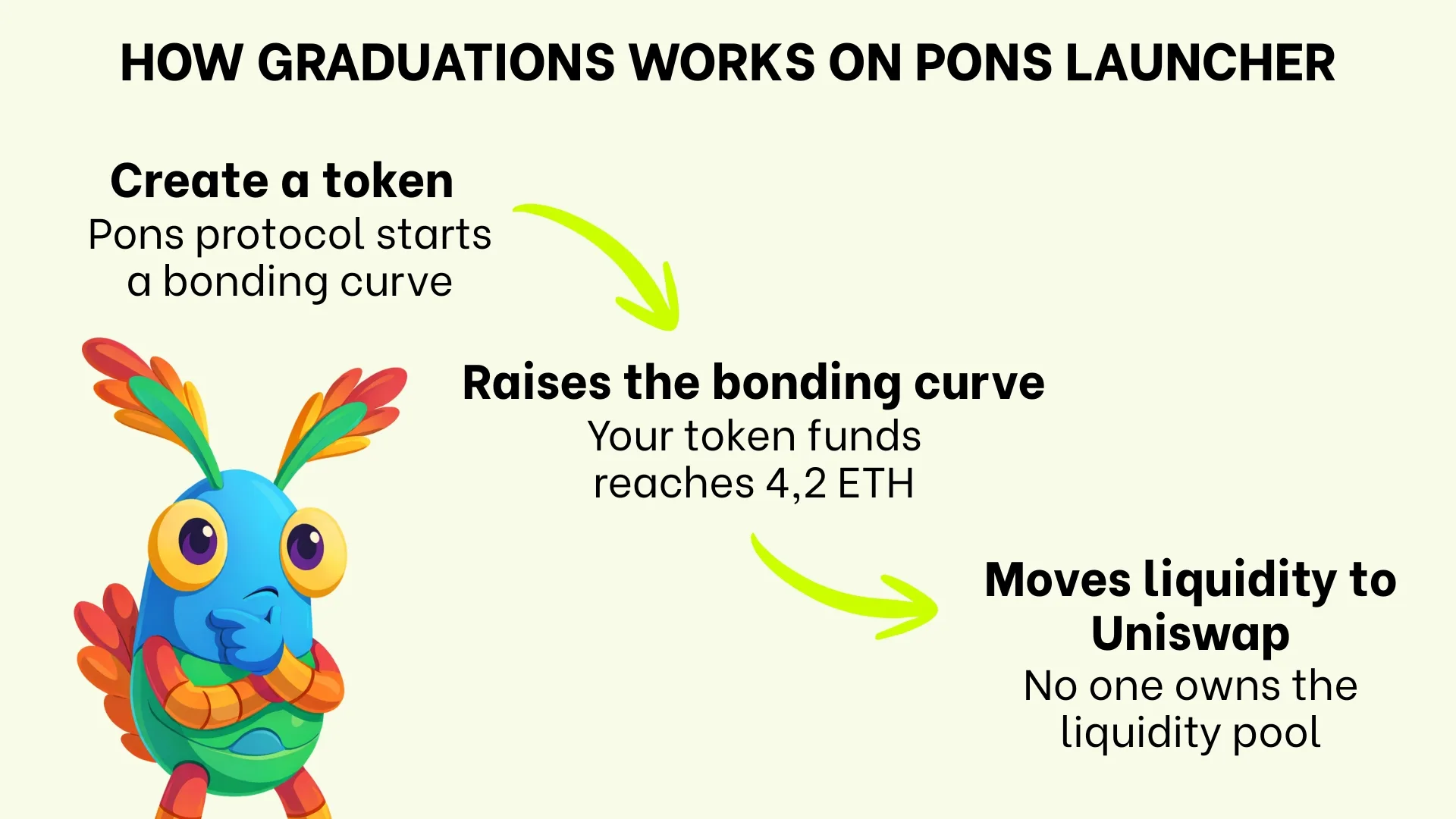
Okay, that whole intro was necessary to explain the ‘Graduation’ process for any token created on Pons. When the bonding curve runs out of supply (meaning it has sold every token allocated for this purpose), it moves the liquidity collected up to that point over to a Uniswap liquidity pool.
When it does, it locks the liquidity, so no one controls the funds. Not the Pons protocol, not the token creator. From this point on, the graduated asset moves on to trade in a much bigger DEX. To give you a rough idea, Uniswap does around $1.0B in daily volume, while Pons has topped out at $8.0M (a 125,000x gap).
How much you need to become a graduated token on Pons
At the moment, the bonding curve has to reach 4.2 ETH for the token to go through the graduation process. Once you clear that amount of ETH, the liquidity pool on Uniswap goes live and you’ll be able to trade the token from either Pons or Uniswap.
The graduation threshold will most likely get adjusted based on the value of the ETH and the token picked as the liquidity pair.
How to graduate a token on Robinhood Chain’s Pons Launcher: best practices
In this section I’ll walk you through some key points to keep in mind if you want to graduate your token from Pons to Uniswap. There’s no magic formula for this. These tips are essential to boost your odds of clearing the bonding curve, but the success of your memecoin depends on many factors.
With that said, let’s jump straight into the things you can actually control.
1. Pick the right identity for your token
A great example of how to nail a token’s identity is CashCat. This memecoin builds its identity around a reference to the Robinhood network before it went public. So that token blends a piece of Robinhood’s emerging ecosystem with the meme angle that had huge traction on Solana.
So instead of trying to become the next CashCat or the DOGE of this network, focus on being authentic and give your token an identity other people can actually relate to. The easiest way to pull this off is to spot trends on other blockchains or social media and adapt them to Pons, but plenty of other devs are doing the same, so the success rate drops significantly.
Don’t launch random cat or dog tokens hoping one of them hits. Take some time between launches, but don’t go so far in the other direction that you overthink it and never ship. You need to find a middle ground between planning a launch and just spamming tokens for the sake of it.
If you really want to go all-in on a theme, run a hype test on forums or social media first. This also helps you kickstart a community and check whether your next token’s identity actually has legs. Which brings us to the next point.
2. Never underestimate the power of communities
To graduate a token from Pons, you basically have two paths:
- A lot of people buying small amounts of tokens
- A few people buying large amounts of tokens
If you’re a solo dev with no social presence and you’re not posting on forums, getting traction is going to be way harder. Anyone might think 100 followers is nothing, and maybe it is. But imagine at least 5 of those 100 people actually step up and make an initial buy when you launch. Those are real people pushing you closer to graduating your token, plus they add volume and refresh your position on Pons, giving you more visibility.
On the other hand, it’s also true that starting a community is one of the hardest things to pull off, especially around crypto topics and even more so for memecoins or tokens without immediate utility. Either way, just check the graduated tokens on Pons and you’ll see most of them have at least a link to an X account.
Any effort here gets you closer to your goal, so it’s better to try than to skip the community side entirely.
3. Create the token on Pons using the Bundler Bot by Smithii
Clearing the bonding curve depends entirely on the funds sitting in the pool after launch. If you buy your own token as the dev, you’re sending the wrong signal to anyone who finds it. Why? Picture browsing the Pons homepage or coming across a Reddit post featuring some random token. You click in because it looks interesting, but then you notice the dev is the top holder. Nobody wants to buy when there’s a high risk of rug, and unfortunately that scenario is way too common.
So how do you shorten the race to clear the bonding curve without manually juggling multiple wallets? By using the Pons Bundler by Smithii. With our tool you can launch a token while adding up to 20 different wallets to split the initial buy.
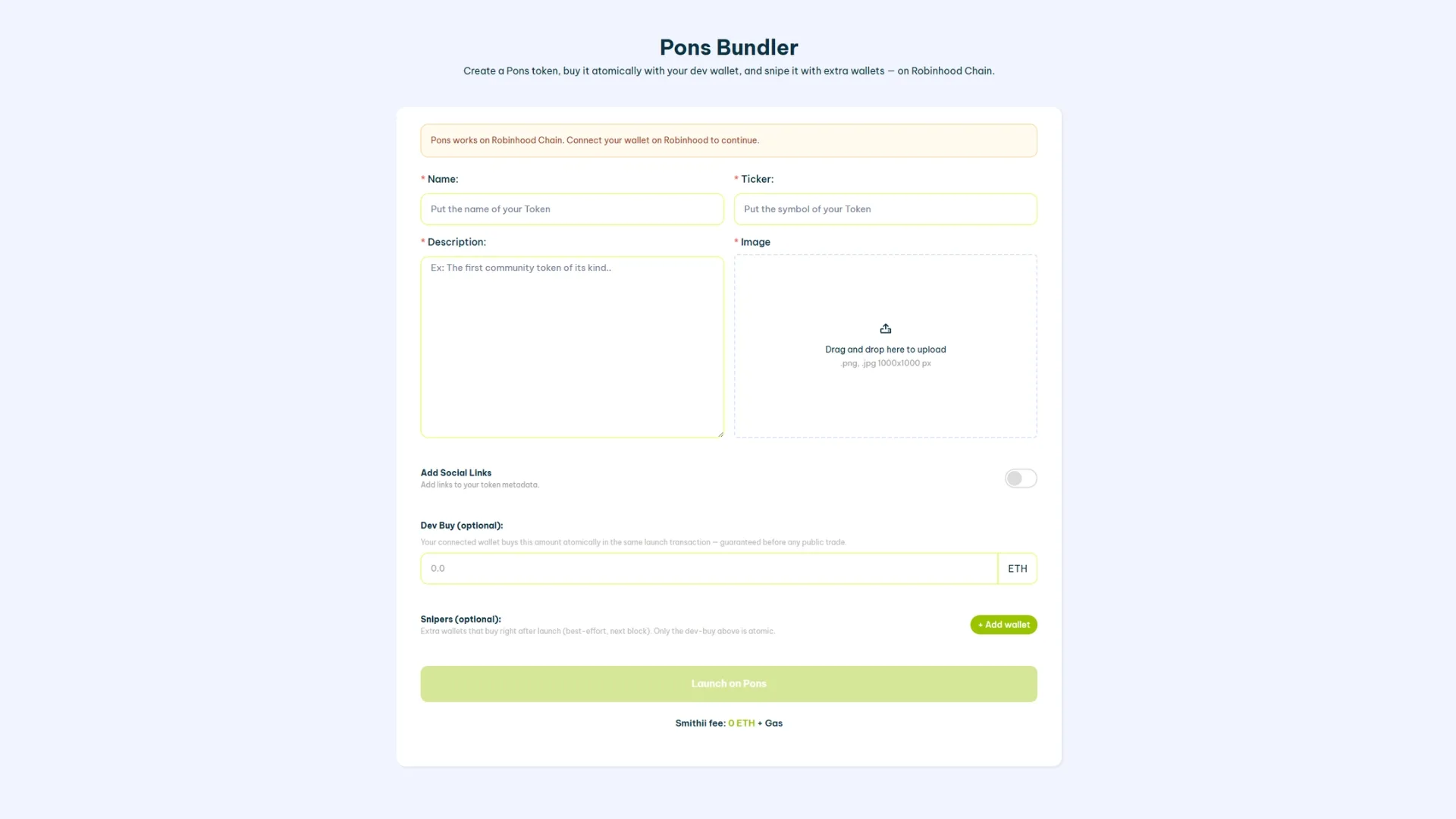
It’s the fastest and most effective way to close the gap to graduating your token, but it’s also the most expensive, since you’ll need to add liquidity to be included in the bonding. The other upside is that you’ll add holders with a single click, which also matters if you want other people to feel encouraged to jump in and help you clear the bonding curve.
4. Boost your token’s discoverability with a volume bot
Another lever you can pull is your token’s discoverability, which can be optimized by using a volume bot for Pons. Every second a new token gets created or traded, so Pons refreshes its homepage to surface the assets that could be more appealing to users.
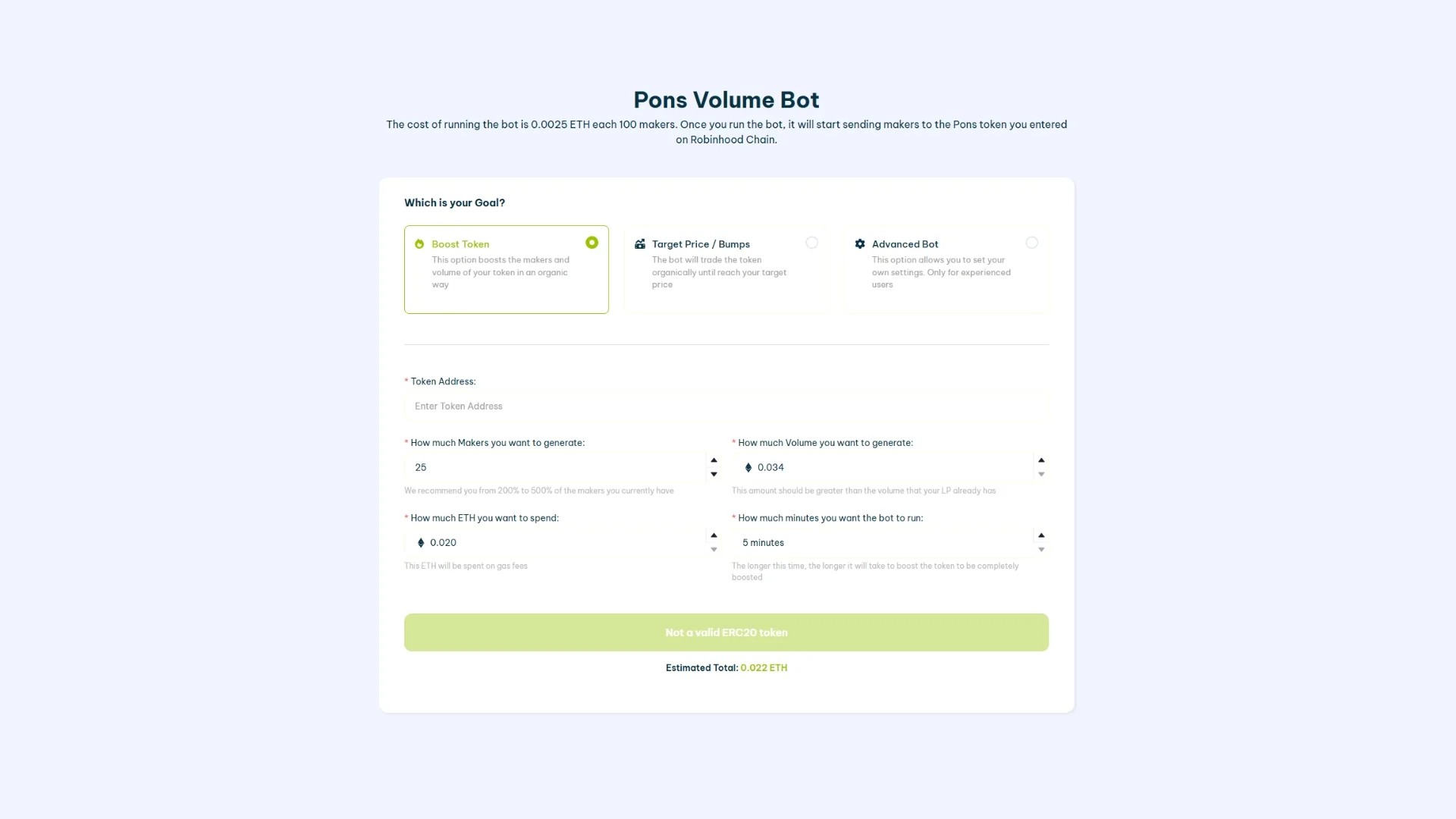
By using a volume bot, you’ll generate traffic that looks organic and you’ll be able to update your position on the token list, boosting your exposure and the odds that more people discover you. Clearly this is a strategy that needs to be paired with real traffic, so you also have to put effort into attracting genuinely interested people, whether through KOL campaigns, posts on Reddit/X/Telegram/Discord, or other channels, like running a airdrop on Robinhood.
It takes less than 5 minutes to set up and get running, and plenty of other devs are already using one to boost their exposure. Unless you have a massive user base because you built an unprecedented community, the volume bot is probably the most reliable tool for those first few hours after launch.
5. You have to be persistent, for a reasonable amount of time
Before you land a solid market cap, you’ll probably have to launch several dozen tokens. Trends die fast, so if you missed the window, it’s time to move on to the next one. Getting stuck on the same token that reaches no one and only stays alive through artificial methods will burn time and resources you could be spending on a fresh memecoin on Pons.
A good example was the FIFA World Cup. For a month, memecoins tied to the biggest sports event on the planet were everywhere, but there’s no point trying to push a token around it a month after it wrapped up. Simply put, the hype is gone and nobody cares about riding something that’s already over.
If the coin you launched isn’t sparking any interest at all, then it’s better to pivot to another theme and start thinking about the next one. The odds of volume coming back are basically zero (or at least, it’s really rare to see it happen).
What happens after you clear the Pons bonding curve
Once you graduate a token on the Pons Launcher, the liquidity pair moves to Uniswap and control over the liquidity is gone for good. The creator tax and the token’s price behavior stay in place, and anyone can keep buying from the Pons platform or directly on Uniswap.
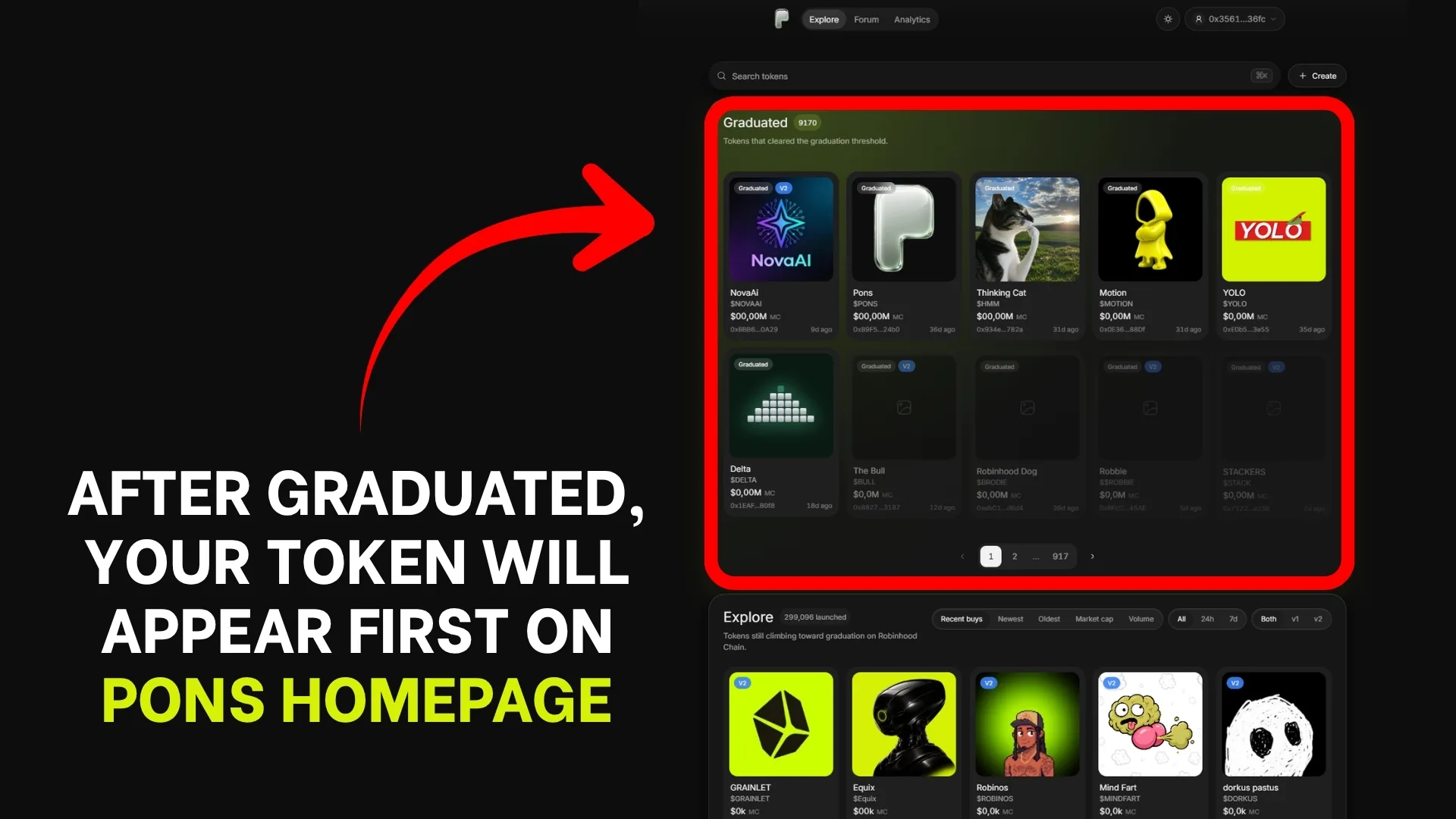
You’ll also show up as featured on the homepage, since you’re a freshly graduated token, which may drive even more interest than before.
If someone happens to buy an amount of tokens that exceeds what’s available in the bonding curve, the protocol automatically hands over the remaining tokens and refunds the rest of the ETH they were swapping.
After launch, I recommend using these bundlers to speed up the graduation process while spreading the token holdings across multiple wallets:
- Pons Bundle Buy: lets you run a coordinated buy from multiple wallets, all in the same transaction block.
- Pons Bundle Sell: same as the previous one, but for selling. Really useful if you want to exit the token when there’s no volume, or to fund your project through staggered sells.
If you’d rather run your own liquidity pool directly, we also have a guide to launching a liquidity pool on Uniswap.
FAQ
How many tokens can I graduate on Pons?
There’s no cap, not on how many tokens you can create nor on how many you can graduate. That said, graduating even one is a solid achievement; pulling it off with more than one would be a real feat.
How do I get my memecoin to Graduation on Pons Launcher?
To hit Graduation on your memecoin on the Pons Launcher on Robinhood Chain, all you need to do is clear the bonding curve. Right now that means gathering 4.2 ETH in funds so that the Pons protocol automatically moves the liquidity to Uniswap.
What happens if I don’t manage to graduate a token on Pons?
Nothing bad, the token will still exist on the Pons platform and will remain tradable. But you won’t be able to move the funds raised so far to any liquidity pool, and you can’t shift the funding to another project either.
If I have enough ETH, can I graduate my token on my own?
Yes, you can graduate a token by yourself and no one’s stopping you. The catch is that if you do it from your dev wallet, you’ll be the top holder, which is a red flag that discourages others from buying the token. Instead, the smart move is to use a bundler bot like the one from Smithii.
Do I get any direct reward for clearing the Pons bonding curve?
No, you won’t get a one-time reward for hitting the target to become a graduated token. What does happen is that you’ll show up as featured on the homepage, which could translate into better visibility and pull in potential buyers.
Can I pick another DEX instead of Uniswap to graduate my token?
No, the Pons protocol only allows graduation to Uniswap. That’s how it’ll stay for now and there don’t seem to be alternatives coming. What you can pick is the liquidity pair during the token’s creation.
Conclusion
With this guide on how to graduate a token on Pons Launcher you’ve got a whole toolkit to improve your memecoin’s chances of success. It’s not an absolute guarantee, but you’ll definitely be ahead of the vast majority of devs who just wing it.
With a bit of strategy, planning, and the right Smithii tools, you’ll be one step ahead of everyone else and can reach a much bigger audience.

Content creator and SEO contributor at Smithii. Systems Engineering student and crypto-tech enthusiast.