
How to remove liquidity on Hyperliquid without looking like you’re bailing
Pulling funds out of a pair is a routine management move, but on Hyperliquid there’s a nuance that flies under the radar on other networks: here, people actually read the explorer. A liquidity withdrawal gets seen, and it gets interpreted.
That doesn’t mean you shouldn’t do it. It means you should know how to remove liquidity on Hyperliquid properly: how much to pull out and what’s left behind once you exit.
I’ll walk you through the process, why a partial exit is almost always the smarter play, and what you need in place to execute it.
Pulling out everything vs. pulling out a bit isn’t the same, plus what you’ll need
The tool handles both, and the difference isn’t just about the amount.
A partial withdrawal is routine management. You trim exposure, take some capital back, or rebalance without breaking how the pair works. It goes unnoticed and nothing meaningful changes.
Draining the whole pair is a different story. It leaves the token with basically no market, any trade after that swings the price violently, and on a network where the average user can read a chart that gets flagged instantly as the worst-case scenario.
If your goal is to pull capital without tearing down the project, staged exits are almost always the answer. And if the pair was already thin to begin with, the problem started earlier: we cover it in how much liquidity a token actually needs.
All you need: the LP tokens
When you added to the pair, you got LP tokens back. They’re the receipt for your share, and they’re the only thing the tool checks.
So the withdrawal comes out of the wallet holding them, not the one that created the pool or the one that deployed the token. And if you burned them back then, that liquidity is locked forever, which is exactly the effect projects go for when they do it on purpose.
How to remove liquidity on Hyperliquid, step by step
The Liquidity Remover by Smithii for Hyperliquid burns the LP tokens you point it at and returns both assets from the HyperSwap pair in the same transaction. You can close the position entirely or pull whatever percentage you want, with shortcuts for 50% and max so you don’t have to run the math. Here’s the screen:
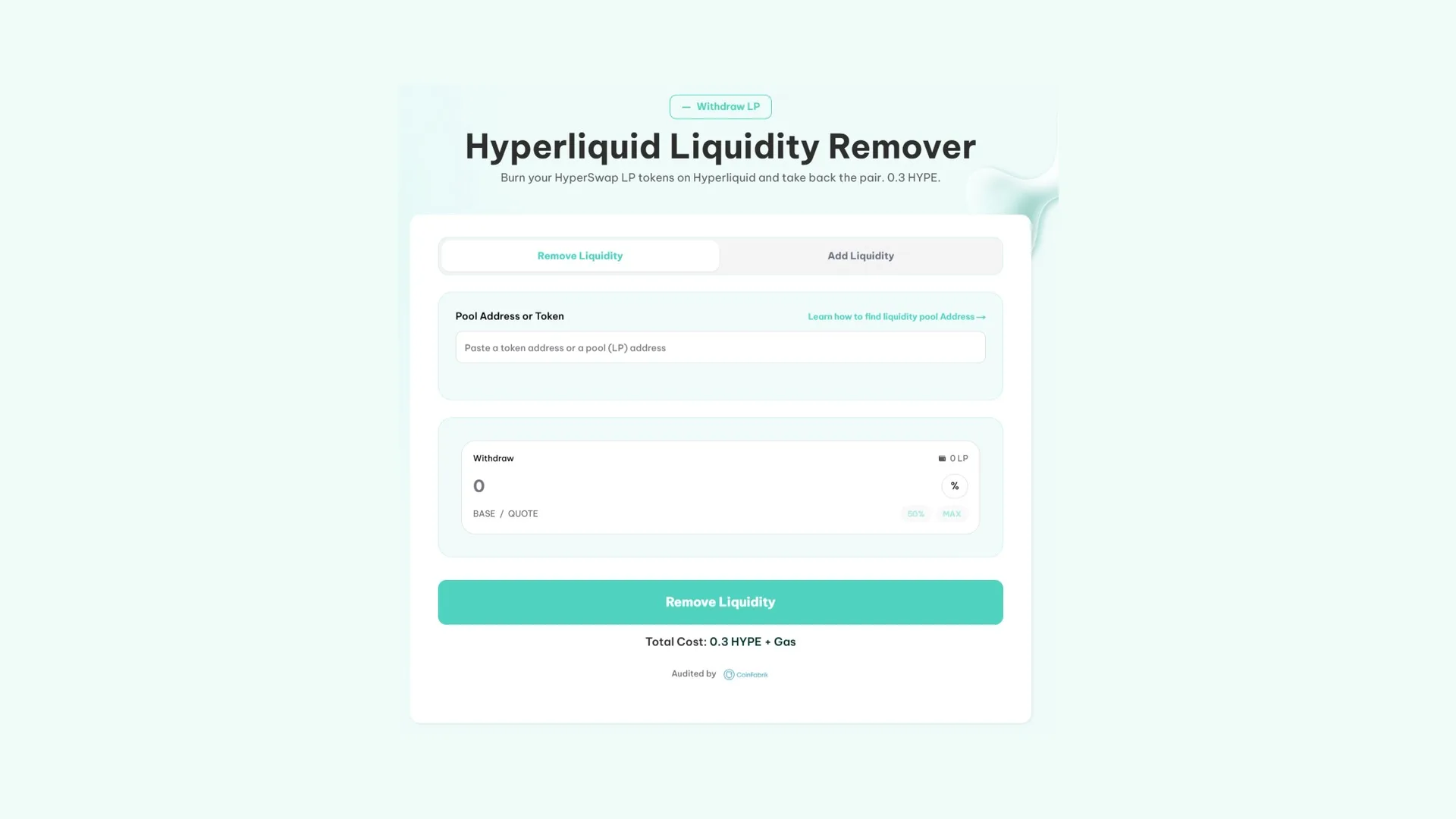
You need the wallet holding the LP tokens and the pair address, or the token address if you don’t have the pair noted down. From there:
- Connect with the wallet that holds the LP tokens.
- Enter the pair address. It’s a different contract from your token: the token is the asset, the pool is where it trades.
- Pick the fraction you’re pulling.
- Run it and sign. Both assets land in your wallet.
What the withdrawal costs on Hyperliquid
The transaction is 0.3 HYPE plus gas, regardless of how much you pull.
What you get back and what stays in the pair
Two effects worth knowing up front:
- The mix changes. You don’t get back the exact amounts you deposited, you get your share of the pair at its current split, which will have rebalanced with price action.
- Depth drops in proportion to what you take out. A pair that used to absorb buys smoothly can turn fragile in one move if you pull a big chunk.
That second effect is especially visible on this network, where users compare depth as a matter of course. A pair that goes thin after a big withdrawal is exactly the kind of signal we describe in why most tokens never go anywhere.
What to do after pulling the funds
- To get back in later, the reverse process is in how to add liquidity on Hyperliquid.
- If the pair is still alive but thinner, you’ll need to sustain its presence: the Hyperliquid volume bot.
- If you want to start a fresh pair, check how to create a liquidity pool on Hyperliquid.
FAQ
Do you have to pull everything out at once?
No, and usually you don’t want to. Just set the fraction you want back and the rest keeps adding depth to the pair.
How much does it cost to remove liquidity on Hyperliquid?
0.3 HYPE plus network gas, regardless of how much you withdraw.
Who can execute the withdrawal?
Only whoever holds the LP tokens for that pair in their wallet. It doesn’t matter who opened the pool: what matters is where those tokens sit right now.
Do I get back the same assets I put in?
You get the share that corresponds to the current ratio, not the original amounts. If price moved while you were in, the composition will have shifted.
Can I jump back in later?
Whenever you want. Removing liquidity doesn’t close any doors: you can deposit again into the same pair later, at whatever ratio it holds at that moment.
Wrapping up
Removing liquidity on Hyperliquid is technically trivial and strategically tricky. The tool doesn’t tell the difference between a tweak and a full teardown, but the market does.
Take out what you need, do it in chunks whenever possible, and leave the pair in shape to keep working if the project is still alive.

Content creator and SEO contributor at Smithii. Systems Engineering student and crypto-tech enthusiast.