
How to create a liquidity pool on Hyperliquid for your token
Plenty of people land on Hyperliquid assuming their freshly created token will show up on the network’s order book. It doesn’t work that way, and finding out late costs time.
The order book is for the markets the protocol lists. Your token lives on HyperEVM and needs something different: a pool that gives it a price and lets people buy it.
I’ll walk you through how they differ, how to create a liquidity pool on Hyperliquid, what to pair it with, and how much depth it needs to hold its own on a network full of traders.
Order book and pool aren’t the same thing, plus what to pair your token with
An order book has two human sides: someone places a sell order, someone else crosses it with a buy. Depth is built collectively by every participant.
A pool works the other way around. It’s a contract holding two assets and a formula that calculates the price based on the ratio between them. There’s no counterparty: whoever buys is buying from the deposit, and the price shifts depending on how much they pull out.
Neither model is superior; they solve different problems. If you’re curious about the mechanics, we compare them in depth in CLMM vs AMM.
The practical takeaway for you is this: your pair’s depth is on you. You don’t inherit it from the volume the network moves.
What to pair your token with on HyperEVM
Picking the other side isn’t a minor detail. It defines who finds it easy to buy from you:
- Against HYPE. It’s the natural route inside the ecosystem and connects you with anyone already holding a balance on the network. The trade-off: your token’s price ends up quoted in an asset that also moves.
- Against a stablecoin. Gives a direct read on value and makes life easier for anyone coming in from outside. Usually a better fit if your project isn’t purely speculative.
If you’re pairing against the network’s native coin, keep in mind that a pair needs two tokens and native HYPE isn’t one: you have to wrap it first. It’s explained in what WHYPE is and how to wrap your HYPE.
How to create a liquidity pool on Hyperliquid, step by step
The pool is spun up with the Smithii Liquidity Pool Creator for Hyperliquid, which deploys a HyperSwap V2 pair straight from your browser without touching the DEX interface. The first call you make is the counterparty: one tab pairs against HYPE, and the other lets you drop in any token on the network for that side. Here’s the screen:
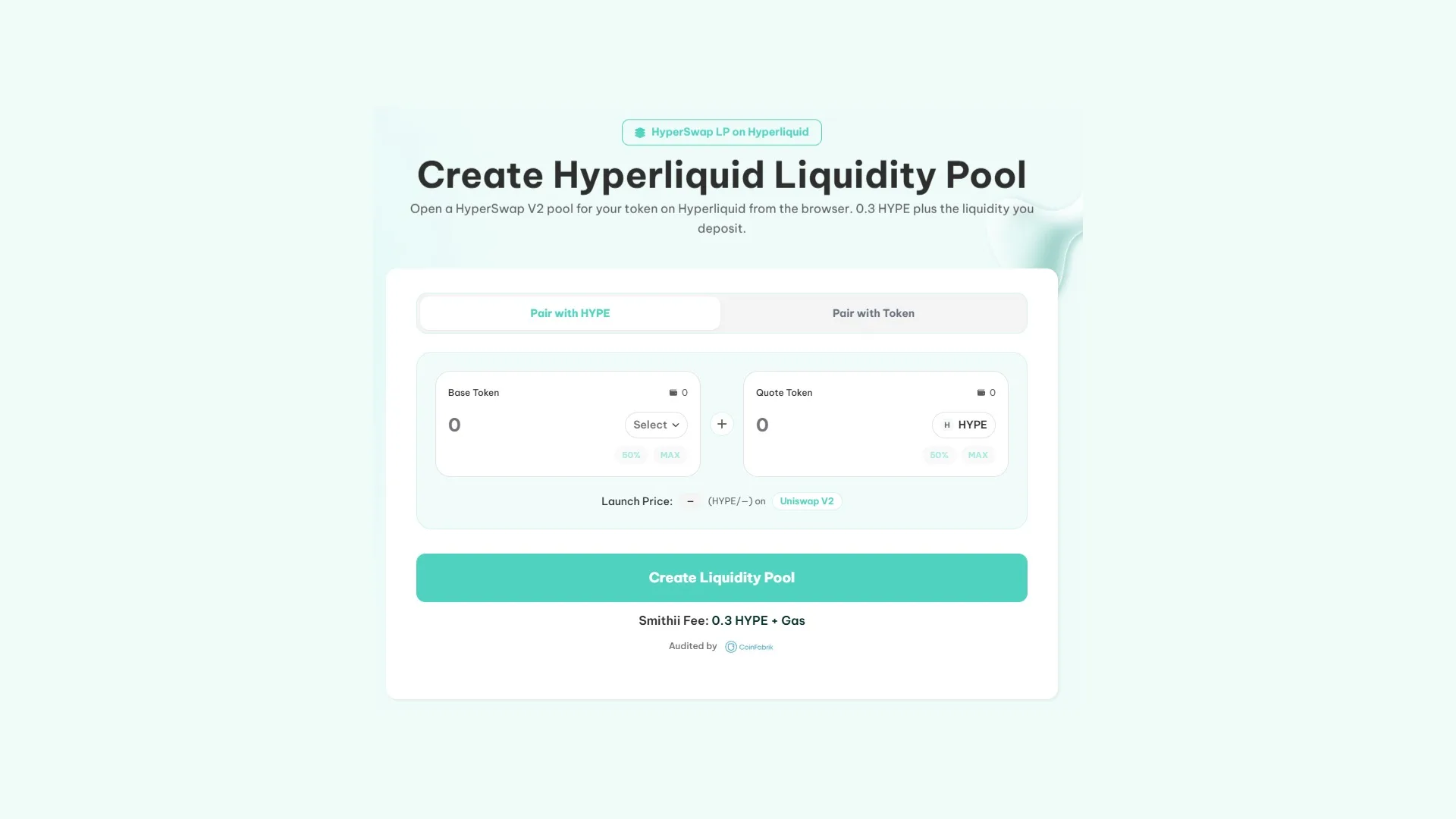
With your token’s contract identified and both assets of the pair available in your wallet, here’s the flow:
- Have both assets in your wallet before starting, in the amounts you plan to deposit.
- Select the reference asset, which is the side used to measure the price.
- Enter your token’s address to complete the pair.
- Set the amounts on each side. That ratio is the starting price, and the tool shows it to you before you sign.
- Confirm. The pair goes live and you receive the LP tokens that represent your position.
How much it costs to create the liquidity pool
The tool costs 0.3 HYPE plus gas. Liquidity is separate, and it’s worth not confusing it with an expense: those funds stay deposited and come back to you as buyers show up.
How much depth your pair needs here
This is the number people underestimate the most. Depth determines how much the price moves when someone buys, and on a network where the average user is used to markets with real backing, a shallow pair is spotted instantly.
The useful way to think about it isn’t how much money you have to spare, but what size of trade you want to be able to absorb without the chart falling apart. From there you work backwards to the figure.
A shallow pair turns any regular buy into a spike and any regular sell into a collapse, and that scares off exactly the profile you want. You’ve got the full calculation in how much liquidity you should add to your token.
The HYPE you deposit doesn’t disappear. It stays in the pool’s contract and comes back to you as volume comes in.
What to do after launching the market
- That you actually have holders, not just an empty pair: Hyperliquid’s multisender.
- That the pair shows activity, since aggregators rank by movement: Hyperliquid’s volume bot.
- That you know how your supply is distributed: Hyperliquid’s token snapshot.
- If you don’t have the contract yet, start one step earlier: how to create a token on Hyperliquid.
If you paired against HYPE, your HyperSwap V2 pair is the one scanners use to rule out that your token is a honeypot by simulating a buy and a sell.
FAQ
Can my token trade on Hyperliquid’s order book?
Not automatically. The order book covers the markets the protocol itself lists. A token you deploy on HyperEVM trades against a pool, same as on any EVM network.
How much does it cost to create the pool?
The tool costs 0.3 HYPE plus gas. The liquidity you add is separate and isn’t spent: it stays deposited in the pool contract.
Who sets the initial price of my token?
You do, and only once. The ratio between the two amounts you deposit when creating the pair sets the starting price. From there, the market takes over.
Which asset should I pair against?
HYPE plugs straight into the liquidity already flowing through the network. A stablecoin gives a price that’s easier to read for outsiders. It comes down to who you want to reach first.
Can I pull the liquidity out later?
Yes, by handing in the LP tokens you receive when creating the pair. Hold on to them: they’re the only proof of your stake in that pool.
Conclusion
Creating the pool is what turns your contract into a market. The process wraps up in a single signature, and the real call comes down to one thing: how much depth you launch with and which asset you pair against.
Nail that and the pair will behave predictably from the first trade. Get it wrong, and no strategy down the line will save a market that swings twenty percent on every buy.

Content creator and SEO contributor at Smithii. Systems Engineering student and crypto-tech enthusiast.