

How to generate volume for a token on Hyperliquid and escape the aggregator limbo
To break out of the dead zone almost every new token sits in, you need to know how to generate volume for a token on Hyperliquid. Aggregators and screeners rank what they show based on recent activity. No activity means no visibility, no visibility means nobody finds you, and if nobody finds you, there’s no activity.
The volume bot exists to force that first push. Here’s what it actually does, what it won’t do no matter what anyone tells you, and what you need to pair it with for it to matter.
What ‘volume’ really means to a screener and what a bot won’t do
When an aggregator decides which tokens to show, it ignores your narrative and your community. It looks at this:
- Traded volume over a period, meaning how much value has changed hands.
- The number of makers, meaning how many distinct addresses took part. High volume concentrated in two wallets is worth far less than the same volume spread across a hundred.
The bot works on those two numbers by generating trades from addresses it spins up on the fly. If you want the full breakdown of the general mechanics, independent of the network, we cover it in how a volume bot works in crypto.
What the volume bot can’t do
This kind of tool is perfect right after launching your own token on the network because it lets you generate activity that complements organic traffic.
A volume bot buys visibility, not demand. It puts you where people are looking and gives the project room to get known. What holds a price up is real people buying because they want the token, and no bot generates that.
On this network there’s an extra nuance worth keeping in mind: the typical Hyperliquid user can read a chart. An activity pattern with no fresh holders behind it gets spotted faster here than on fast-launch chains. All the more reason to use it as backup, not as a front.
How to generate volume for a token on Hyperliquid step by step
The bot is configured from the Smithii Volume Bot for Hyperliquid, which runs buys and sells on HyperSwap spread across several addresses. Before you touch any numbers, it asks for the goal: push the token, target a specific price, or switch to advanced mode and set every parameter yourself. When you enter you’ll see this screen:
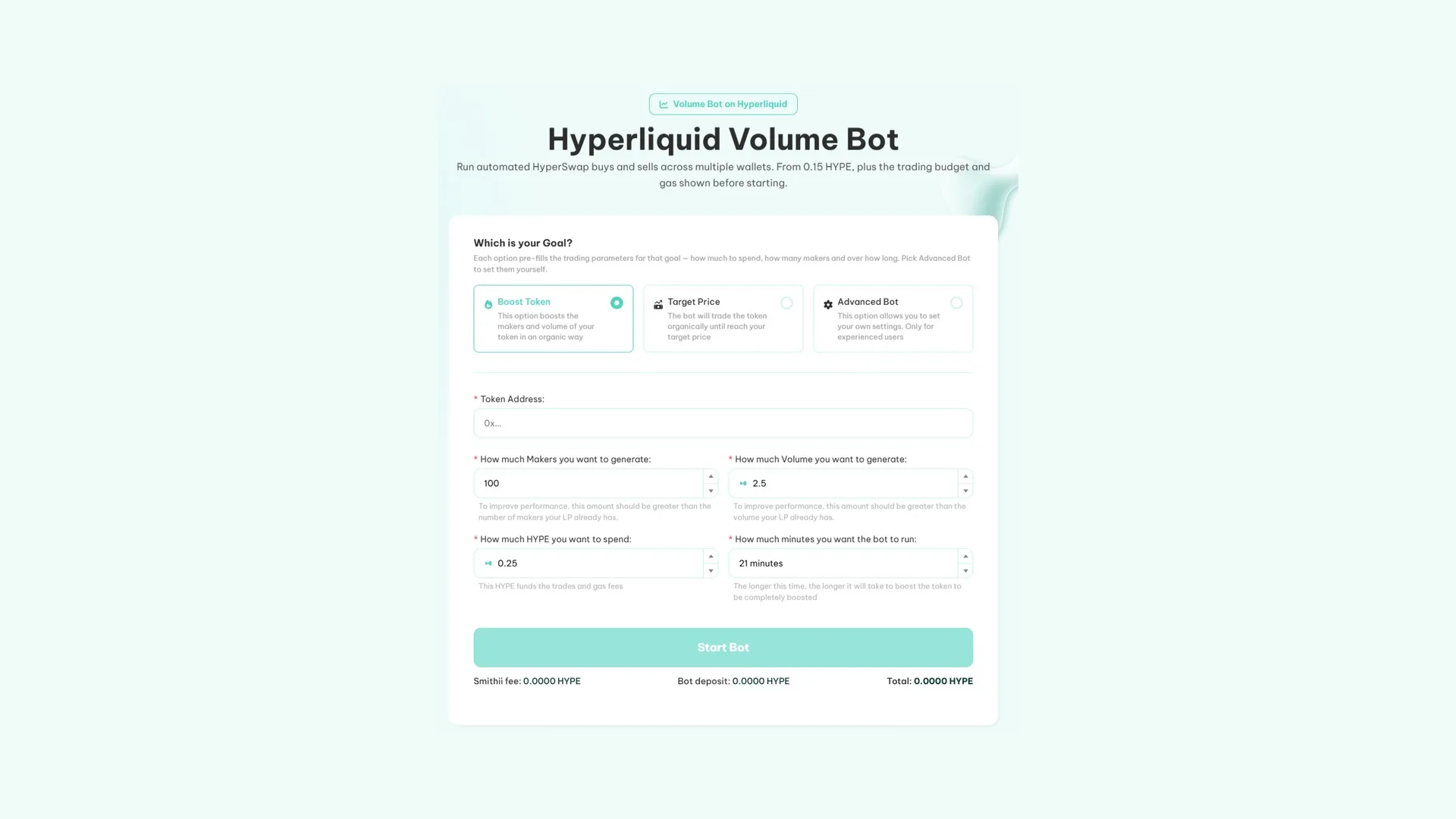
With the token address on hand and HYPE in the wallet for the fee, gas, and trading budget, launching it goes like this:
- Connect with your wallet, which needs HYPE for the tool, the gas, and the budget you plan to move.
- Set the pair by pasting the token address.
- Set the intensity: how many makers and how much volume you want to generate.
- Cap the cycle with a budget and a duration.
- Launch it and sign. From there it runs on its own.
When the cycle ends, any unused HYPE goes back to your wallet.
How much the volume bot on Hyperliquid costs
The fee starts at 0.15 HYPE per 100 makers, plus gas. It’s tied to the number of distinct addresses you request, so it scales as you crank up the intensity. The budget you move is a separate matter: it isn’t spent, it cycles between the bot’s addresses and the pool.
The sequence where the bot actually works
The bot pays off when it fits into a proper order. Outside of that, it’s wasted money:
- First of all, the market. Without an open pair with depth there’s nothing to trade against: how to create the liquidity pool on Hyperliquid.
- At the same time, real holders. Spreading the token across active addresses is what gives the activity substance: the Hyperliquid multisender.
- In parallel, distribution. The bot puts you on screen; getting someone to click is a different job, the one we cover in how to promote a meme coin.
- Then measure. A snapshot of holders will tell you whether the base is actually growing or just rotating.
The rule that sums it all up: the bot gets you eyeballs, the community gets you buyers. If you only have the first one, you’re paying for an empty storefront, which is pretty much why most tokens go nowhere.
FAQ
What’s the price of the volume bot on Hyperliquid?
It starts at 0.15 HYPE per 100 makers, plus gas, so the total depends on how many distinct addresses you want involved. The budget you decide to move is separate and isn’t a fee: it cycles between the bot’s wallets and the pool.
Does this pump the price of my token?
No, and anyone telling you otherwise is selling smoke. It trades in both directions to sustain activity. A price pushed up artificially snaps back the moment the bot stops.
Can I use it without having opened a pool?
No. The bot needs a market to trade against, so the pair has to exist and have enough depth for trades not to move the price around.
Is it legal to use a volume bot?
Generating volume on your own pair isn’t illegal in most jurisdictions and is a common practice in new projects. The issue kicks in when it’s used to fake traction with the intent to dump afterwards and leave buyers stuck.
What happens to the leftover HYPE?
It comes back to your wallet once the cycle closes. Nothing stays locked inside the tool.
Conclusion
The Hyperliquid volume bot solves one specific, narrow problem: making sure your pair actually shows up on the aggregators during the days you need it to.
Use it knowing what it buys you and what it doesn’t. With a solid pool, real distribution and marketing work behind it, it’s the piece that buys you time. Without any of that, it’s just a bill.

Content creator and SEO contributor at Smithii. Systems Engineering student and crypto-tech enthusiast.