How Do Meme Coin Creators Make Money? 3 Legal Ways and Real Numbers
How do meme coin creators make money when there is no product behind the coin? It’s a fair question, and a little skepticism is healthy: most of what you see on the charts is either a joke that mostly faded in a day. There is no reason why does it exist, it’s just a meme converted into a crypto token.
Still, some creators (“devs” is the used term on the ecosystem) earn real money legally, and they do it from a short list of sources.
In this post I break down where that money comes from, how much a launch can actually pay and where earning stops being legitimate. One thing up front: creating a meme coin is never a guaranteed profit. Let’s start with real numbers.
How much meme coin creators make: two launches we tracked
Before the theory, here are two results we shared on X. Both creators launched on Pump.fun with a Smithii bundle, which means they bought their own coin from several wallets in the same block it was created, before anyone else could.
The first one is $WYNX. The creator spread 42.5 SOL across 34 wallets in the launch block and took 180.4 SOL out, a realized profit of +138 SOL. The coin peaked at a $1.3M market cap, and the creator still held 2.7% of the supply when we posted it.
The second creator started much smaller: a bundle worth just 10.6 SOL that ended in +143 SOL of realized profit, a return of +1,355%.
Now the honest part. These two are winners, and we picked them because they are worth showing. More than 90% of meme coins never get far: they fade within hours, get abandoned or turn out to be scams. For every launch like these, hundreds never find enough buyers to pay back what their creator spent. Read these numbers as what is possible, not as what is normal.
Best part is that anyone could be that lucky meme coin. So let’s see how a meme coin can become profitable.
How do meme coin creators make money? The 3 legal ways
There are three legitimate sources of income, and most creators combine at least two of them. Which one matters most depends on how the coin was launched and who is behind it.
| Source | How it pays the creator | What it depends on |
|---|---|---|
| Creator fees | A percentage of every trade on the coin | Trading volume, day after day |
| Launch allocation | Selling the coins bought at launch | Buying early and the price going up |
| Team treasury | Selling team tokens as they unlock | A real project, a community and public tokenomics |
1. Creator fees on every trade of your meme coin
This is the cleanest source, because it doesn’t require selling anything. On launchpads like Pump.fun, a slice of every buy and every sell goes to the wallet that created the coin. Pump.fun calls them creator rewards and has paid them since May 2025.
The percentage changes with the coin’s phase. On the bonding curve, the creator gets 0.30% of each trade. Right after graduating to PumpSwap it jumps to 0.95%, and from there it steps down as the market cap grows, all the way to 0.05% for the largest coins. A graduated coin trading 500 SOL a day in the 0.95% tier pays its creator 4.75 SOL a day. Every tier, and how to collect them, is in our guide to Pump.fun creator fees.
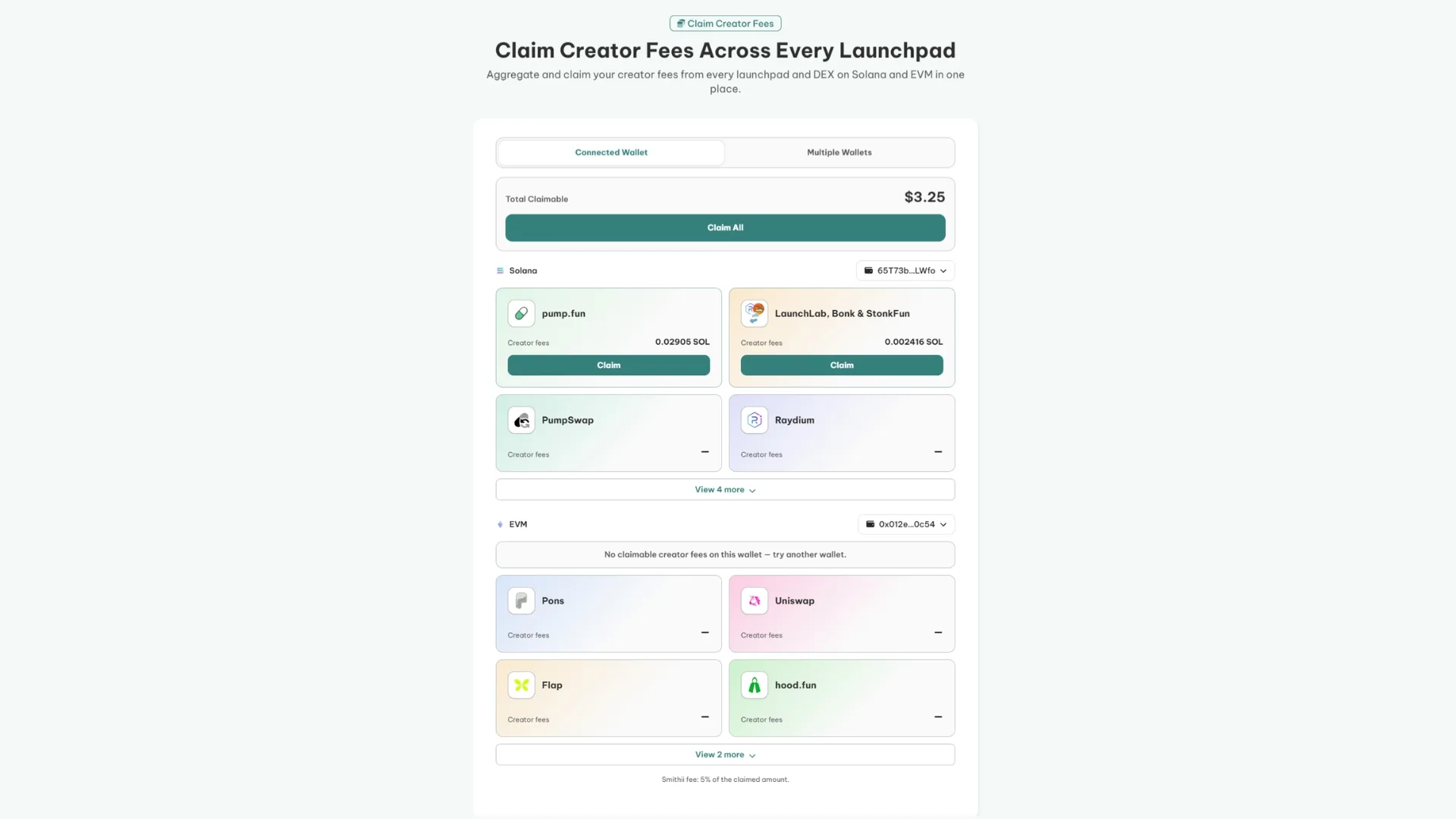
Here is the catch: fees only pay while people keep trading. A coin that moves 20 SOL of volume on the curve pays its creator 0.06 SOL, barely anything. Most coins never get past that point, so many creators launch coin after coin, hoping one of them catches real volume. It works like a lottery with a ticket price, and it explains why launchpads are flooded with new tokens every minute.
Because the best percentage starts right after graduation, a lot of creators focus on getting there. If you want to see what that milestone involves, this is how to graduate a Pump.fun token.
Other launchpads pay creators too, under their own rules. Clanker, on Base, sends 40% of its 1% swap fee to the creator, which works out to 0.4% of the volume. Several Solana launchpads also share part of their trading fee, although not all of them publish a fixed percentage.
2. Selling the launch allocation (dev buy and bundle)
This is how the two creators above made their money. When you create a coin, you can buy part of the supply in the same transaction, before anyone else. On Pump.fun that first purchase is called the dev buy. With a bundler, it is split across several of your own wallets in the launch block, so the opening buys come from you and not from sniper bots.
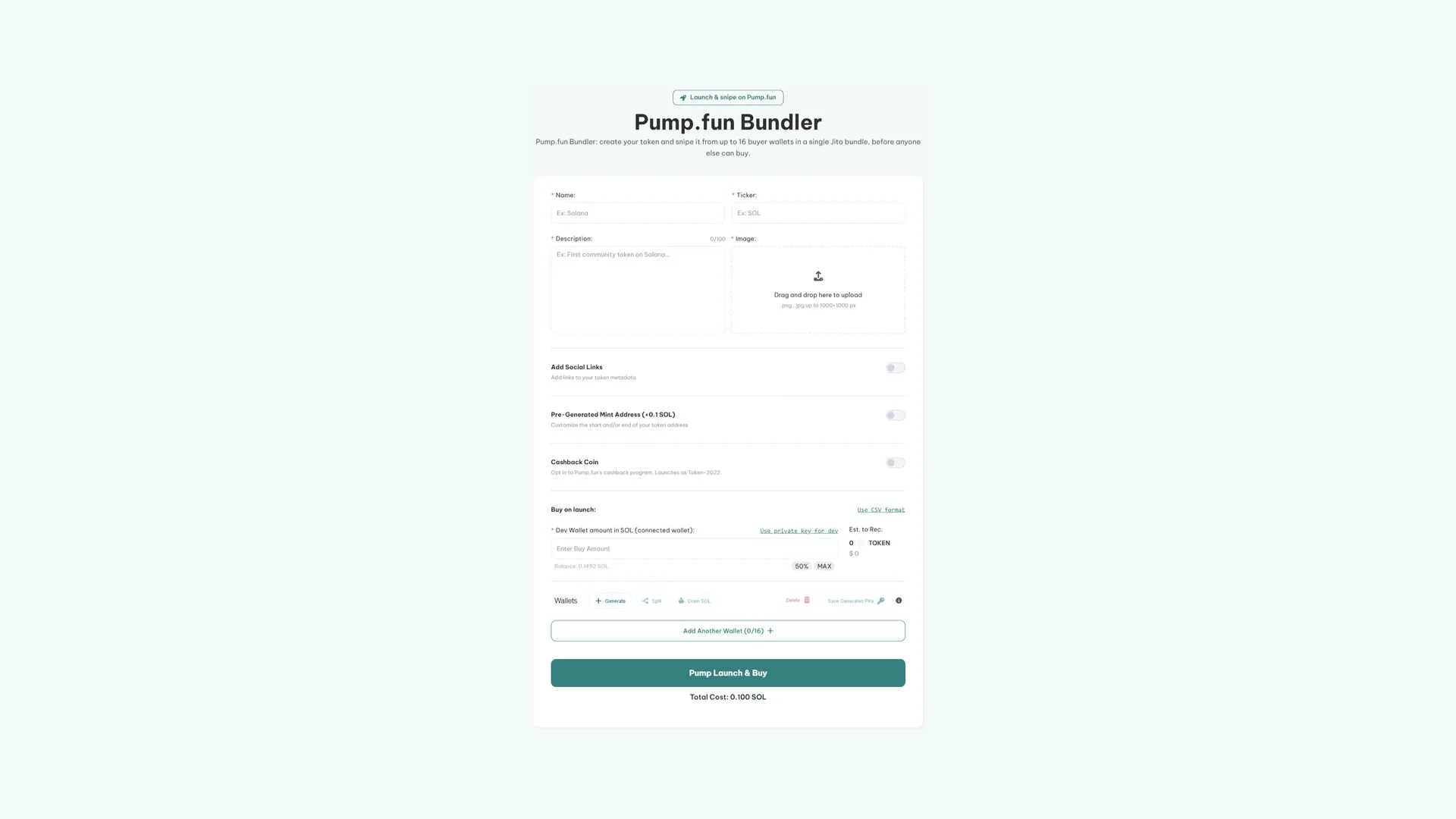
If the coin attracts buyers, its price climbs along the bonding curve and those early coins are worth more. Selling part of them is how the creator turns the rise into profit, the way the $WYNX creator went from 42.5 SOL to 180.4 SOL.
This is also where trust is won or lost. Anyone can look up the creator’s wallets on an explorer, and dumping everything at once crashes the price on the people who just bought. The market calls that a soft rug. Creators who want the coin to last sell gradually and keep part of the supply, like the 2.7% the $WYNX creator still held.
Almost all of this activity happens on Solana, the most popular network for meme coin creators, thanks to fees of a fraction of a cent and the widest choice of launchpads. If you want to see the full process there, here is how to create a meme coin on Solana.
3. Team treasury and vested token unlocks
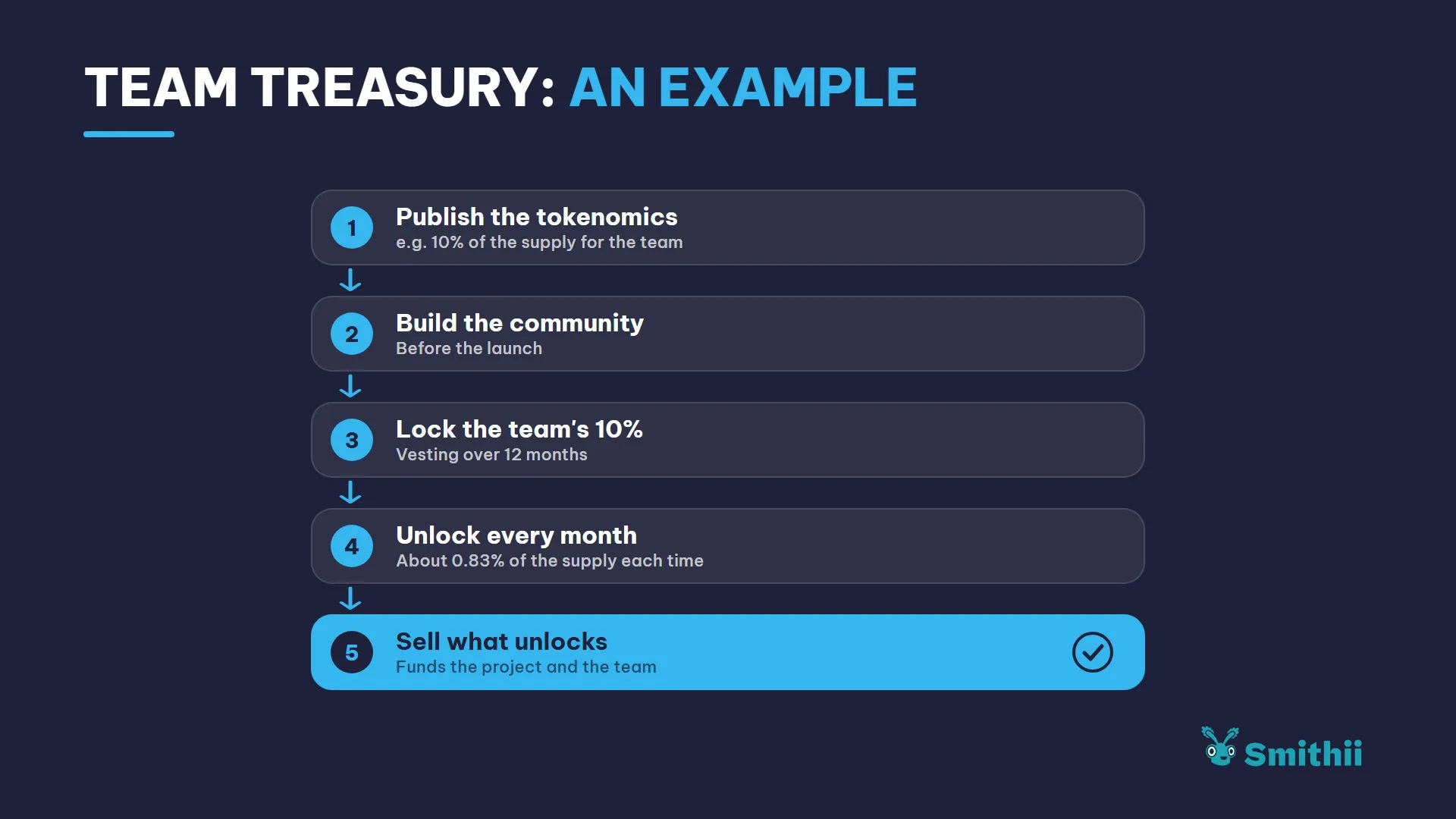
When a meme coin is a serious project with a team behind it, the income usually comes from a planned share of the supply. Before launch, the team publishes its tokenomics: how much goes to liquidity, to the community, to marketing and to the team itself.
The team’s tokens are locked with vesting and released in portions, every month or every quarter. The team sells what unlocks to fund the project and pay itself, and buyers can verify on-chain that nobody is able to dump the whole allocation on day one. Our guide to design tokenomics covers how to split the supply, and this one explains how to lock Solana tokens with vesting.
This model is common when the coin is launched by an organization, an influencer or anyone with an audience, because it needs a community built before the launch. Without one, a vesting schedule protects nobody: there is simply no one there to buy the unlocked tokens.
The rare exception: when a meme coin gains real utility
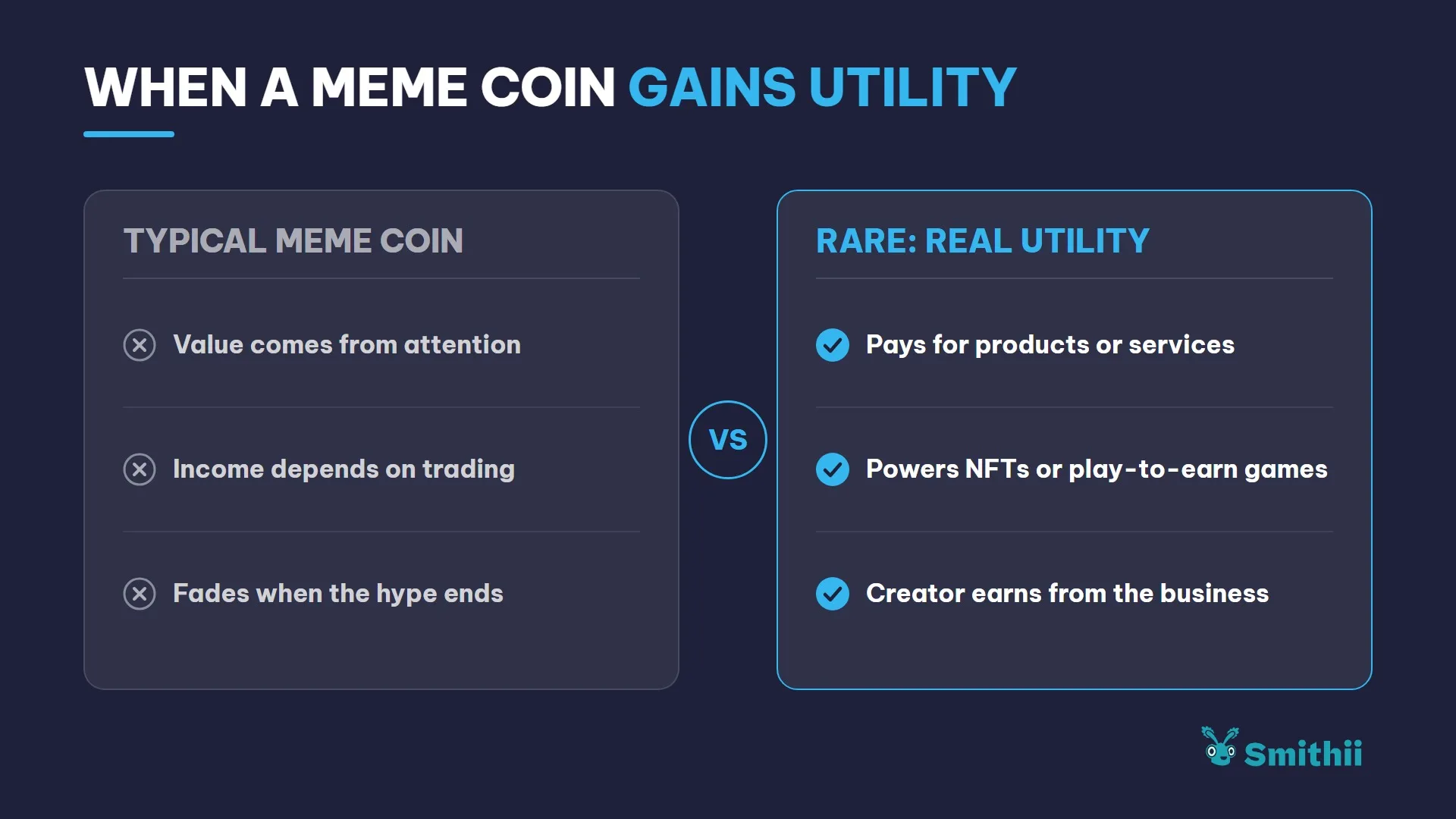
In very specific cases, a meme coin outgrows the joke. Its community starts using it as a currency to pay for products or services, or the project builds entertainment around it, such as NFT collections or play-to-earn games where the coin is what players earn and spend. At that point, the creator can earn from that business and not only from the token.
Be clear about what this is: a unique fork in the life of one project, not the typical path. Building utility takes a team, years of work and a community that stays after the hype is gone. Nobody should launch a meme coin expecting it to become one of these.
Are meme coins a scam? Where earning stops being legal
The skepticism comes from somewhere: many meme coins are scams. What separates a legitimate creator from a scammer is not how much money they make, but how they make it. These are the patterns that cross the line:
- Rug pull: the creator removes the liquidity from the pool, so holders can no longer sell.
- Hidden supply: the creator controls a large share of the coins through wallets presented as independent buyers, fakes demand and then sells into it. Spreading your launch buys across your own wallets is not a scam in itself; hiding it to deceive buyers is.
- Pump and dump: a coordinated campaign with false promises of returns, followed by selling to the buyers it attracted.
- Honeypot: a contract written so people can buy but never sell. You can use a rug check to avoid this scam method before buy a meme coin.
The three legitimate sources work in the open. Creator fees are part of the launchpad’s public rules, launch buys are visible on-chain, and vested team tokens follow a schedule anyone can check. What counts as fraud also depends on where you live, so before launching it’s worth checking is it legal to create a meme coin in your country.
Can you make money creating a meme coin? What decides it
You can, but nothing guarantees it. Creating a meme coin doesn’t mean making money, and as we said, more than 90% of them never get far. The ones that do pay their creators tend to have three things in common:
- Trust. It is the main challenge for any creator: someone has to believe in your coin enough to put money into it. Revoked authorities, locked liquidity, a small dev wallet and a creator who doesn’t disappear after launch are the first things buyers check.
- Attention. Volume comes from people, and people come from promotion: memes, X, Telegram and small creators in your niche. Our guide to promote a meme coin covers that playbook.
- Timing and budget. The meme has to be trending when you launch, and every launch costs SOL in fees, first buys and promotion. That is money you can lose if the coin doesn’t catch on.
If you still want to try after all this, learn the basics first with our guide on how to make a meme coin, and only use money you can afford to lose. Nothing in this post is financial advice.
FAQ
How do meme coins make money?
A meme coin doesn’t make money by itself, because there is no product behind it. Its price rises when more people want to buy it than to sell it. The creator earns from that activity through creator fees on every trade, by selling the coins bought at launch or from vested team tokens.
Is creating a meme coin profitable?
Rarely. Most meme coins never reach enough volume to pay back what their creator spent on the launch. A few, like the two examples in this post, return many times the initial amount, but it is never guaranteed and this is not financial advice.
Do meme coin creators get paid when people buy their coin?
On launchpads with creator fees, yes: a percentage of every buy and sell goes to the creator’s wallet. On Pump.fun it is 0.30% while the coin is on the bonding curve, and between 0.95% and 0.05% after graduation, depending on the market cap.
Why do creators launch so many meme coins?
Because most coins get no volume, and creator fees only pay when people trade. Launching often is a way to find the one coin that catches attention. The side effect is that launchpads fill up with tokens nobody buys.
Is it a scam if the creator sells their tokens?
Not by itself. Selling the coins bought at launch or vested team tokens is a normal way to earn. It becomes a problem when the creator hides how much of the supply they control, lies about the project or dumps everything on buyers at once.
Conclusion
Now you know how meme coin creators make money legally: creator fees on every trade, selling what they bought at launch and vested team tokens when there is a real project behind the coin. In rare cases, utility opens a fourth door.
None of them works unless people trust the coin enough to buy it, and most coins never get there. If you decide to launch anyway, do it in the open and with tools you can verify.
That is where Smithii Tools can help: the toolsuite has been running since 2023, its smart contracts have been audited by Halborn and CoinFabrik, and thousands of projects have used it to create, launch and manage their tokens.

Content creator and SEO contributor at Smithii. Systems Engineering student and crypto-tech enthusiast.