
How to add liquidity on Monad so your pair can absorb the buys
There’s one telltale sign a pair is running thin: someone places a perfectly normal buy and the chart jumps thirty percent. Then someone else sells and it drops just as fast. The project looks unstable even when it isn’t.
The fix is knowing how to add liquidity on Monad in the pool you already have open. Nothing needs rebuilding: you deposit more on both sides at the current price and the depth goes up without the price noticing.
Let’s go over what actually changes, when it’s time to do it, the process, and how to work out the number.
What happens in the pair when you deposit more
A pair’s depth is what determines how much the price moves on each trade. When there’s little deposited, any normal move gets amplified.
And that’s exactly the filter anyone thinking of coming in with serious money applies: they check how much their own buy will move the price before pulling the trigger.
- The price stays the same, because you enter from both sides at the current ratio.
- The next trade weighs less on the chart, which is the whole point.
- You receive LP tokens for what you added, and they’re your claim to get it back.
- Your share of the pair grows, and with it your cut of the fees.
When it makes sense to reinforce your liquidity pair on Monad
- The launch came in tight and the project can now afford to reinforce the pair.
- The token pumped and the initial liquidity is now too small for its current size.
- There was a prior withdrawal and you want to bring the pair back to where it was.
- A campaign or a listing is coming and you don’t want the first wave to knock the price off balance.
On how much to deposit, the useful criterion isn’t how much you have to spare but what size of buy you want to be able to absorb without hiccups. It’s covered in how much liquidity you should add to your token.
How to add liquidity on Monad, step by step
The deposit is made with the Smithii Liquidity Adder for Monad, which works on Uniswap V2 pools and calculates the ratio for you: type in one of the two amounts and the tool fills in the other at the current ratio, so you don’t have to do the math. The LP tokens that confirm the deposit land in your wallet. This is the screen:
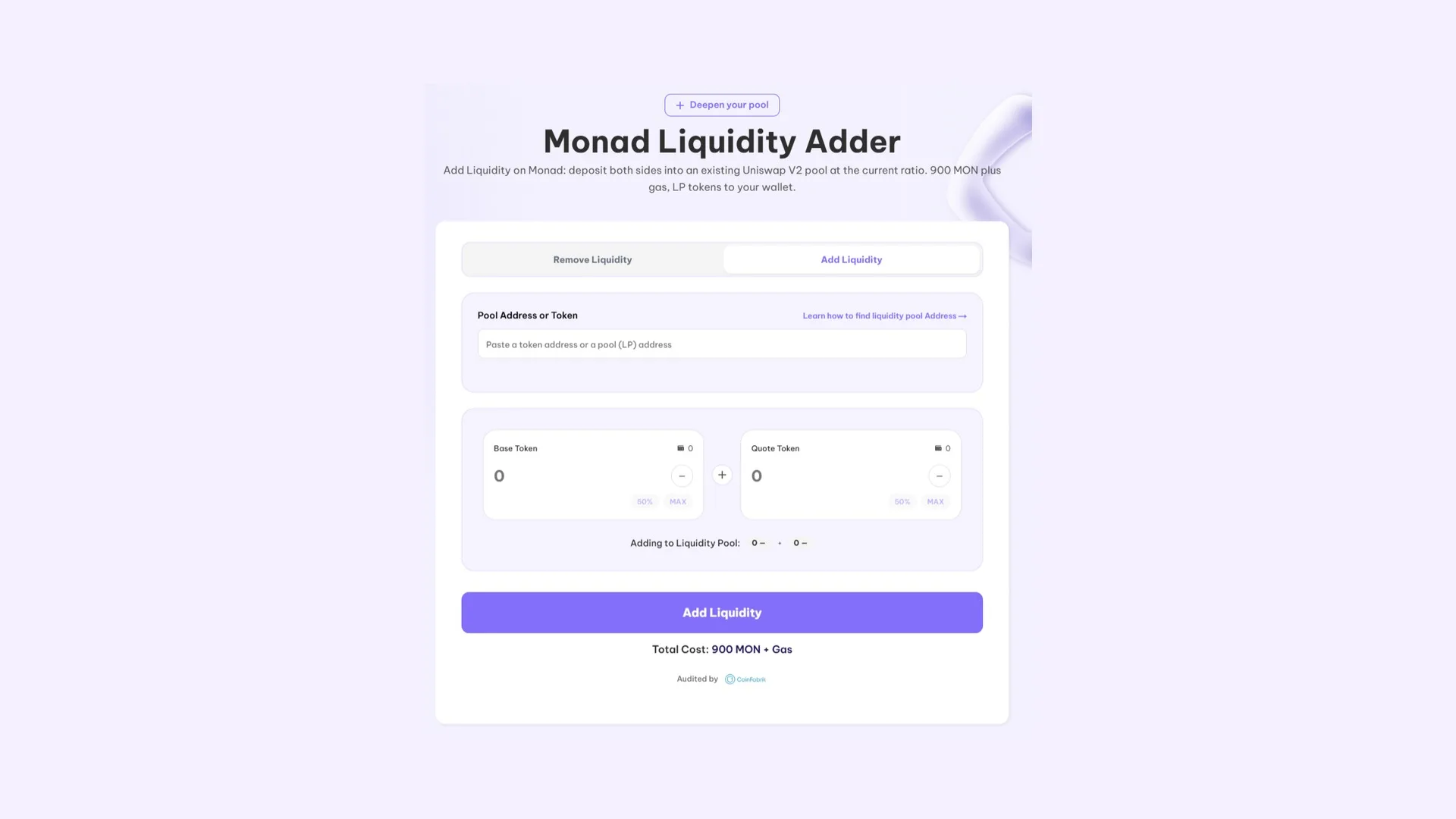
With the pool address or the token address on hand and both assets available in the wallet, here’s the flow:
- Connect your wallet with both assets of the pair ready.
- Point to the pool using its address or the token address.
- Type in one of the two amounts. The other fills in automatically at the current ratio.
- Sign the deposit and collect your LP tokens.
How much it costs to add liquidity on Monad
The fee is 900 MON plus gas. And two things that get mixed up need to be kept apart: that’s what the operation costs, not what you’re contributing. The funds you deposit are still yours inside the pair and come back as volume rolls in.
One technical detail worth sorting first: if the pair has the network’s native coin on one of its sides, keep in mind that a pair is formed by two tokens and native MON isn’t one. You have to convert it, which we cover in what WMON is and how to convert your MON.
What you’re signing up for when you add to a pool on Monad
Supplying liquidity isn’t the same as a fixed-interest deposit. While your funds sit in the pair they’re tied to how the two assets move relative to each other: if one breaks away from the other, the position rebalances itself and you’ll exit with a different mix than you came in with.
The upside is that you earn a slice of the fees the pair generates. For a project reinforcing its own market the calculation is different than for an outside investor, because the goal is to hold up the token, not to chase yield. If you want the mechanics in detail, we break them down in the guide on supplying liquidity.
Which tools this operation pairs well with
- If the pair doesn’t exist yet, the prior step is creating the liquidity pool on Monad.
- If you need the capital back later, the reverse move is covered in how to remove liquidity on Monad.
- If the pair has depth but no activity, depth alone won’t pull anyone in: the volume bot on Monad.
FAQ
Does depositing push the price up or down?
Neither. The contribution goes in on both sides at the current ratio, so the balance between the assets stays intact. What changes is that later trades move the chart less.
Do I need both assets?
Yes. A deposit is always made up of both sides. If you only hold one, you’ll need to convert a portion before adding.
How much does adding liquidity on Monad cost?
900 MON plus gas. That’s the tool’s fee; the funds you contribute aren’t spent, they stay inside the pair.
Can I contribute to someone else’s pool?
Yes. Any pair accepts contributions from anyone, and in return you get LP tokens for the share you add.
How do I get my contribution back?
By handing in the LP tokens you receive when depositing. Keep them safe: they’re the only claim to those funds.
Conclusion
Adding liquidity on Monad fixes a pair that fell short without touching any other piece of the project: the price doesn’t budge and depth goes up.
Base the number on the trade size you want to support, not on whatever you have left over that day, and the pair will start behaving the way you expected from the very next buy.

Content creator and SEO contributor at Smithii. Systems Engineering student and crypto-tech enthusiast.