
How to create a liquidity pool on Monad and give your token a price
A freshly deployed token can be transferred, distributed, and held. The one thing it can’t do is be bought, and that’s what a liquidity pool fixes. Here’s how to create a liquidity pool on Monad and which decisions will weigh on you afterward.
The process only takes a few minutes. The amount you decide to deposit, on the other hand, will shape how your chart behaves for a long time, and no amount of marketing will fix it later.
Here’s how the mechanism works, how to pick the reference asset, the procedure, and a sensible way to figure out how much liquidity you actually need.
How to price a token on Monad
A pool is a contract that holds two assets and applies a formula to swap between them. There are no orders, no counterparty: whoever buys is buying from the deposit, and the price comes from the ratio between the two sides at any given moment.
When you create the pair you deposit both tokens at once (Quote Token and Base Token), and that ratio locks in the starting point. It’s literally the only time the price is your call and not the market’s, so it’s worth doing the math instead of picking a round number.
In return you get LP tokens, which represent your share. If you want to understand the different pool architectures out there, we break it down in CLMM vs AMM.
What to put on the other side of the pair
- MON, if you want to connect with people already active on the network. The native token is the natural choice inside the ecosystem.
- A stablecoin or another token ERC20, if you’d rather have your token’s price read directly without having to translate it in your head.
A technical detail that trips a lot of people up: a pair is made of two tokens, and native MON is not one. If you’re going to pair with the network’s coin, you need to wrap it first, which we cover in what WMON is and how to wrap your MON.
How to create a liquidity pool on Monad, step by step
With the Liquidity Pool Creator by Smithii for Monad you can launch a liquidity pool in just a few steps. In doing so you’ll be creating a liquidity pool on Uniswap V2. Once you’re in the tool interface, here’s what you’ll see:
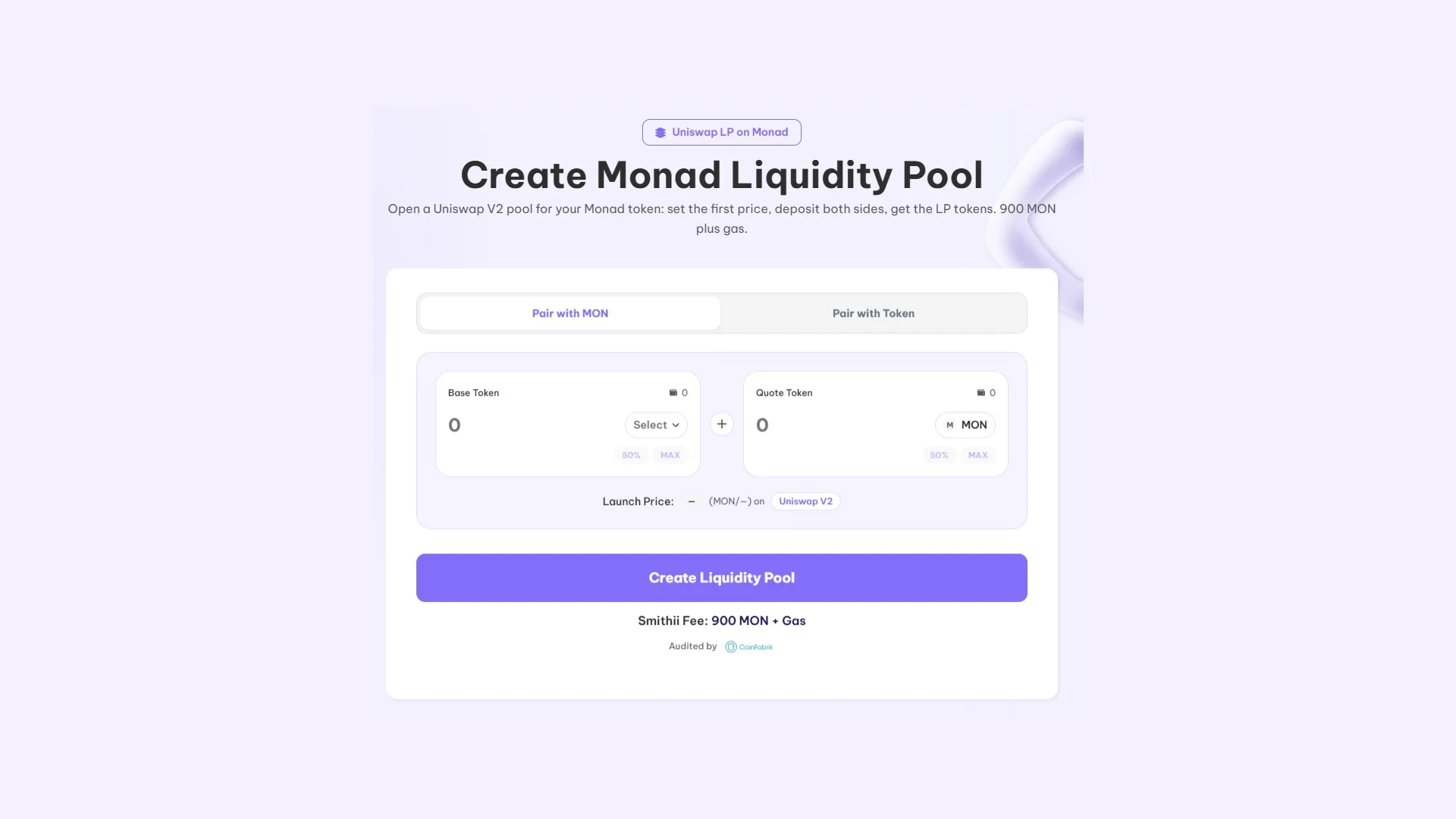
If you already have your own Monad token and enough MON to open the pool, do this:
- Connect the wallet that holds both tokens. It can be any of them (the wallet dev token or a different one, as long as it has enough tokens).
- Set the reference asset, the side against which the price will be measured. Base Token is the main one and Quote Token is the one that will give it a value.
- Split the amounts. The tool shows you the starting price that comes out of that ratio before you sign.
- Hit ‘Create Liquidity Pool’, sign the transaction, and you’ll automatically receive the LP tokens with the liquidity pool already live.
How much it costs to create the pool
The tool costs 900 MON plus gas. Liquidity is a separate concept and shouldn’t be counted as an expense: it stays inside the contract and comes back to you as buyers come in.
How much liquidity a new liquidity pool on Monad should have
The useful way to think about it isn’t how much you can afford, but what size buy you want your pool to absorb without sending the price flying. With that figure in mind, the depth you need pretty much works itself out.
A thin pool makes a normal buy look like a pump and a normal sell look like a rug pull. It’s the first thing anyone considering putting real money in checks, even before your narrative or your socials.
You’ve got the full reasoning, with tiers based on project size, in how much liquidity you should add to your token. And if you’re wondering why so many projects fall by the wayside, insufficient liquidity shows up in almost every diagnosis of why 90% of tokens don’t make money.
Pairing into a pool isn’t spending. The funds are still yours inside the contract and come back as volume rolls in.
What to do after creating a liquidity pool on Monad
Now that your token is tradable, there are plenty of other things you can do to boost your chances of standing out on the blockchain. Here’s what I’d recommend:
- Get holders from day one: use the Monad multisender to attract potential collaborators or to set up a rewards system with a mass send.
- Keep the pair active so it stays visible: run the Monad volume bot to boost organic traffic to your token by putting it back on screener and platform lists.
- Track holder growth: the Monad token snapshot lets you see wallet rotation, new holders coming in, or a drop compared to before.
Since you hold the LP Tokens, you can also pull the liquidity at any time if you want to start over, if there aren’t enough traders, or if you’re setting up a stronger liquidity backing.
FAQ
What exactly does a liquidity pool do?
It’s what lets people buy and sell a token. It holds two assets and calculates the price from the ratio between them, so there’s always a counterparty available.
What launch price will my token have?
Whatever comes out of the two amounts you deposit when creating the pair. That initial ratio is yours to set, and from the first swap onward the market takes over.
How much does it cost to create the pool on Monad?
The tool costs 900 MON plus gas. The liquidity you add sits separately and isn’t consumed: it stays locked inside the pool contract.
What are LP tokens?
They’re the receipt for your share of the pool. You get them when you deposit, and you’ll need to hand them back the day you want to withdraw your funds, so keep them safe.
Can I reinforce the pair later on?
Yes. Adding funds at the current ratio deepens the pool without moving the price, which is the standard way to fix a pair that’s gotten too thin.
Conclusion
Creating a liquidity pool on Monad is the exact moment your token stops being a contract and becomes a market. The process is short and the only real call is the depth you launch with.
Size it based on the trade volume you want the pair to handle and you’ll end up with a pair that behaves the way you expect from the first buy.

Content creator and SEO contributor at Smithii. Systems Engineering student and crypto-tech enthusiast.