
WMON: what it is and how it differs from the MON in your wallet
One day you open your Monad wallet and see two balances worth the same but with different names: MON and WMON. The gut reaction is to suspect one of them is some weird token that sneaked in.
It isn’t. WMON is your own MON expressed as a token, and it exists because parts of the ecosystem can’t work with the network’s native coin as-is.
Let’s break down what each one represents, where you can use the first, where you need the second, and how to switch between them in two clicks.
What WMON is and how it differs from MON
Monad has its own coin, MON, which powers the network and settles fees. Sitting on top are the smart contracts, and those handle tokens that follow the ERC-20 standard: pieces with a fixed set of functions any protocol can call without knowing the token upfront.
MON isn’t one of those pieces. It lives at the lower layer, the protocol layer, which is why a contract built for tokens has no way to interact with it directly.
WMON fills that gap in the most literal way possible: a contract takes your MON, holds it, and issues the same amount back as a token. That token already meets the standard, so the rest of the ecosystem treats it like any other. And since the original MON stays locked in, every WMON is backed 1:1 at all times.
What you can do with MON vs. WMON
Side by side, the dividing line is easy to spot:
| Action | Native MON | WMON |
|---|---|---|
| Pay network gas | Yes | No |
| Send to another wallet | Yes | Yes |
| Be part of a pair in a pool | No | Yes |
| Split via a multisender | No | Yes |
| Approve to a contract | No | Yes |
The rule of thumb is simple: anything that runs through a smart contract needs WMON; anything that’s just moving balance between people works with MON.
How to convert MON into WMON step by step
The conversion happens from the Monad Wrapper by Smithii, which wraps and unwraps on the same screen: the selector in the middle flips the direction of the operation, so the same interface works for going from MON to WMON and for the reverse trip. It all resolves in a single transaction. When you open it, you’ll see this:
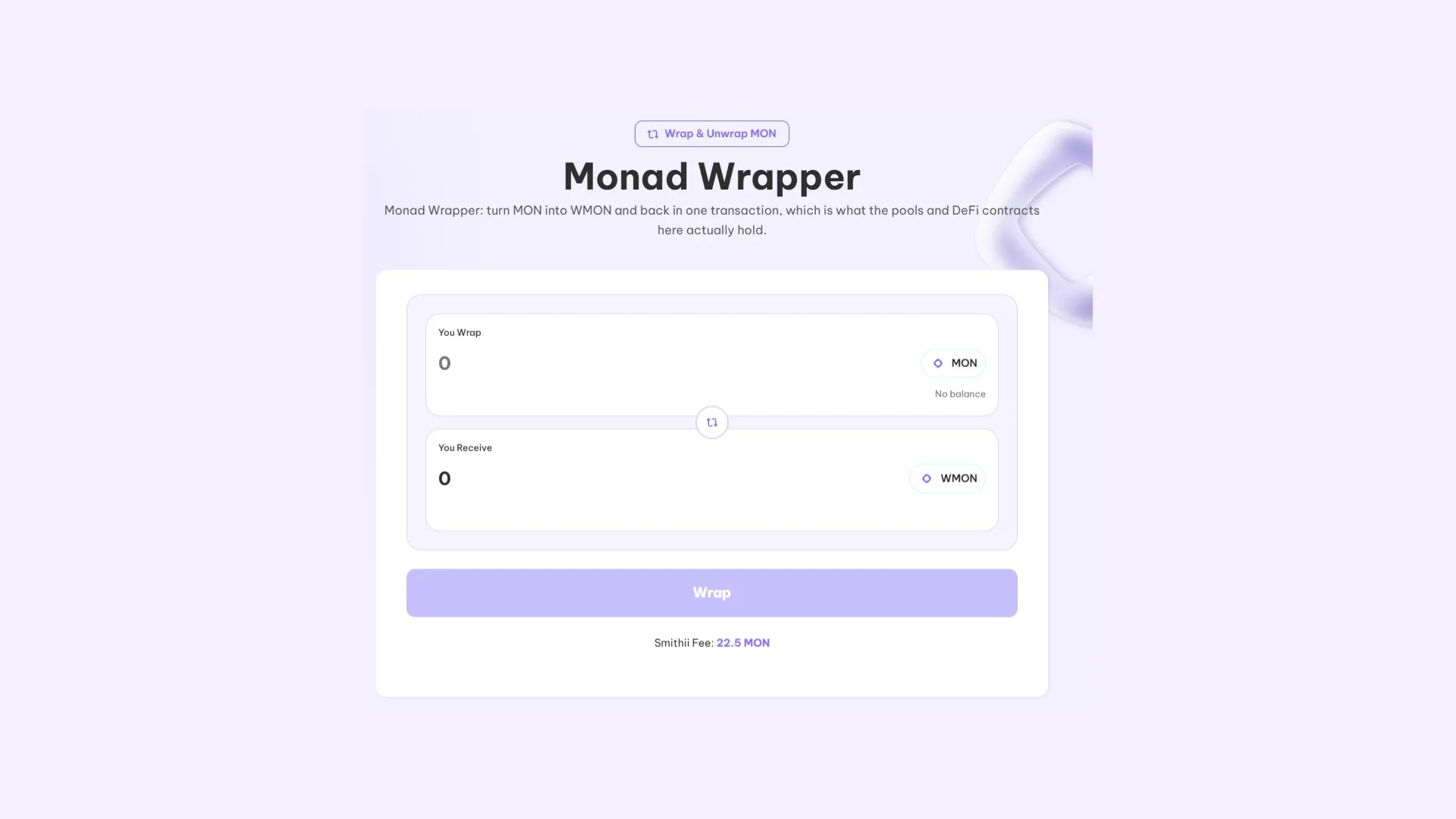
With MON in your wallet and some set aside for gas, the conversion goes like this:
- Open and connect the wallet that holds your balance. Any EVM wallet set up for Monad works.
- Pick the direction. MON to WMON when you’re about to use a protocol, or WMON to MON when you want the native coin back.
- Enter the amount. Always leave some unconverted, for the reason you’ll see right below the fees table.
- Approve in your wallet and the equivalent balance shows up instantly, no extra confirmations needed.
How much the Monad Wrapper costs
The tool costs 22.5 MON plus network gas, and it’s the same in both directions. Since gas on Monad barely adds up, that flat number is basically everything you pay.
Worth keeping in mind when you plan: if you expect to hop in and out of several protocols, it’s cheaper to convert one amount that covers multiple operations than to do separate conversions each time.
Leave some MON unconverted for fees. Monad gas is paid in native MON, never in WMON, so a wallet with its entire balance converted can’t sign the operation that would reverse it.
When you don’t need to convert anything
Worth pointing out because it saves money: there are plenty of things WMON adds nothing to.
- Sending MON to someone. A wallet-to-wallet transfer works with the native coin, no middleman needed.
- Receiving payments or holding a balance. While MON just sits in your wallet, converting it only adds a cost with nothing in return.
- Paying network fees, which is the exact opposite case: there the native coin is the only one that works.
Wrapping is a one-off technical requirement, not an upgrade. You do it when a contract demands it and undo it when it’s no longer needed.
How to unwrap and get your MON back
Getting native MON back is the same operation in reverse: you hand over the WMON, the contract takes it out of circulation and releases the MON it had been holding all along.
There are no lockups, no counterparty deciding whether to give it back, and no penalty for doing it a minute later. The MON was deposited the whole time, so returning it doesn’t depend on anyone’s goodwill.
What holding WMON in your wallet actually lets you do
Wrapping is just the paperwork; what matters is what it unlocks. Here are the usual destinations inside Monad:
- Pair it in a pool so your token has a price and a market: how to create a liquidity pool on Monad.
- Distribute it across many wallets in a single operation, something the native coin can’t do: the Monad multisender.
- Feed activity into an already open pair: the Monad volume bot.
If you landed here because you’re building your own project, the starting point is different: how to create a token on Monad.
FAQ
Is WMON a different cryptocurrency from MON?
No. It’s the same value in another form. One WMON always equals one MON, no exceptions and no spread: there aren’t two prices to track and there’s no market where one can drift from the other.
Does wrapping my MON carry any price risk?
None. Since there’s no conversion between different assets, there’s no slippage, no exchange rate, and no chance of getting less than what you put in. You go in with an amount and come out with the same.
How much does it cost to convert MON into WMON?
The operation costs 22.5 MON plus Monad gas. It applies the same in both directions, whether you’re wrapping or unwrapping.
Can I pay network gas with WMON?
No, and this is the most expensive mix-up of them all. Monad fees are settled in native MON, so you need to keep some unwrapped to keep operating.
When don’t I need WMON?
Any time the operation is wallet-to-wallet. Sending MON to someone, receiving it, or just holding it doesn’t require any conversion. Wrapping only comes into play when a contract that expects a token is involved.
How do I tell legit WMON from an imitation?
By the contract address, which is the only thing that can’t be duplicated. The name and symbol shown by a wallet are chosen by whoever deploys the contract, so they don’t prove anything.
Conclusion
WMON isn’t a new asset you need to wrap your head around, it’s your MON with its work clothes on. Same value, same backing, plus access to contracts that would otherwise lock you out.
Wrap it when a protocol asks for it, unwrap it when you’re done, and always keep some native MON around for fees. With that clear, the technical side stops being an obstacle.

Content creator and SEO contributor at Smithii. Systems Engineering student and crypto-tech enthusiast.