
Buyback and Burn: The Key Strategy for Your token’s Long-Term Sustainability
Launching a project is just the first step of a long road. If you want your token to actually mean something, you need solid financial management (what’s called tokenomics). Every blockchain is volatile, so trust and supply control are the pillars that separate serious projects from the short-lived ones.
That’s exactly why buyback and burn have become powerful tools for devs looking to strengthen the long-term health of their assets. And this works on Solana, Ethereum, BSC, Base, or any other blockchain.
In this post we break down what this strategy is, how to replicate it, and how to pull it off without blowing it. Read to the end.
What is buyback and burn?
The concept breaks down into two mechanical actions that, while they usually go hand in hand, serve very different purposes. Let’s quickly go through each one.
Buyback
A buyback is when devs decide to use part of their revenue (whether from fees or project utilities) to buy their own tokens directly on a DEX or CEX. It’s important to let the community know when this happens, since they might think a whale is loading up and panic.
Burn
Burning tokens is the process of sending them from dev-related wallets (like the treasury wallet) to an address where they can never leave again. These no-control wallets are known as dead wallet, and the tokens are permanently removed from the supply. It has a direct deflationary effect.
Real Impact: Price Vs. Inflation
There’s a distinction here that often trips up newcomers. Burning alone doesn’t move the price. An asset’s price moves exclusively through the interaction between buy and sell orders. Burning tokens that are already out of circulation simply reduces total supply, directly attacking the inflationary effect and making the asset scarcer.
On the other hand, a buyback does have a direct impact on price, since it creates real buy pressure in the market using the project’s own capital. Running both together doesn’t just cut supply, it injects volume and support into the chart.
Why run a buyback and burn?
Running a buyback and burn is, above all, a statement of intent. It’s not just about moving numbers on a blockchain; it’s pure market psychology and a way to grow trust in your token. Let’s go through the main reasons:
- Inflation control: Excessive token emission from staking or farming rewards is a long-term problem. The burn acts as a necessary counterweight to keep things balanced and prevent value from getting diluted over time. Native tokens like $SOL and $ETH use systematic burn mechanisms.
- Confidence boost: When a team uses its own profits to buy back the token, it signals the project is profitable, the devs believe in its value, and they’re thinking long term. This is key if your memecoin marketing strategy, for example, is built around the idea that the community is everything.
- Holding incentive: A steadily shrinking circulating supply rewards long-term holders of the token, since their share of the total supply grows without them having to buy more.
![Token life cycle with a buyback and burn strategy: 1. Earn fees as revenue, 2. Buyback & Burn, 3. More confidence and transparency, 4. New investors join [Cycle end]](https://smithii.io/wp-content/uploads/2026/02/token-life-cycle-with-buybacks-and-burn-strategy.webp "token-life-cycle-with-buybacks-and-burn-strategy")
Pros and cons of buyback and burn
Like any other playbook, buyback and burn isn’t a magic fix for anyone looking to launch their own cryptocurrency. Let’s break down the nuances by weighing the pros and cons.
Pros
- Support during critical moments: Lets the team stabilize the price in periods of high volatility.
- Tax efficiency: Compared to dividends, burning is usually more efficient for holders in many jurisdictions.
- Ecosystem health: Removes excess supply that could get dumped by whales or bots.
Cons
- Opportunity cost: Capital spent on buybacks isn’t going toward product development or marketing.
- False sense of security: Just because a project runs buyback and burn doesn’t mean it can’t turn into a rug pull down the line. These moves build confidence, but real safety comes from the team’s integrity and contract audits.
Alright, with all that said, let’s get straight into how to actually run a burn and buyback strategy. To walk you through it, I’ll replicate the process as if I had already created a token on Solana.
How to run a buyback and burn strategy effectively
The upside of running a buyback and burn on Solana is that the process is pretty straightforward. At this stage it’s important to think about what you want to achieve with this strategy and the kind of short- and long-term impact you’re after.
For example, burning tokens isn’t the same as burning liquidity pool tokens. When you add liquidity to a pool, you receive LP tokens that let you pull your contribution back out. That means if you burn them, the risk of a rug drops significantly (though it’s not completely off the table).
So, if you want to build more confidence in your project, burning liquidity pool tokens is the way to go. On the other hand, if you want to shrink the circulating supply to create a ‘deflationary’ effect, that depends on how many tokens you burn. It can also make rewards worth more over time, as we mentioned earlier with the $SOL examples.
So, here’s how to run buybacks and burns efficiently:
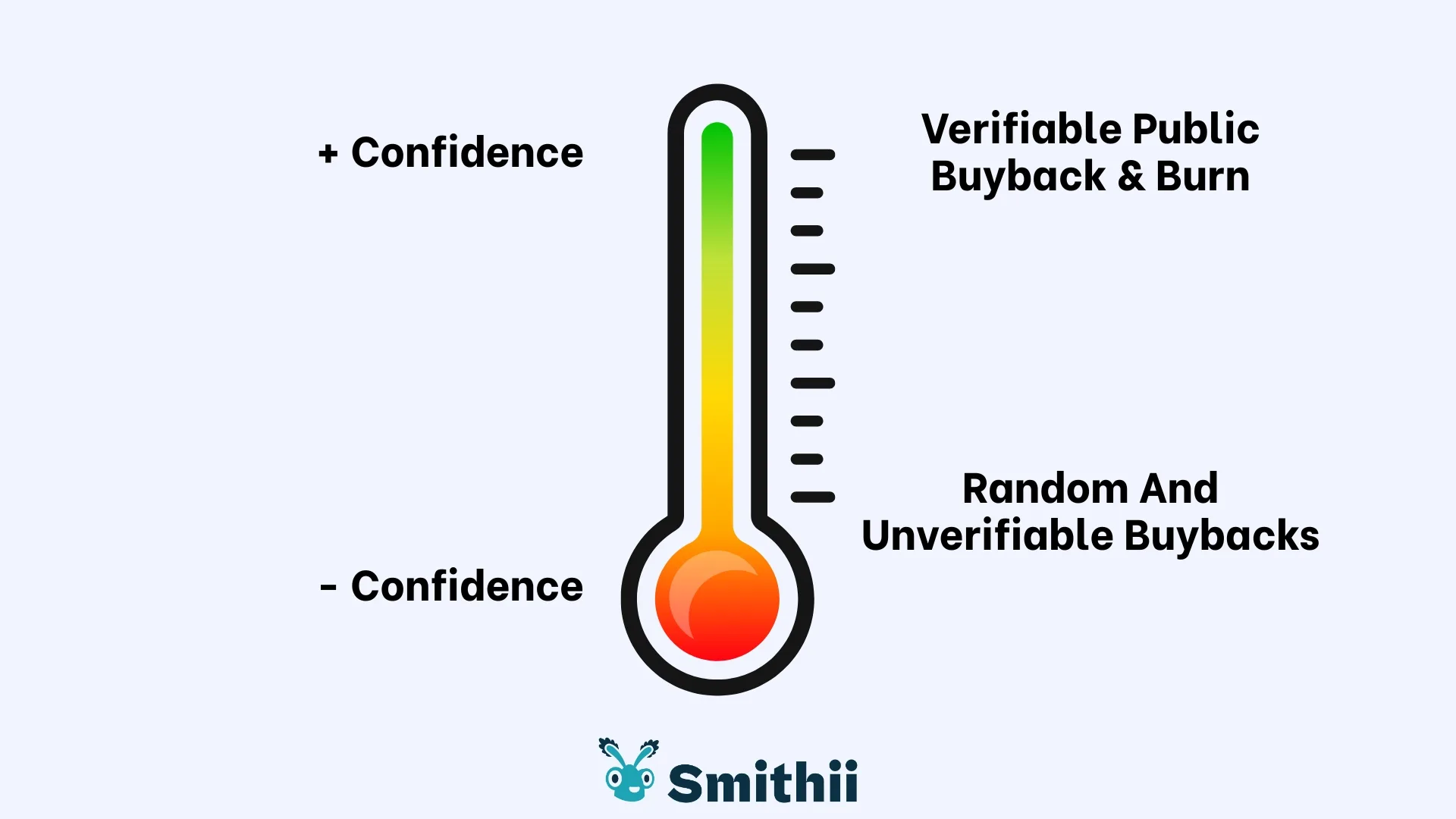
- Announce how the profit funds will be used: Transparency on the info side scores you major points, so let your community know you’re about to make a sizable buy using project funds.
- Buy the tokens manually: Nothing fancy here, just execute the buy in the pool manually.
- Burn the tokens: You can use sol-incinerator, a handy app for burning tokens. We also have a guide for burning LP tokens that walks you through it without any headaches. If you’d rather do it from the same suite you used to create the token, here’s an alternative to Sol Incinerator for burning tokens on Smithii.
- Share the details of every transaction: Post the transaction ID and the burn, so anyone can verify you actually went through with it.
Doing it in silence not only wastes a chance to keep that confidence going, it can also look like you’re moving funds under the radar, which does the opposite of what you want.
Key points to keep in mind
- Define the funding source: Will it be a fixed percentage of transaction fees, or a slice of quarterly profits?
- Frequency: Recurring burns usually build more trust than a single massive burn, since they create a healthy rhythm in the token’s economy.
- Burn tokens or LP: Remember that if you want to create deflation or shrink the supply, burn SPL tokens in the case of Solana. If you want to burn the tokens that unlock liquidity, go with LP tokens instead.
Conclusion
A buyback and burn is far more than a hype play. It’s a piece of financial engineering that, when used right, shields your project from inflation and tightens the bond with your community. It’s not a guarantee against bad behavior down the road, but it’s a clear signal that the team is in it for the long run.
At Smithii you’ll find every tool you need to build, maintain, and manage your Web3 project across multiple blockchains. On top of the tools, you’ll also get plenty of guides to help you with your tokens and memecoins. If you have questions or something to add, drop a comment on this post.

Content creator and SEO contributor at Smithii. Systems Engineering student and crypto-tech enthusiast.