

How to do an airdrop on Hyperliquid and pay hundreds of wallets in a single operation
Picture wrapping up a trading competition with four hundred winners, or settling this month’s referral commissions. You’ve got the list, you’ve got the amounts and you’ve got the token. What you don’t have is a whole afternoon to sign four hundred back-to-back transactions.
That’s exactly why it pays to know how to do an airdrop on Hyperliquid using the multisender: you load the list once and the full distribution runs bundled, without going wallet by wallet.
In this guide I’ll walk you through how to use it on HyperEVM, what it’s going to cost you, and above all where the real risk of a mass payout sits, which isn’t in the button but well before it.
Why doing it one by one isn’t just slow
The obvious problem with paying people manually is time. The one that actually causes headaches is different: every signature is a chance to paste the amount from one row into the address of another. With forty recipients the odds are already uncomfortable; with four hundred it’s just a matter of statistics.
There’s a second reason, less obvious and one that carries weight in a traders’ network. Four hundred separate transfers leaving your wallet over the course of hours look terrible on the explorer. A bundled payout reads as what it is, a scheduled payment, whereas a steady drip of individual sends looks way too much like someone moving funds in a hurry.
Bundling the payout saves you time, but above all it saves you from having to explain later what you were doing.
How to do an airdrop on Hyperliquid step by step
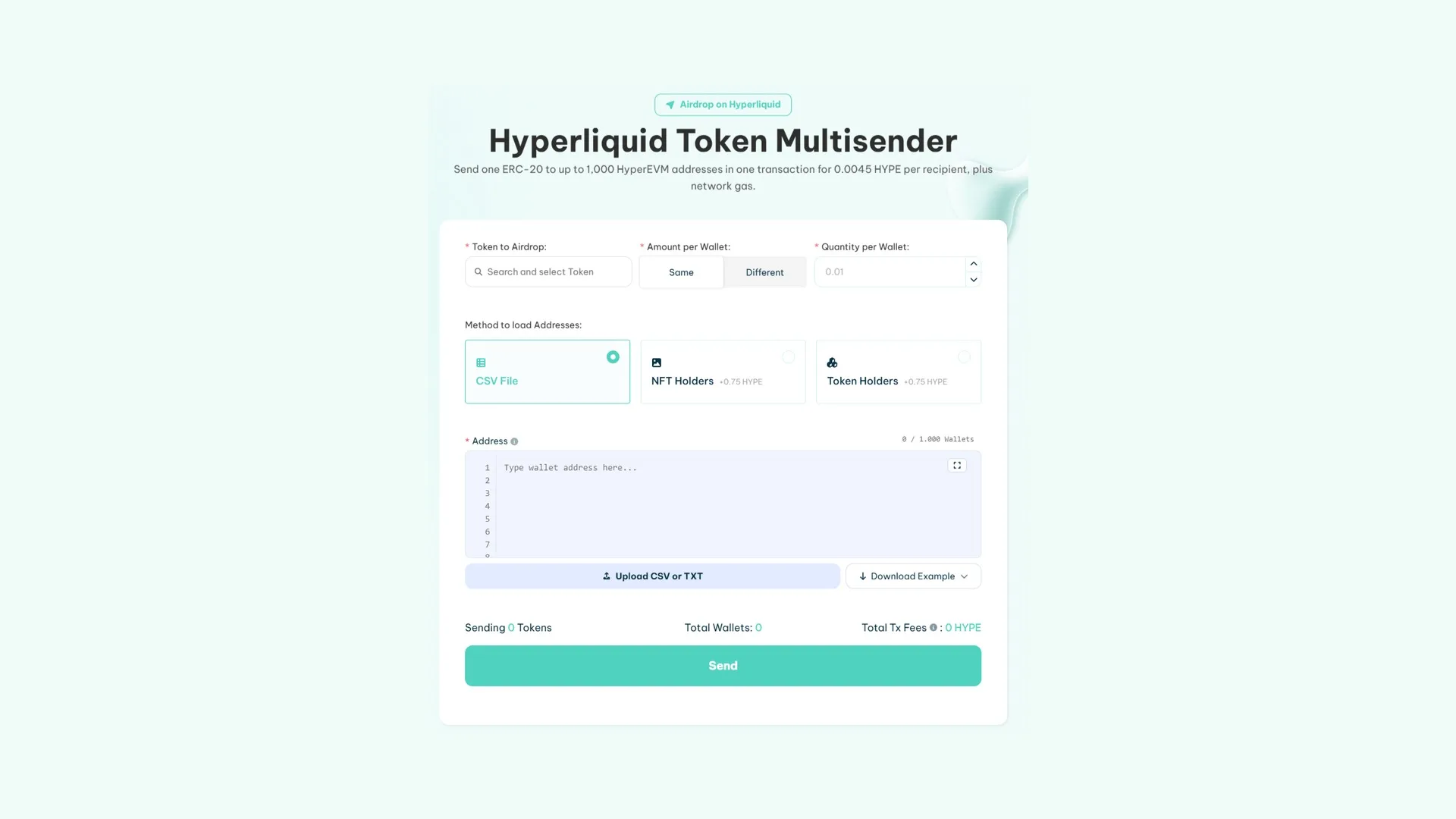
The payout is done from Smithii’s Token Multisender for Hyperliquid, which bundles up to a thousand transfers into a single signed operation. There’s no contract to deploy and no per-recipient confirmation: you load the list, review the summary and sign once. When you open it you’ll see this screen:
With the list ready and the wallet loaded with the token and enough HYPE, the process is short:
- Connect the paying wallet. This is the one that’s going to release the tokens, so it needs to hold the balance you’re distributing plus enough HYPE to cover the operation. Any EVM wallet with the network configured will do.
- Point to which token you’re distributing by pasting its contract address on HyperEVM.
- Upload the recipient list, with one address and its amount per row.
- Cross-check the summary against your own numbers. The tool tells you how many addresses it has read and what the total adds up to. If that number doesn’t match what you had, don’t move forward: there’s an extra row, a missing one or a shifted decimal.
- Sign and execute. The payout goes out bundled and the wallets receive their share.
How much the Hyperliquid Airdrop Tool costs
The tool charges 0.0045 HYPE per wallet address on the list, plus the gas for the payout. It’s a per-recipient amount, not a flat fee per operation, so the total is tied to the number of lines in the file: a thousand addresses don’t cost the same as thirty.
That’s why it’s worth having the number worked out before you sign off on the list: it’s the variable that decides whether the payout fits the budget or whether you need to trim recipients, and not something you can leave for the end.
The list is where you win or lose
I’m going to hammer this because it’s the only part of the whole process with no fix: an executed transfer can’t be canceled, can’t be reversed and can’t be recovered. If you send a thousand tokens to someone who was owed a hundred, you’re depending on that person wanting to send them back.
Three checks before you upload anything:
- Don’t type the addresses yourself. They should be copied from their source or exported from a tool. Any address typed out or rebuilt by hand is a time bomb.
- No duplicates. It’s the hardest mistake to spot in a long file and the most embarrassing when someone else does: a duplicated address gets paid twice and the difference comes out of what everyone else was owed.
- The file’s total matches what you planned to distribute. If you had fifty thousand tokens budgeted and the file adds up to fifty-five thousand, the mistake is in the file, not in your memory.
What to do if you show up without a recipient list
A lot of distributions kick off with no file ready: you know exactly which community you want to reward, but you haven’t collected a single address yet. The load-method selector exists for that exact moment, so you don’t have to leave the tool just to go hunt down the data.
- CSV or TXT file. For anyone who already has recipients lined up in a spreadsheet. There’s a downloadable example with the format the field expects, so you don’t have to figure it out through trial and error.
- Manual entry. Wallets get pasted straight into the box. Handy when you’re dealing with ten or fifteen and building a file isn’t worth the trouble.
- Holders of a token. Point it at a contract and the tool fills the list with everyone holding it, no need to run the Token Snapshot from Hyperliquid as a separate step.
- Owners of a NFT collection. Same routine but pointed at a collection, which is what the NFT Snapshot from Hyperliquid handles when used on its own.
Both holder options add 0.75 HYPE to the send, the same price the snapshot costs by itself, so you’re not paying twice for the same data. What you gain is skipping the export-and-reimport step in between, which is where formatting slip-ups and misaligned columns usually sneak in.
What it’s actually used for on a network like this
Hyperliquid pulls in people who trade daily, and that shifts the typical use case for a multisender. It’s not all cold airdrops here:
- Paying out what you already owe. Competition prizes, referral commissions, contributor payouts. People expecting a specific payment who will notice if it arrives late or short.
- Recurring incentive programs, where each cycle you distribute against a table that keeps changing. The list is different every month and building it by hand stops making sense by the second round.
- Distributing team and investor allocations in a single verifiable move, instead of a chain of transfers that anyone can spin however they like.
- Growth airdrops, which still work, but on this network they deliver more when the list is well picked than when it’s just long.
What you want sorted before hitting send
A distribution lands at the worst possible moment if the token can’t do anything yet. Before you sign:
- That the token exists and is configured the way you want it to stay: how to create a token on Hyperliquid.
- It has to be tradable. Anyone who gets a token with no market can’t do a single thing with it, and the moment is wasted: how to create the liquidity pool.
- That the pair can handle the traffic in the days after, when some recipients will head over to check the chart: the volume bot from Hyperliquid.
Once the distribution is done, the way to see how it really landed isn’t your file, it’s the chain. A follow-up snapshot of the holders will tell you how many actually kept what they got, which tends to be a pretty different number than you’d expect.
FAQ
How much does using the multisender on Hyperliquid cost?
It’s 0.0045 HYPE per wallet address, plus gas for the send. Since it’s charged per recipient, the total scales with the size of your list and it’s worth doing the math before you finalize the file.
Can I assign a different amount to each wallet?
Yes, and that’s the norm for a payout. Each row in the file carries its address and its amount, so you can pay tiered prizes or variable commissions in the same send.
What happens if an address on the list is written wrong?
If it isn’t a valid address, that row fails. The real problem is different: a valid but wrong address will actually receive the tokens, and there’s no undoing that. That’s why addresses should come from an automated source rather than being copied by hand.
Do I need a special wallet?
No. Since you’re working on HyperEVM, MetaMask, Rabby or any EVM wallet with the network configured works fine. It just needs to hold the token you’re going to distribute plus HYPE to cover the operation.
Is there a cap on recipients?
The tool splits large lists into batches on its own. In practice the ceiling comes from what you’re distributing and the gas you have on hand, not the number of rows in the file.
Can I use it to distribute HYPE instead of a token?
It’s built to distribute HyperEVM tokens. If you want to pay out in the network’s native asset, that’s a different flow and not what this tool covers.
Wrapping up
The multisender isn’t a flashy tool: no one launches a project just to send tokens in batches. But it’s one of those you end up using every month, and the one that turns an incentives program from a nice idea into something you can actually keep running without burning an afternoon each cycle.
Execution is the easy, cheap part. Spend your time on the file itself, because that’s where the one mistake you can’t undo lives.

Content creator and SEO contributor at Smithii. Systems Engineering student and crypto-tech enthusiast.