
CLMM vs AMM: Which Should You Choose on Solana? (DeFi)
Not sure which protocol is best for creating your liquidity pool? Understanding the differences between CLMM and AMM matters if you want to make the right call.
Both models let you create liquidity pools on decentralized exchanges (DEX), but they work in different ways.
In this article, we’ll break down what each one is, the key differences between them, and a practical framework for choosing the right protocol for your project.
What Does AMM Mean?
An AMM (Automated Market Maker) is a decentralized protocol that lets you create an automated market without a traditional order book. Instead of matching buyers and sellers, trades execute against liquidity pools made up of two tokens.
Each pool typically follows a constant product formula (x*y=k): the product of the two token balances stays constant, which determines the swap price between them. This ensures there is always a price available for the trade, although the amount received changes based on the pool’s balance.
In traditional AMMs, the liquidity deposited by providers is spread evenly across a very wide price range; in theory, from 0 to infinity. That means no matter the current price of token, the pool always keeps some liquidity ready, even at prices far away from the market.
The upside is that any trade can execute at any time (there is always liquidity to buy or sell, even if the price impact is high). The downside is that much of that liquidity sits “idle” or underused when the real price stays inside a narrow range. In other words, the traditional model trades capital efficiency for simplicity and full price-range coverage.
What Is a CLMM?
CLMMs are the next step after AMMs, built around the idea of concentrated liquidity. A Concentrated Liquidity Market Maker lets LPs focus their capital within specific price ranges instead of spreading it evenly across the entire price curve.
In practice, the liquidity provider chooses a range (for example, $0.05 to $0.10 for a volatile token, or $0.99 to $1.01 for a stablecoin) and supplies liquidity only inside that range.

As long as the token price stays within that range, trades can access much deeper available liquidity because the LP’s capital is stacked there. That means lower slippage and better prices for traders. If the price moves outside the selected range, that LP’s liquidity becomes inactive and no longer participates in swaps until the price moves back into range, where it becomes active again.
Technically, a CLMM works by creating multiple “minipools” across discrete price intervals, often called ticks. Within each tick, the formula is still x*y=k, so the constant product logic remains. At the pool level, though, liquidity is not continuous across the full price spectrum. It is segmented by the ranges LPs choose to fund.
You may also find this article useful: How to Set Tick Size and Minimum Order Size
The main advantage is higher capital efficiency. By placing funds where they matter most, near the current price or the range where you expect volume, fee returns increase and less capital is needed to create the same market depth as a traditional AMM.
CLMM vs AMM: Key Differences
Below, we break down the main differences between a traditional AMM and a CLMM on Solana, comparing how each one works:
| Aspect | Traditional AMM | CLMM (Concentrated Liquidity) |
|---|---|---|
| Liquidity distribution | Spread across the entire price range; there’s always some liquidity available. | Placed only within a specific range chosen by the LP. |
| Capital efficiency | Low: a lot of capital sits idle. | High: every dollar of capital is actually working where it’s used. |
| Depth/Slippage | Shallower depth, more slippage on large trades. | Deep liquidity inside the active range, with minimal slippage there. |
| LP fees | Split across all deposits; average returns. | Earned only inside the active range; potentially much higher returns. |
| Impermanent loss | Moderate but steady. | Can be larger if the price exits the range, though extra fees can offset it. |
| Management required | Basically passive (set-and-forget). | Active: you have to shift ranges as the price moves. |
| Ease of use | Very simple to launch and friendly for first-time LPs. | More complex (picking ranges, understanding ticks, position NFT). |
| Best use cases | Fast launches, volatile memecoins, broad accessibility. | Stablecoins, tokens with predictable price action, limited capital chasing efficiency. |
Which Protocol Fits Your Use Case?
Now that you know the differences between AMM vs CLMM, the key question is: which one makes more sense for your token?
Here is a practical two-step guide: first, look at the type of token you are launching, then define the main goal for that token.
1. Assess the Type of token and Similar Use Cases on Solana
Memecoins: many creators of these tokens choose traditional AMMs on popular DEX because they are simple and make the token show up quickly on aggregators like Jupiter. Concentrated liquidity is not common for memecoins because it requires more active management, and the price can multiply or crash outside any expected range.
Utility tokens: these are tied to platforms, games, DAOs, or other projects that offer functionality beyond speculation. These projects usually want a stable, deep market for their token, but they also care about security and predictability. In practice, most utility tokens on Solana have started with traditional AMMs. That is because launching a standard pool is simpler, and the DeFi community already knows how to use it.
Stablecoins: here, the priority is to minimize price movement and support large swaps without drifting from the peg. Traditionally, this has been handled through special stable-curve AMMs (such as Saber or Mercurial on Solana) that use a formula different from x*y=k, optimized to keep the price around 1. However, CLMMs can also be highly effective for stablecoins: for example, an LP can concentrate liquidity from $0.99 to $1.01, creating massive depth inside that narrow range.
2. Define your token’s main liquidity goal
Virality and fast adoption: If your goal is to get the token into as many hands as possible (for example, a community or marketing token where you want lots of people holding and trading it), your priority is easy access. In this case, a popular-platform AMM is the right fit. Make sure your token shows up on aggregators and explorers (Jupiter, Solscan, etc.) from day one.
Price stability: Maybe your token has a use case where a stable or predictable price is important (for example, it is used as a medium of exchange in a dApp, or it is backed by assets). In that case, reducing volatility and spread is essential. A CLMM works well here because it provides concentrated depth around the target price.
You may also want to read this article: How Much Liquidity Should I Add to My token on Solana?
How Do You Create a liquidity pool with CLMM and AMM on Solana?
The fastest and simplest way to provide liquidity or create a liquidity pool, whether CLMM or AMM, is to use automated software tools that simplify the process and do not require coding knowledge.
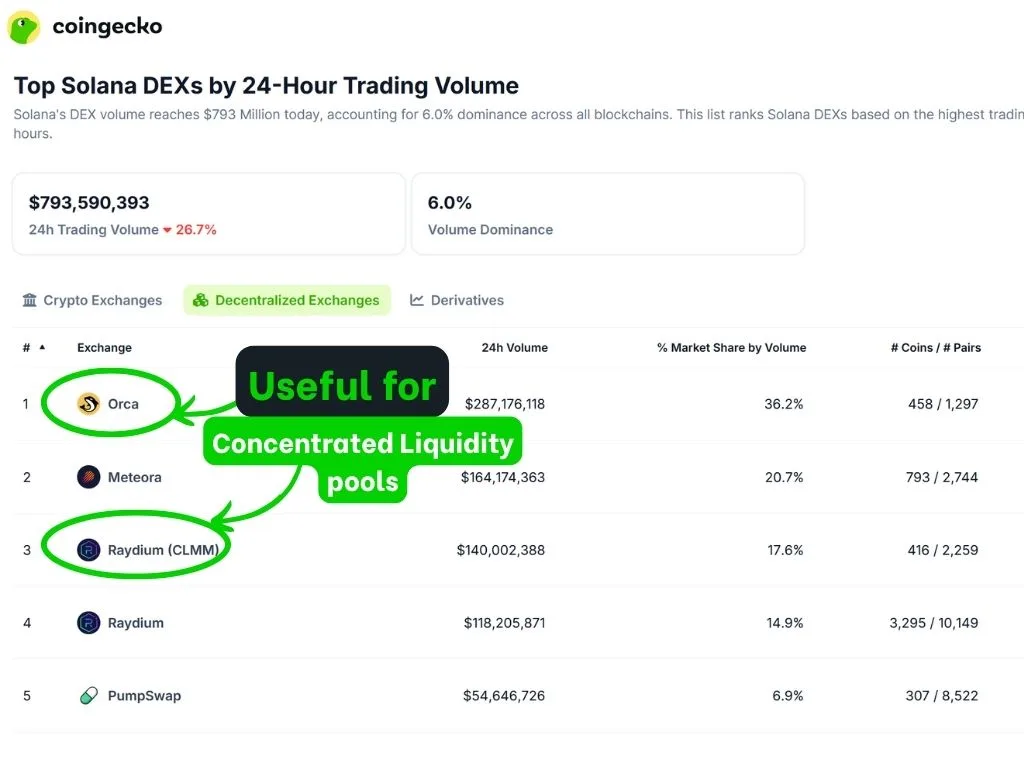
For CLMM, we recommend using Orca or Raydium, since they are the DEX with the highest current trading volume on Solana where concentrated liquidity pools can be launched.
On the AMM side, you can learn how to use the Smithii Create Liquidity Pool tool, which lets you add liquidity to your token in just a few clicks.
CLMM vs AMM FAQ
At Smithii, we build DeFi tools for developers and token creators across multiple blockchain networks, especially Solana. We’ve helped launch thousands of tokens and liquidity pools, so here are answers to a few CLMM vs AMM questions users ask us often:
What Is Raydium CLMM?
CLMM on Raydium refers to the type of AMM this DEX offers for creating concentrated liquidity pools. It is currently the method Raydium recommends for creating liquidity pools, which is why you will see it as the first available option with a “Suggested” label.
What Does CLMM Mean on DexScreener?
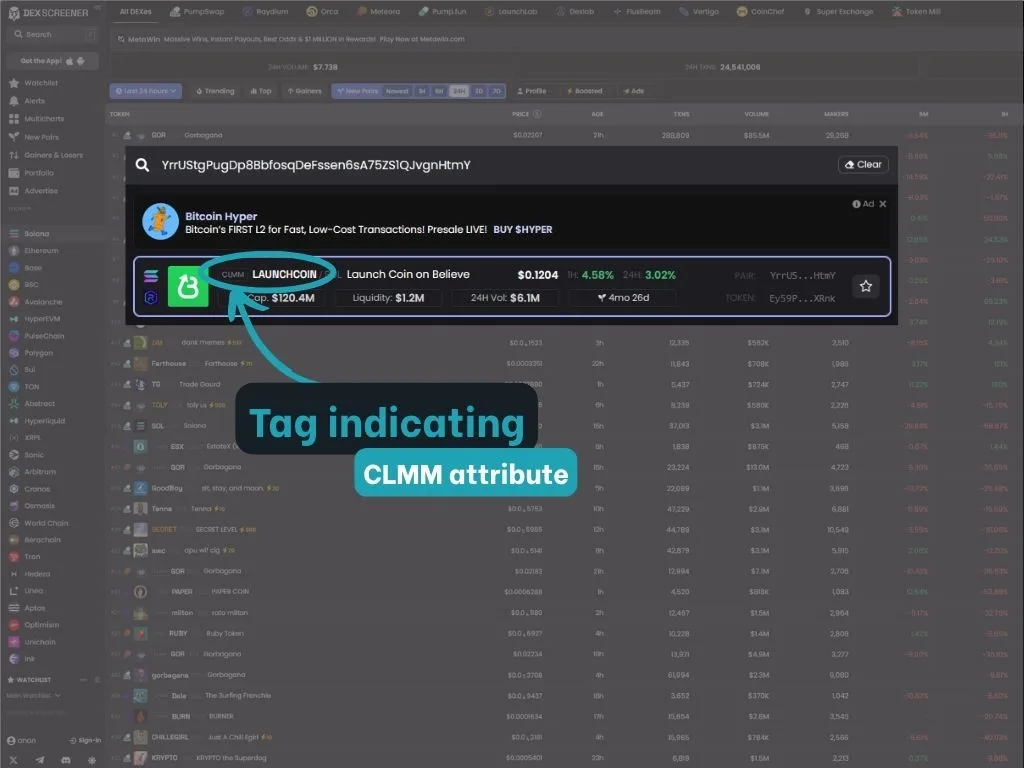
When you see “CLMM” on DexScreener, it means concentrated liquidity pool was provided for that cryptocurrency through the Concentrated Liquidity Market Maker protocol. You will see this signal as a label next to the name of the relevant token. You may also see “CPMM”, “DYN”, “DYN2”, “DLMM”, and other labels depending on the model used. If no label appears, it belongs to the traditional AMM protocol.
Conclusion
If you’re thinking about providing liquidity for your token, understanding the difference between CLMM vs AMM matters because it can shape your yield opportunities, management overhead, and adoption. Remember, at Smithii we offer a tool to launch a liquidity pool using the AMM protocol.

Industrial Engineer turned Solana trader. Marketing at Smithii and contributor to the $SHRIMP memecoin launch.