
How to find who owns an NFT collection on Monad and export the wallets to CSV
Here’s how to find who owns an NFT collection on Monad: an NFT snapshot returns the addresses holding pieces of that collection. It sounds similar to a token snapshot, but the people coming out of one list vs. the other don’t behave the same way.
And that’s exactly the reason to use it: buying an NFT is a much more deliberate decision than buying a token. Someone picked a specific collection, paid for a specific piece, and in many cases holds it out of belonging, not because they’re waiting on a quick pump.
Let’s break down what kind of audience you get, how to extract it, and when it pays off more than a standard snapshot.
What list you get with a NFT snapshot
- A pre-filtered group. A collection has a theme, an aesthetic, and a community behind it, so the targeting comes built in.
- Addresses that barely rotate. The holder of a NFT keeps the piece far longer than the average token buyer, which means the list stays valid weeks later.
- An eligibility criterion, not just a recipient. Holding a piece works just as well as a minimum balance when deciding who gets into a whitelist.
- Thematic context. If your project connects with that collection’s universe, its holders aren’t just any audience: they’re the audience.
How to find who owns an NFT collection on Monad, step by step
You pull the list with the NFT Snapshot from Smithii for Monad, which reads the ownership registry of an ERC-721 collection and exports the addresses that hold it to CSV. It lives on the same screen as the token snapshot, right in the next tab. When you open it, here’s what you see:
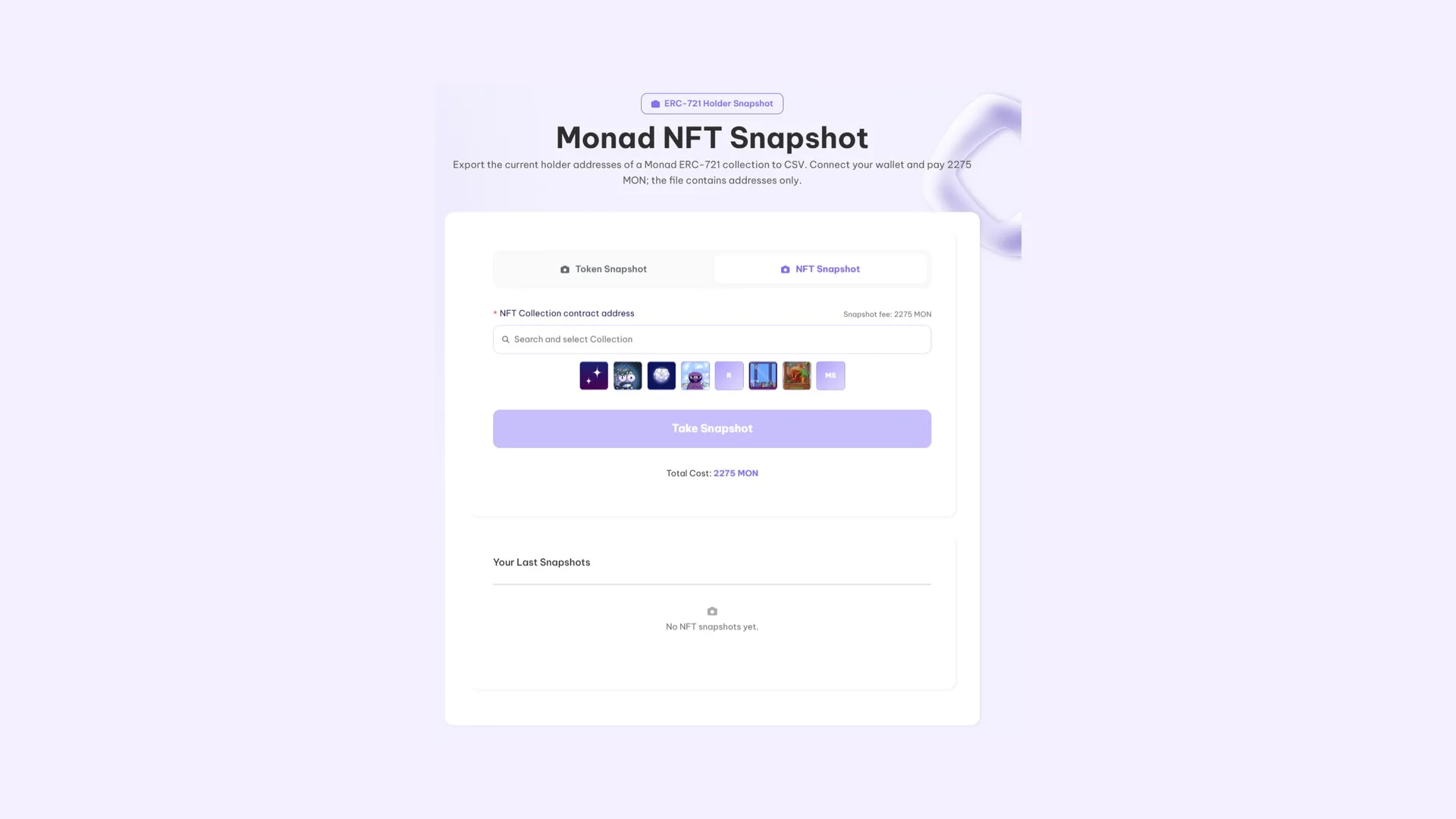
With the collection’s contract identified and MON in your wallet for the fee, the flow goes like this:
- Connect your wallet with MON for the fee.
- Point to the collection using its contract address. That’s the contract of the whole collection, not of an individual piece.
- Run the extraction.
- Save the file with the resulting addresses.
How much it costs to pull the NFT holders list
The extraction costs 2275 MON plus gas. It matches the token snapshot because the underlying work is the same: the entire ownership registry of the contract has to be read, not just a slice.
What to do with the addresses you get
Sitting in a file, they’re worth nothing. The three destinations that actually make sense:
- Introduce yourself to that community with a drop. The addresses go into the Monad multisender tool and the token lands in wallets that already share a common interest.
- A whitelist for your own launch, where holding a piece of the collection acts as the access key.
- Loyalty rewards, comparing two separate extractions to reward whoever’s still around and skip whoever moved on.
If you’re after token buyers rather than collectors, the tool you want is the Monad token snapshot.
Have everything else ready before you distribute
A airdrop that lands in wallets that can’t do anything with the token is a wasted opportunity. Check these first:
- A deployed and locked contract, with the final configuration in place: how to create a token on Monad.
- A market where they can sell it or buy more, because without that the distribution just sits as a frozen balance: how to create the liquidity pool.
- A pair that can handle the traffic from anyone who drops in to check after receiving it: the Monad volume bot.
And when it comes to picking which collection to target, the segmentation criterion is the same one we apply in the memecoin marketing guide: affinity over volume.
FAQ
How is it different from the token snapshot?
One deals with amounts, the other with ownership. In a fungible token, what matters is how much each address holds; in a collection, what matters is who owns which piece, and that group tends to be far more cohesive and rotate much less.
Can I extract an NFT collection I didn’t create?
Yes. Who owns each piece is recorded openly on-chain, so you can query any Monad collection even if you have nothing to do with it.
How much does the NFT snapshot cost on Monad?
It costs 2275 MON plus gas, the same fee as the token snapshot, because both cases walk through the contract’s full state.
Does a wallet with multiple pieces show up duplicated?
No. Each address appears only once regardless of how many pieces it holds. So if you later turn the list into a distribution, nobody gets paid twice.
Does this work for building a whitelist with the holders of an NFT collection on Monad?
It’s one of the most common use cases: holding a piece from a specific collection works as an access requirement just as well as holding a minimum balance.
Conclusion
The NFT snapshot gives you access to something the token version doesn’t: communities with their own identity and holders who don’t vanish a week later.
It’s a smaller and much better defined audience. Pick the collection based on real affinity and the list stops being a file and turns into people who actually show up.
If the collection lives on Arc, the process and what the CSV contains are covered in extracting the holders of an ERC-721 on Arc.

Content creator and SEO contributor at Smithii. Systems Engineering student and crypto-tech enthusiast.