

How to renounce ownership of a token on Monad: when it’s a good idea and when it isn’t
There’s a widespread idea in crypto that needs a bit of nuance: that renouncing the contract is always good, and the sooner the better. It depends entirely on how you set up the token, and in some cases the move adds practically nothing.
This article on how to renounce ownership of a token on Monad isn’t going to push you either way. It’s going to give you the framework to decide for yourself, because this is an action you only get to do once.
What to weigh before renouncing ownership
Before anything else, here’s a check almost nobody runs: look at which admin functions your contract actually has.
The owner role doesn’t grant blanket powers. It only enables what you turned on when you deployed the token. If back then you built a simple contract with no open minting, no pause, and no adjustable fees, your owner role can barely do anything, and renouncing changes little more than a label on the explorer.
If instead you left several of those functions active, that role does represent real power over other people’s money, and renouncing carries real weight.
Put another way: the value of renouncing is directly proportional to what you could do if you didn’t.
Three questions to ask before giving up control
Answer them honestly and the decision sorts itself out:
- Do I plan to mint more supply at some point? If the answer is yes, even a year down the road, renouncing kills that option forever.
- Is the fee where I want it to stay? A percentage you’re still tweaking based on how the market reacts shouldn’t be frozen yet.
- Can I explain every permission I’m keeping? If not, the problem isn’t renouncing: it’s that you enabled functions you didn’t need.
That third one comes up more often than you’d think, and it gets fixed beforehand, not after. We cover it when setting up the contract in how to create a token on Monad.
What changes for whoever is sizing you up
From the outside, an ownerless contract wipes out the uncomfortable question in one shot. Nobody has to take your word for it or read your intentions: the info lives in the contract itself and takes seconds to check.
It’s one of the few signals in this space that leaves no room for nuance or interpretation. Either there’s an owner or there isn’t.
It’s worth understanding why that matters so much. Baseline distrust is one of the barriers that eats more projects alive, and it shows up repeatedly in the breakdown of why 90% of tokens don’t make money.
What you give up by renouncing control
What you lose isn’t theoretical: any room to react on the contract disappears. If a few months down the line something comes up that would have called for an adjustment, the answer will be no, no exceptions.
When you’re not sure, the alternative isn’t half-renouncing, because that doesn’t exist. It’s waiting, leaving the contract as it is, and being upfront about which permissions you’re keeping and why. A clear explanation holds up pretty well while the project shows how it behaves.
How to renounce ownership of a token on Monad step by step
Once you’ve made the call, execution lives inside the Token Manager by Smithii for Monad, the panel where you manage an already-deployed token. Renouncing is one of its options: it calls the contract function and hands the owner role to an address nobody controls. There are no parameters to decide, so the technical part takes less time than reading this section. When you load your token you’ll see this screen:
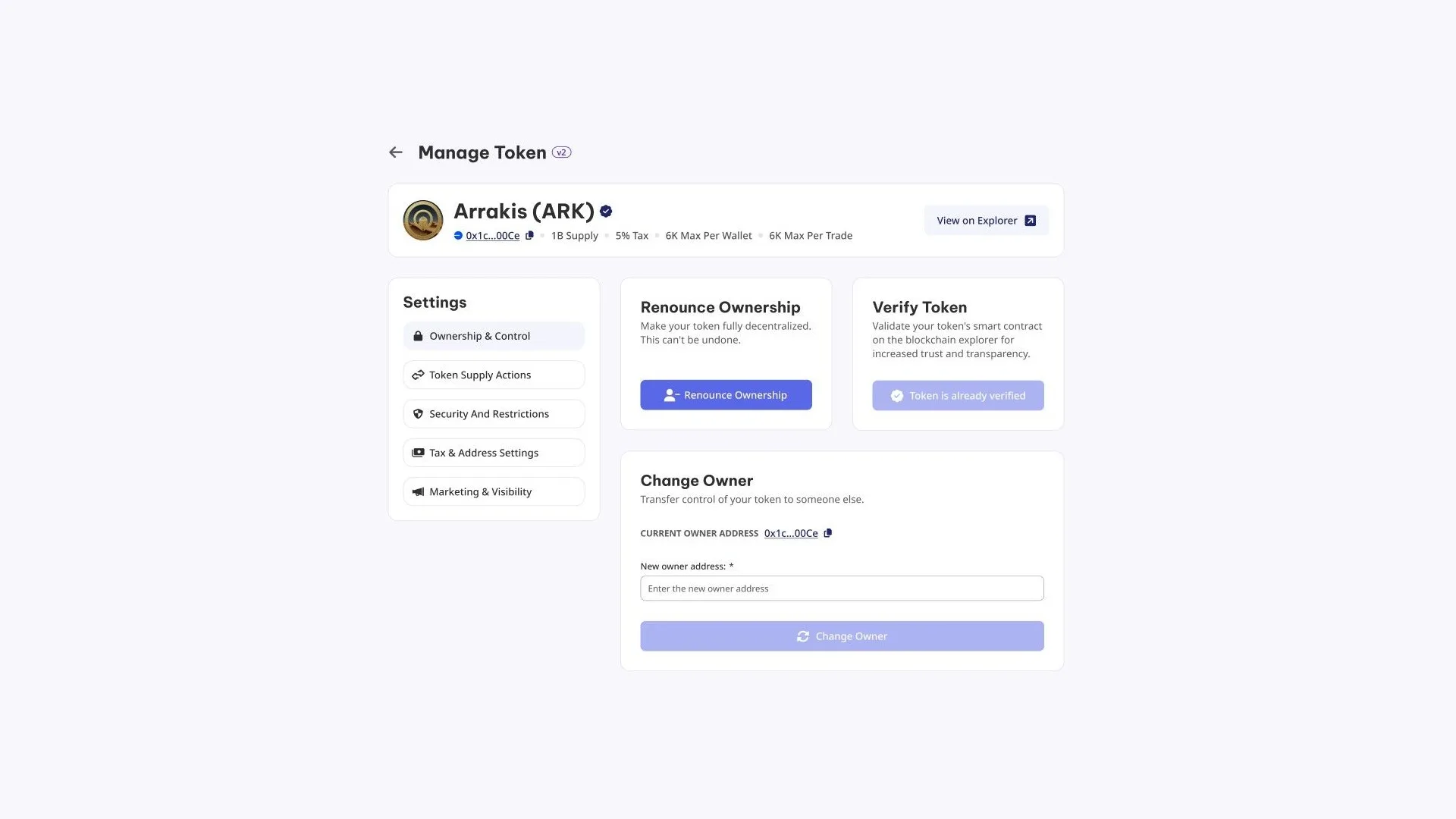
With the owner wallet connected and the contract address on hand, it’s four steps:
- Open the Token Manager and connect the owner wallet, which has to be exactly the one holding the role.
- Load the token by pasting its contract address. The header returns the name, supply, current fee, and the per-wallet and per-transaction limits.
- Go into Ownership & Control, the first section in the side menu, and go over the setup one last time. Literally the last.
- Hit Renounce Ownership and sign. The contract becomes ownerless and that’s the end of it.
Once you’ve renounced, you can run a rug check on Monad and watch the score shift: owner control is one of the heaviest factors in the report.
How much it costs to renounce ownership
The operation costs 900 MON plus network gas.
Which functions get locked after renouncing ownership on Monad
The screen where you renounce is the same one that gathers everything the owner role lets you do. It’s worth walking through the side menu before signing, because every section is a capability that will stop existing:
- Ownership & Control. Next to the renounce button sit Change Owner, which hands the role to another address instead of destroying it, and Verify Token, which validates the contract on the network’s explorer.
- Token Supply Actions. Mint new supply to any address you point to, burn tokens to reduce the circulating total, and force a transfer between wallets, designed to recover funds that have gotten stuck.
- Security And Restrictions. The blacklist, the whitelist, the antibot toggle with its exempt addresses, and the antiwhale that caps the maximum per transaction, the maximum a wallet can accumulate, the minimum time between buys, and the number of days the limit stays active.
- Tax & Address Settings. The fee percentage, the wallet that receives it, and the addresses that are exempt from paying it.
There’s also a third path that almost no one mentions. Change Owner doesn’t remove the role: it hands it to another address, which can be a team multisig. It doesn’t send the same signal as an ownerless contract, but it splits control instead of leaving it with one person, and it still allows a rollback.
If something on that list made you pause, now isn’t the time. If none of it matters to you, renouncing costs you nothing.
When in the project it makes sense to do it
From experience, the point where this decision fits well is when the project already runs without intervention:
- There’s a market, because a spotless contract with no open pair can’t be bought by anyone: how to create the liquidity pool on Monad.
- The supply is distributed and not concentrated in the deployer wallet: the multisender on Monad.
- The numbers back up what you say publicly, which you can verify with a holder snapshot on Monad.
Renouncing the contract while you still hold most of the supply convinces no one. These are two signals that get read together, and the second one weighs more than the first.
It’s also worth not mixing up different problems: renouncing protects against owner abuse, not against what happens on launch day. That one plays out on another field, the one about how to avoid sniping bots.
FAQ
Is there any way to get control back?
None. The role transfers to an address nobody controls, and there’s no mechanism to reverse it, neither from your side nor from Smithii’s.
Does it affect the tokens I hold?
No. What you’re giving up are the admin permissions on the contract, not your balance, which stays in your wallet exactly as before.
How much does it cost on Monad?
The operation costs 900 MON plus network gas.
Is renouncing a must?
It isn’t mandatory, but it’s one of the first things people check. If you decide to keep control, have an explanation ready for which functions you’re keeping and why you need them.
What happens to minting if I renounce?
It gets permanently disabled. If your project planned future emissions, renouncing cancels them, so it’s worth reviewing the schedule before signing.
Conclusion
Renouncing ownership on Monad only matters as much as there is something to renounce. On a plain token it’s almost symbolic; on one with broad permissions, it’s the strongest signal you can send.
Start by checking which functions are actually active, answer the three questions above, and act accordingly. And if you’re unsure, wait: the step will still be there tomorrow, but undoing it won’t be an option ever.
If the contract is deployed on Arc, those same decisions are made from the token management panel for that network, which flags the ones that can’t be undone.

Content creator and SEO contributor at Smithii. Systems Engineering student and crypto-tech enthusiast.