
What was the first meme coin ever made? Junkcoin, Bellscoin, and the origin of the phenomenon
The first meme coin ever made wasn’t Dogecoin. Before the Shiba Inu dog became the logo on financial headlines and NASCAR sponsorships, two satirical projects already existed in 2013 that laid the groundwork for the genre. The popular narrative usually skips that part and starts the story on December 6, 2013, but the blockchain tells a different story.
In this walkthrough we go over who actually launched the first meme coin, why two of them dropped almost at the same time, what happened to those pioneer projects, and how the ecosystem went from having to manually clone Bitcoin’s codebase to a world where you can launch a meme coin on Pump.fun in under a minute.
The 2013 context matters, because it turned every launch into a technical feat with very real consequences: vulnerable networks, scarce miners, centralized exchanges, and an infrastructure that punished any project that couldn’t sustain its own Layer 1 blockchain. That’s the backdrop Junkcoin and Bellscoin emerged from, the first documented financial memes in history.
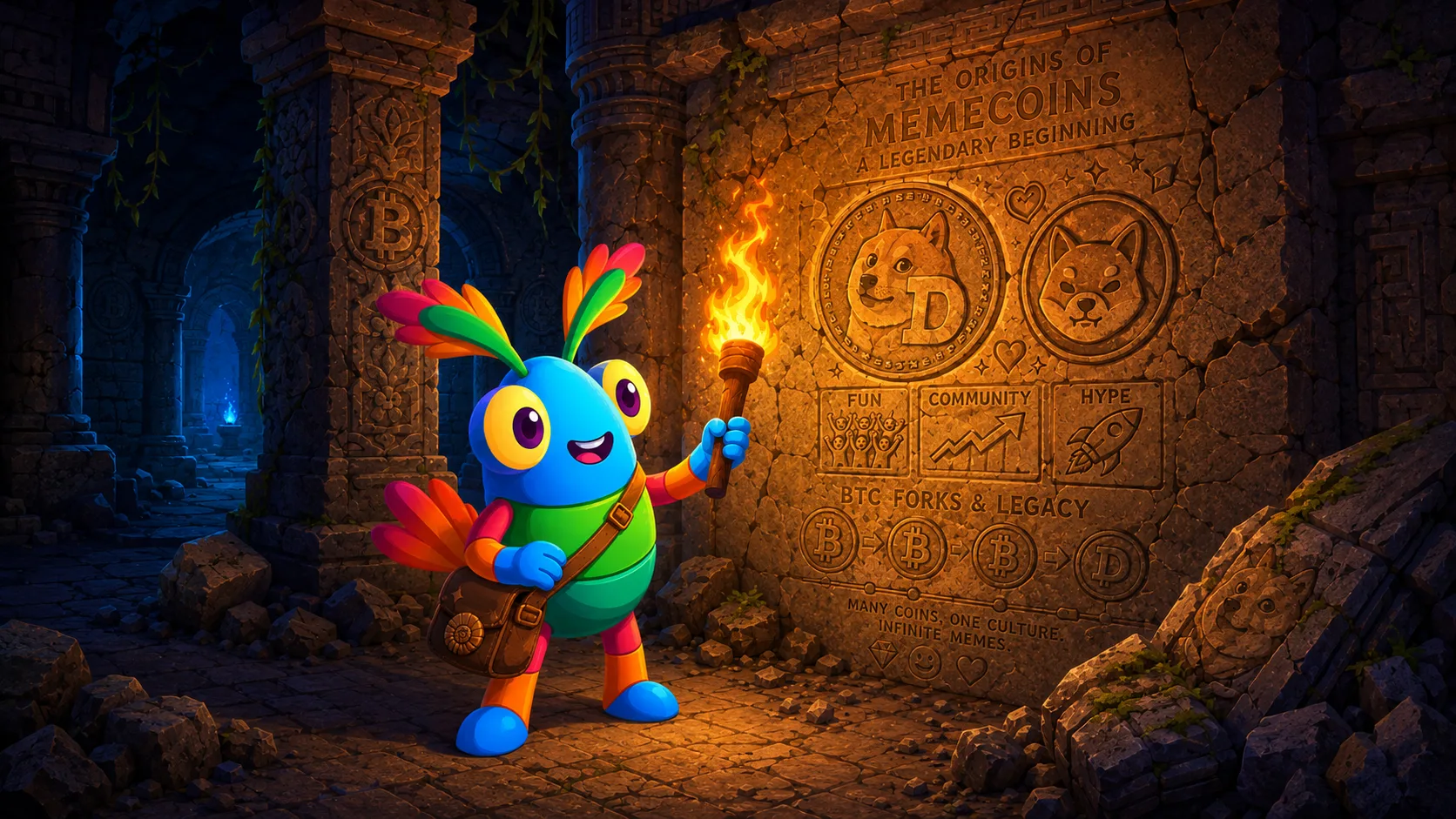
What was the first meme coin ever made?
The short answer, depending on the criteria you apply:
- Junkcoin (JKC), launched on May 3, 2013: technically the first deliberately satirical crypto experiment ever documented on-chain.
- Bellscoin (BELLS), launched on November 28, 2013: the first meme coin conceptually built by a developer with a public profile, eight days before Dogecoin.
- Dogecoin (DOGE), launched on December 6, 2013: not the first, but the one that cemented the genre and dragged all subsequent memecoin culture behind it.
The debate over “the first meme coin ever made” comes down, then, to what you mean by first: the first satirical blockchain to exist on-chain was Junkcoin, the first one designed with a brand narrative and an identified developer was Bellscoin, while Dogecoin became the first one to go mainstream.
Let’s now walk through the story of each of these experiments that laid the foundation for today’s memecoin culture.
Junkcoin (JKC): the first satirical experiment of May 2013
Junkcoin showed up on May 3, 2013 on the BitcoinTalk forum with a brutally honest tagline: “Designed to fail”. It was a direct fork of Litecoin designed as a satire of the runaway proliferation of Bitcoin clones with no technical innovation or real purpose. The project was making fun of itself from the very first commit.
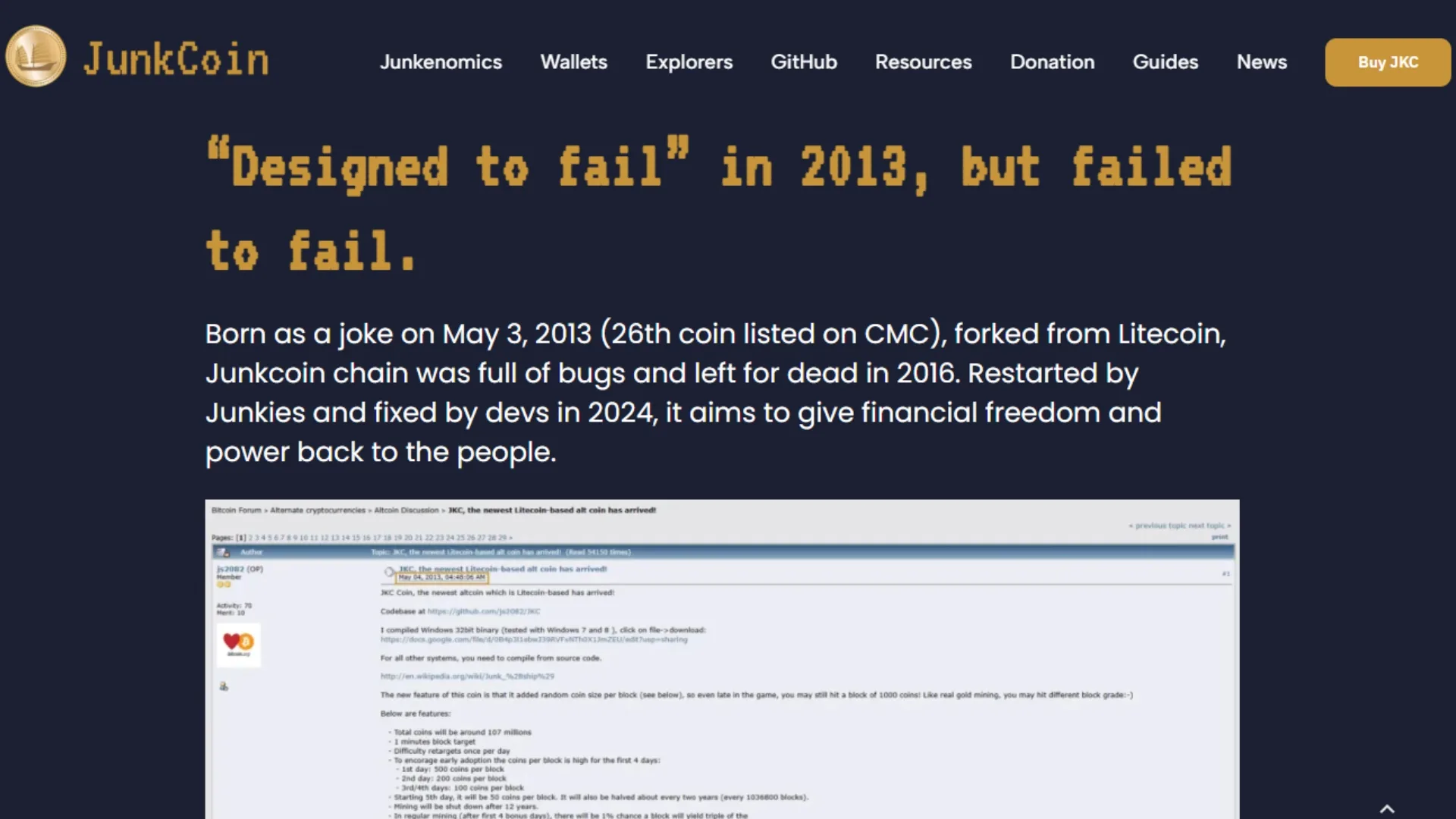
Back then, creating a cryptocurrency meant manually cloning and modifying Bitcoin or Litecoin’s codebase, running your own node network, and pulling in enough hashrate to keep the network from getting taken down by a 51% attack in the first week. Launching Junkcoin “to fail” was, in that context, a deliberately ironic move.
Although the project fell into total abandonment for a decade, its code survived through an unexpected route: a Junkcoin derivative gave rise to Luckycoin, which in turn served as the direct software ancestor that would shape Dogecoin’s codebase.
In November 2024, a group of enthusiasts revived the original Junkcoin network, recovering its May 2013 genesis block as one of the oldest sets of addressable UTXOs in the ecosystem.
Bellscoin (BELLS): the first meme coin with a developer-driven narrative
If Junkcoin was the first sketch, Bellscoin was the first project built as a brand. Created by IBM software engineer Billy Markus (known by his alias BillyM2K) and posted on BitcoinTalk on November 28, 2013, Bellscoin beat Dogecoin’s launch by just eight days. Interestingly, Markus is the same person who, alongside Jackson Palmer, would launch Dogecoin a few weeks later.
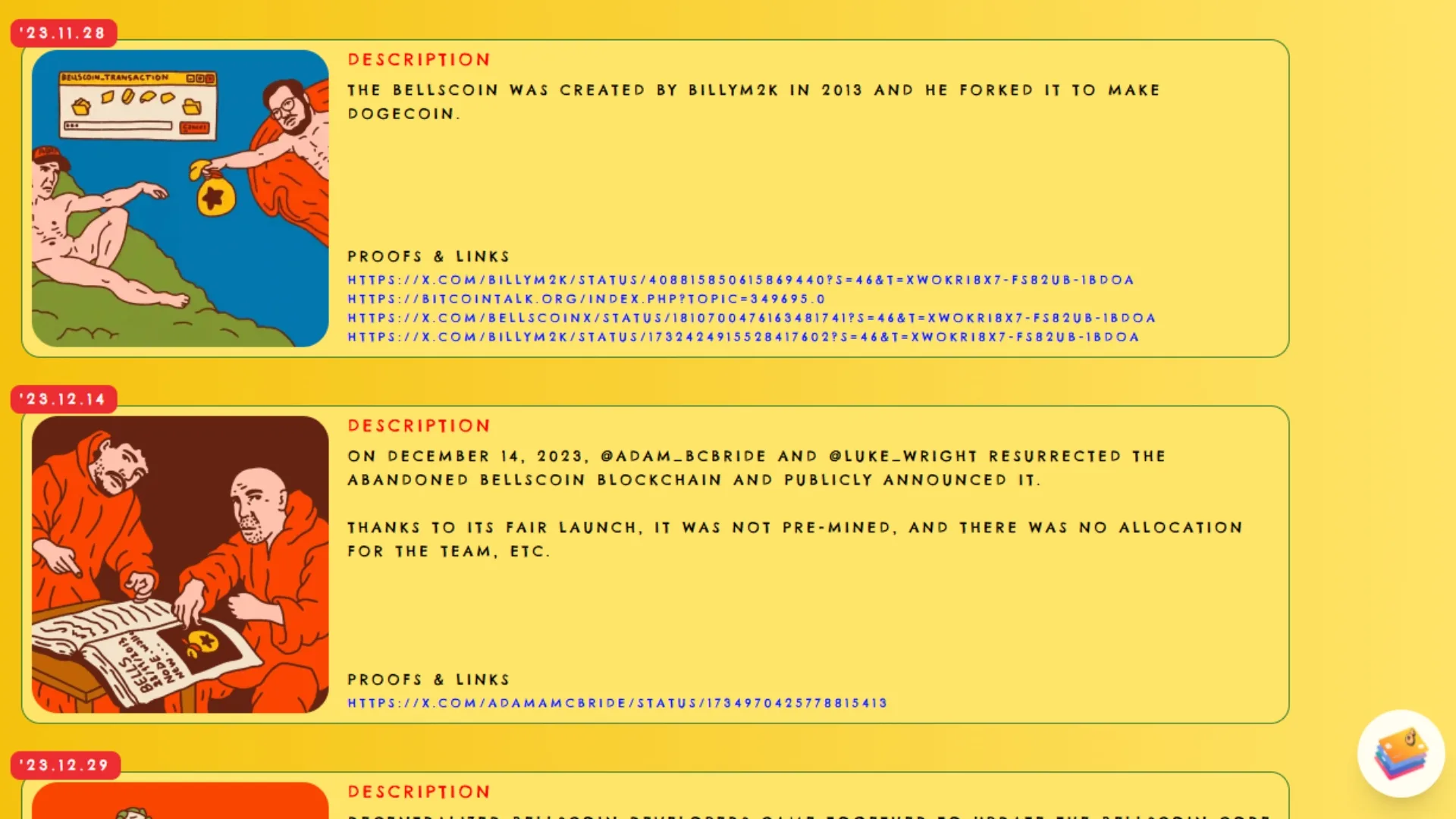
Bellscoin took direct inspiration from Nintendo’s Animal Crossing, using the “Bells” from the video game as its thematic core. But the most interesting part is its economic design. Markus implemented a fully random block reward system, instead of Bitcoin’s constant and predictable subsidy. A miner could receive anywhere from a single unit up to 10,000 coins, mimicking the randomness of collecting items in Animal Crossing. For its time, it was a piece of economic design quite ahead of the curve for a satirical project.
The problem came down to timing and attention. Bellscoin lost traction to Dogecoin’s massive launch a few days later, and its blockchain went completely offline by late 2014. Just like Junkcoin, the Bellscoin network was revived by developers who got hold of the source code and brought the project back online.
These days, deploying your own token on Solana is trivial compared to what Markus pulled off in 2013.
Why is Dogecoin believed to be the first meme coin?
Dogecoin launched on December 6, 2013, also with Billy Markus leading the code, alongside Jackson Palmer. It technically arrived third, but it kept the historical title for one simple reason: it survived and went viral. The combination of the “Doge” meme, a community far more active than Bellscoin’s, and a meme that was already internet culture on Reddit gave it a traction advantage the earlier projects never had.
DOGE’s first official market price was recorded on January 23, 2014 at $0.00154 per unit. From there, what kept Dogecoin alive wasn’t technical innovation (it actually inherited code from Luckycoin and launched with no supply cap), but a community organized around the idea that promoting a meme coin with humor and collective purpose could matter just as much as its economic design.
The 2013 context that turned every launch into a feat
To understand why Junkcoin and Bellscoin were able to launch but also why they nearly disappeared, you have to look at the technical and market conditions of 2013. It’s a world almost unrecognizable compared to today’s ecosystem.
The technical rigidity before smart contracts
In 2013, the concept of simplified token issuance didn’t exist. Vitalik Buterin’s proposal (founder of Ethereum) for a general-purpose programmable blockchain was barely a theoretical draft by the end of that year. Smart contracts didn’t exist, neither did the ERC-20 standard, AMMs like Uniswap, nor DeFi platforms.
That meant any new project had to run its own P2P network, attract enough hashrate to avoid a 51% attack, maintain unstable native wallets, and manually convince the first exchanges to add support. Most 2013 altcoins were extremely vulnerable and died within weeks. Junkcoin and Bellscoin ended up exactly there.
Mt. Gox and the extreme centralization of the market
The crypto market in 2013 was dominated by a single exchange: Mt. Gox handled around 70% of global Bitcoin volume. Later academic research documented that the rally that took BTC from $100 to over $1,000 in 2013 was driven by bot-account manipulation inside Mt. Gox, right before the exchange collapsed in early 2014.
The birth of CoinMarketCap and the mass proliferation
CoinMarketCap launched in April 2013, initially listing only seven cryptocurrencies. By December 2013, the platform already tracked more than 1,100 different assets. That explosion of clones with no intrinsic value was exactly what pushed Markus and Palmer to create their parodies: the satire was a direct reaction to the flood of useless altcoins.
The first regulatory crackdowns
On December 5, 2013, the People’s Bank of China issued its first official restrictive statement, banning financial institutions from processing Bitcoin transactions. A few days later it extended the ban to payment processors. Bitcoin crashed from $1,200 to under $600 in a matter of weeks. Bellscoin and Dogecoin both launched right in the middle of that chaos.
From Junkcoin to Pump.fun: how meme coin creation has changed
The gap between launching a meme coin in 2013 and doing it today is brutal. The table below breaks down the main differences:
| Aspect | 2013 ecosystem | Current ecosystem |
|---|---|---|
| Issuance standard | Didn’t exist. Every asset required launching its own Layer 1 blockchain. | Standardized smart contracts (ERC-20, SPL, BEP-20). |
| Time to create | Weeks or months (editing C++ code, compiling nodes). | Seconds on no-code launchpads. |
| Exchange structure | Centralized and unstable (Mt. Gox: 70% of global volume). | Decentralized DEXs, AMMs across multiple chains. |
| Asset diversity | From 7 coins in April to 1,172 in December 2013. | Millions of tokens, thousands of launches per day. |
| Governance | Primitive, dependent on mining pools. | DAOs, foundations, PoS and staking mechanisms. |
Today, part of the conversation before launching a project is even picking the right blockchain for a meme coin, something unthinkable in 2013 when the only viable options were Bitcoin and Litecoin forks. The current ecosystem includes options as varied as launching a meme coin on Bonk.fun, Pump.fun, Four Meme or Bags.fm, each one tuned for a different community dynamic.
The consolidation: Dogecoin and Shiba Inu as historical benchmarks
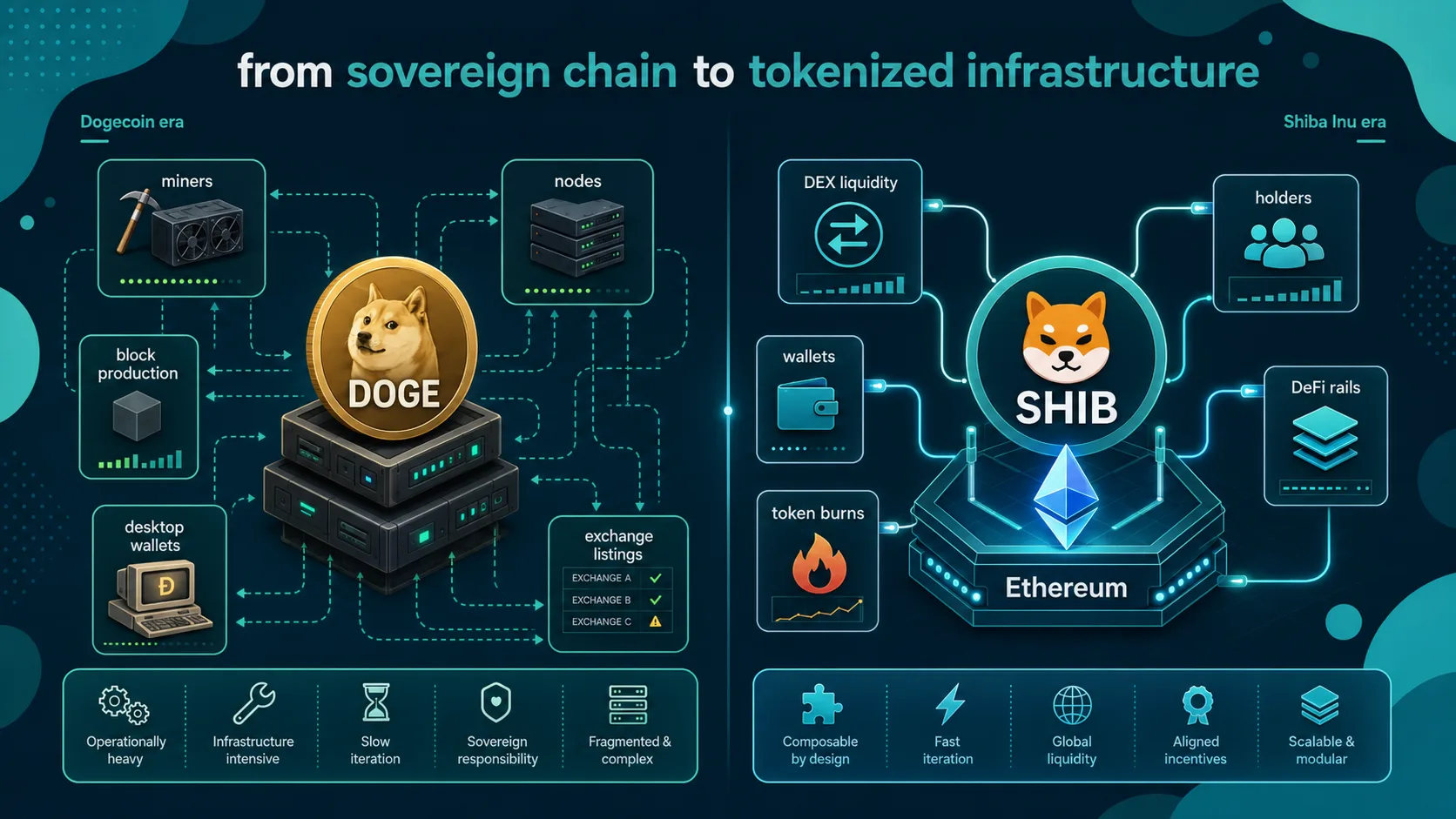
Of the first three experiments, only Dogecoin stayed in continuous operation and turned into a global asset. Its trajectory, together with the later arrival of Shiba Inu, defines the two big historical benchmarks of the genre.
Dogecoin: the first multi-billion dollar consolidation
What kept DOGE relevant in its early years wasn’t the code, it was the community. In 2014, users raised ~$30,000 to fund the Jamaican bobsled team’s trip to the Sochi Olympics, another $30,000 for the Doge4Water campaign in Kenya with Charity: Water, and $55,000 to sponsor driver Josh Wise in NASCAR. It was the first public proof that a meme coin could move capital toward real-world causes.
The big cycle hit in 2020-2021: with global liquidity from the pandemic, heavy speculation on Robinhood and constant backing from Elon Musk, DOGE went from fractions of a cent to an all-time high near $0.74 in May 2021. Market cap reached $85 billion, putting Dogecoin as the fifth most valuable crypto at the time. House of Doge, its investment arm, ended up buying stakes in European sports clubs like US Triestina Calcio and Milano Hockey Club between 2025 and 2026, completing an unprecedented shift: from internet meme to traditional sports ownership.
Shiba Inu: the first major ERC-20 contender
Dogecoin’s success opened the door to a new generation of meme coins, this time built directly as ERC-20 tokens on Ethereum. Shiba Inu launched in August 2020 by an anonymous developer using the alias Ryoshi. Unlike DOGE, SHIB didn’t need to maintain its own blockchain: it plugged straight into the Ethereum DeFi ecosystem.
Its distribution was extreme. Initial supply of 999.9 trillion tokens, with 50% sent directly to Vitalik Buterin’s wallet. In May 2021, Vitalik burned 90% of the tokens he received (410 trillion) and donated the rest to charity. The event sharply cut circulating supply and triggered a massive speculative rally. In October 2021, SHIB hit an all-time high of $0.00008854 and a market cap of ~$54 billion, briefly flipping Dogecoin.
| Parameter | Dogecoin (DOGE) | Shiba Inu (SHIB) |
|---|---|---|
| Launch year | 2013 | 2020 |
| Technology | Sovereign Layer 1 blockchain (Luckycoin/Litecoin copy) | ERC-20 Token on Ethereum |
| Consensus | Proof-of-Work (Scrypt, merged mining with LTC) | Proof-of-Stake (inherited from Ethereum) |
| Supply | Unlimited, fixed annual issuance of 5 billion | 999.9 trillion initial tokens |
| All-time high market cap | ~$85B to $88B USD (May 2021) | ~$43B to $54B USD (October 2021) |
| All-time high (ATH) | ~$0.73-0.74 USD | ~$0.000088 USD |
| Scarcity mechanism | None, encourages low-cost circulation | Dynamic token burn system |
A key technical difference between 2013 and 2020 is that keeping a modern meme coin alive means sustaining on-chain volume as part of the game. Today’s projects rely on tools like a crypto volume bot to refresh their position on DEXs and screeners, something conceptually unthinkable on the 2013 blockchain infrastructure.
What the first meme coins taught us
Beyond the historical data, the interesting takeaway is what Junkcoin, Bellscoin, and Dogecoin made clear from 2013 onward:
- Community attention is a monetizable resource. Bellscoin had better tokenomics than Dogecoin and still died from lack of attention.
- Code lives on through forks. Junkcoin fed Luckycoin, which fed Dogecoin. “Failed” projects can be invisible ancestors of global phenomena.
- Technical utility tends to show up after the meme. Both DOGE and SHIB built their narrative first and developed real utility (Shibarium, DOGE’s retail integration) later.
- The terrain changed, the risks didn’t. The ease of launching tokens today also makes it easier for projects with zero substance to ship. Knowing how to avoid rug pulls in memecoins is part of the craft.
FAQ
What was the first meme coin in history?
It depends on the criteria. The first meme blockchain documented on-chain was Junkcoin (JKC), launched on May 3, 2013 as a satirical fork of Litecoin. The first meme coin with a structured narrative from an identifiable developer was Bellscoin (BELLS), launched on November 28, 2013. Dogecoin arrived on December 6 of the same year and became the first meme coin to consolidate as a global asset.
Why is Dogecoin considered the first meme coin if there were others before it?
Because Dogecoin was the first to cross the threshold of cultural virality. Junkcoin and Bellscoin existed earlier but stayed as forum experiments. Dogecoin combined an already-viral meme (the Shiba Inu dog in Comic Sans), an active Reddit community, and media campaigns that pulled it out of the technical niche. That mainstream visibility replaced the actual historical title.
What happened to Junkcoin and Bellscoin?
Both sat abandoned for years. The Bellscoin network was offline from late 2014 and was revived by developers in December 2023, coinciding with Dogecoin’s tenth anniversary. The Junkcoin network came back online in November 2024. Both projects are still alive today as nodes of historical interest, not as top-tier speculative assets.
Who created Bellscoin?
Billy Markus, an IBM software engineer at the time, known by his online alias BillyM2K. He’s the same person who, eight days later, would launch Dogecoin alongside Jackson Palmer. Bellscoin was his first experiment with meme coins.
Which meme coin has the highest historical market cap?
Dogecoin, with a peak close to $88 billion in May 2021, briefly making it the fifth most valuable cryptocurrency in the world. Shiba Inu reached between $43 billion and $54 billion in October 2021, momentarily overtaking DOGE but failing to hold that position long term.
Conclusion
The first meme coin in history wasn’t Dogecoin, it was Junkcoin in May 2013, followed by Bellscoin in November of the same year. Dogecoin arrived third and kept the crown because it combined inherited code, an already-viral meme, and an organized community in a context where the rest of the ecosystem was collapsing between Mt. Gox and the People’s Bank of China restrictions.
The historical lesson is that the genre was born as satire and stuck around because it articulated something new: that collective attention can be worth more, financially, than technical rigor. From Junkcoin to modern launchpads, what changed was the technical friction. What stayed the same was the social experiment.

Content creator and SEO contributor at Smithii. Systems Engineering student and crypto-tech enthusiast.