HOW DO YOU MARKET A NFT COLLECTION?
“If you offer strong utility, a future-focused roadmap, and a solid whitepaper, you’ll win”… That is NOT how it works, sadly, it just isn’t.
Before we get into it, welcome to the fourth chapter of the NFT creation course. In this chapter, we’re covering how to market a NFT collection. Yes, the thing everyone wants to nail so they can sell their NFT, but very few actually pull off.
We’re going to cover several VERY important ideas you need to understand and internalize. Grab a notebook. Let’s get into it.
HOW DOES NFT COLLECTION MARKETING WORK?
Even though everyone says you need to offer utility, build a roadmap, and write a convincing 1,500-page whitepaper that builds trust and all that, the reality is different.
NFT are an attention game. If you lose people’s attention, you lose the game.
No one cares about your beautiful whitepaper or your amazing utility if you’re not going to sell out, push the floor price up, and make minters money.
This may sound a bit radical and hard to grasp, but just look at the top projects on Opensea, Blur, or Magic Eden.
The truth is, 80% of them offer nothing unique. They are not “builders”. But they do marketing, REALLY good marketing. They create hype, build community, and that sells.
NFT Collection Marketing
SO WHAT SHOULD I DO?
Marketing is basically an art. It comes down to creativity and our ability to stand out and get attention, in a positive way, of course.
In the NFT space, everything works pretty differently. Basically, it happens in reverse: first, you build the community, and then you sell. The opposite of what we are used to in traditional businesses, where a product is offered and a community is built around base.
Of course, there are variables and unique cases, but in general, that is how it works.
That means the success of a NFT collection depends on hype. In other words, demand needs to be higher than supply. And if we do not reach that point, it is hard to perform well, because most NFT are bought for speculation.
You’re probably thinking: “Sure, that’s useful to know, but how the f*ck do I get my collection to build hype and make people want to buy it?”
No worries. Let’s get into it.
Want news and tips for NFT creators?
Subscribe to our newsletter and stay on top of the latest NFT updates.

WHAT DRIVES FOMO IN NFT PROJECTS?
We can point to 4 key factors that separate a FOMO project from one that fails to build hype.
1. X / TWITTER
Twitter is where everyone goes to check out a project, and in this case, the numbers do the talking.
Even with bots and raid tools in play, people are not clueless. They can tell right away when a collection looks like a real opportunity and when it does not.
Twitter is our storefront, so it needs to look solid, attention-grabbing, and above all, it needs strong numbers in followers, post reach, and most importantly, engagement.

2. DISCORD
Usually, we jump into Discord for a quick look if what we first saw on Twitter caught our attention. It can also be our first impression of the project if we come in through a collab/call from another Discord community.
There are also plenty of bots and inflated numbers, but it is easy to spot when a Discord is actually active: messages get reactions, people are chatting, and so on.
It is critical that our Discord is well organized, with accurate information people can dig into to understand what our NFT collection is about. But what matters even more is having huge interest in getting whitelist, an active chat all day, and announcements packed with reactions.
3. PARTNERSHIPS AND COLLABS
After passing the first two “tests” to be seen as a “strong project”, it is time to add the final touch: having partnerships and collaborations with major projects inside the ecosystem, and even beyond it.
There is nothing humans respond to more than social proof. If a collection has partnerships with projects we see as leaders, we will automatically feel more confident and view that collection more favorably.
Partnerships are much easier to close with a solid project and a clear proposal that brings value to both sides.
4. ART AND UTILITY
You can build a massive success without art or strong utility, but good art will open a lot of doors. It gives the project a striking, distinctive image that puts us in a stronger position.
When it comes to utility, fewer users actually take the time to look into the utility and think about whether we are offering something genuinely different. Even so, it is much harder to launch a collection without at least a few convincing utilities to offer.
If we have genuinely strong utilities, they work a lot like the art: they open doors, especially when it comes to landing influencer deals, collabs, and partnerships.
That said, as always, we are speaking in broad terms. There are many other factors that make the difference, unique cases that do not follow the same “rules,” and so on.
There is also a big difference between projects that are just getting started and collections that are close to the mint phase.
Next, we will break down a marketing strategy that actually DRIVES SALES and that most NFT use today.
HOW DO I SELL OUT MY NFT?
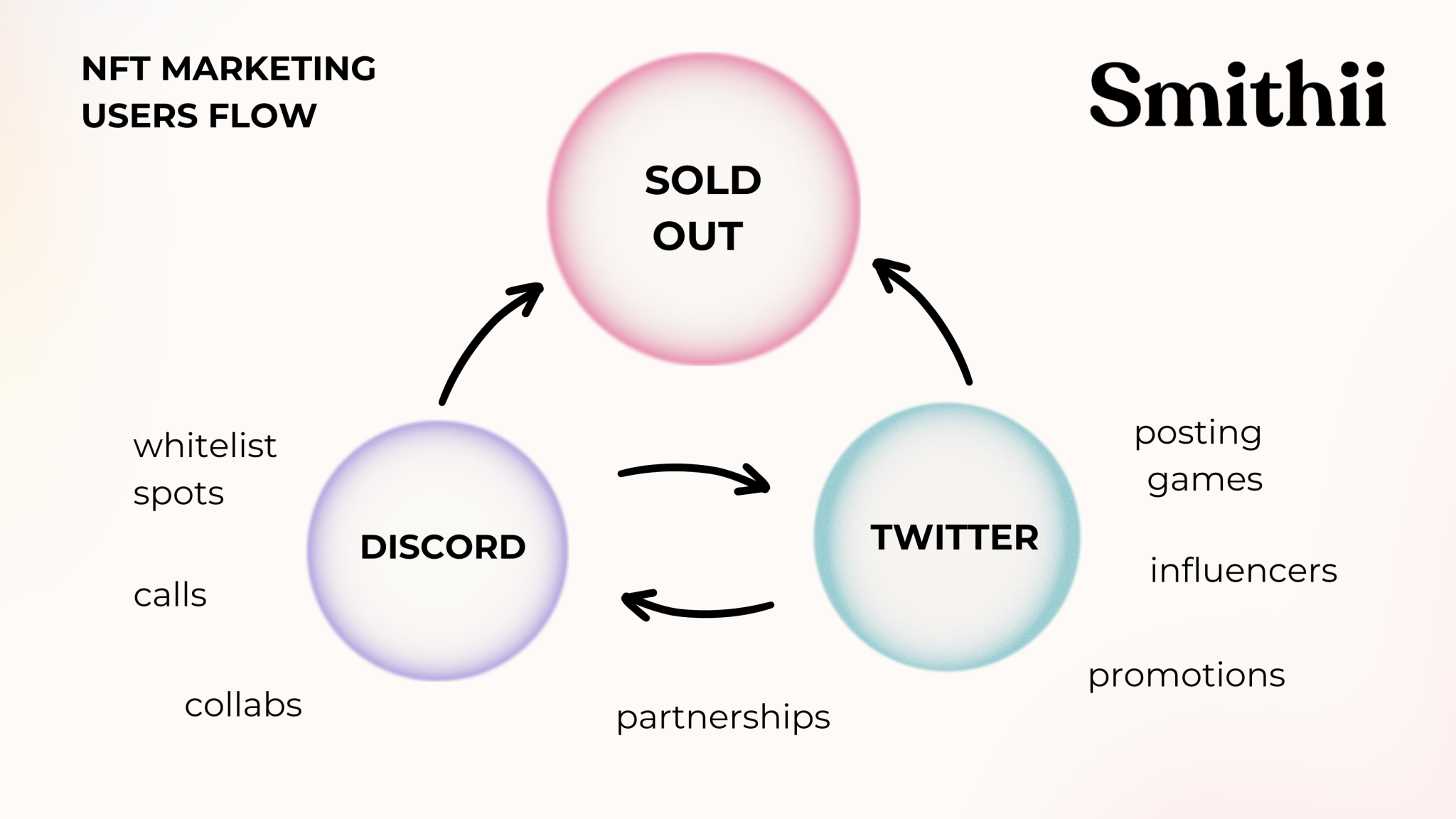
Think of the strategy as a flow of users between Twitter and Discord, which then drives sales on mint day.
The numbers you need for followers, active people, and interactions to reach a sold out will depend on the supply, mint price, and current market conditions.
To get a baseline, the simplest move is to look at collections that minted successfully recently and study their numbers. Compare them with yours, and you can start building your own estimates.
Of course, many factors can affect the result, but if you follow these “rules,” you’ll get a solid estimate.
NFT COLLECTION MARKETING STRATEGY
This strategy will be built around a mint with a whitelist phase, Twitter and Discord as the main social channels, plus collabs and partnerships to grow reach and brand perception.
Let’s get straight to the point. The strategy I’m going to walk you through works like this:
1. INITIAL HYPE
To kick off marketing for your own NFT collection, we need to create a “first wave of hype” that brings in our first followers, interactions, and people interested in the project.
We’ll do this through Twitter, using promotions with influencers. They are expensive, but often necessary.
For this first wave, we’ll need eye-catching illustrations and/or videos that grab users’ attention across 1 to 3 posts.
It is usually a good idea to use hashtags to increase the reach of our posts, even if they obviously do not help much aesthetically.

2. DRIVE TRAFFIC
Once we’ve made that first connection with a solid group of users, the next move is to build demand and funnel traffic into Discord.
You need to build hype before publishing the Discord so it stays active once it opens.
We need it to stay active so users can see there’s real demand for whitelist spots and for minting our NFT project.
Push traffic into Discord and start setting up collaborations with other projects.
3. BUILD COMMUNITY
Once you have users on both Twitter and Discord, the next step is to retain them and turn those users into a real community.
The key pieces will be your collection’s lore, memes, language, and the communication you build around the project.
Push your message and vision out to your community. They’ll become your megaphone and help drive growth.
4. ORGANIC GROWTH
While we build the community, we also need to create what we call organic growth: growth without paid promotions. If we have the capacity to keep promoting ourselves too, even better.
We’ll do it through whitelist collaborations with other projects and DAOs, partnerships, community games, challenges, and any creative ways we can use to drive interaction and bring in invites from outside users, both on Discord and Twitter.
This is a longer stage. We should spend at least 2 weeks on it to get solid results. The smaller our promotion budget, the more work we need to put into organic growth.

5. MINT PLANNING
It’s very common to set the supply from the start while keeping the price as TBA (To be announced).
When our growth curve starts to flatten, it’s time to plan the mint: supply and final price, whether or not to run a private presale, the minting format, which launchpad we’ll use if that’s the route we want, and of course, the mint date.
If you don’t have the exact day yet, at least set a window without making it public. Try to avoid scheduling your mint at the same time as another hyped mint, because it will pull attention away from yours.
At this point, we need to be honest with ourselves, assess our ability to secure a comfortable sold out, and work to get the best possible conditions for our mint.
Running the mint on a recognized launchpad such as Magic Eden, OpenSea, etc. can be a key advantage for building even more hype and demand.
6. PRIVATE PRESALE (OPTIONAL)
This step is optional, but very useful for raising funds to invest in the final push before the mint, getting a clearer read on demand for our NFT collection, and in short, running a “test”.
Usually, you offer a small portion of the total supply, reserved only for major collaborations, partners, and “OG” members, who receive that role through interaction, gameplay, or by buying a NFT.
The main upside is that the price is lower than the public mint and whitelist mint. Platforms like Subber or Atlas3 are usually used for this.
7. FINAL PUSH
This is the moment to bring all the previous work together.
In this final phase, we need to announce our strongest partnerships, publish sneak peeks of the most compelling utilities, keep the Discord more active than ever and, if possible, boost all of it with promos.
By this point, most of the outcome is already set, but make sure there are no mistakes. They can wipe out everything you have built so far.
We will cover how to manage mint day in another chapter.

HOW TO PROMOTE AND MARKET A NFT COLLECTION
Once the strategy is clear, there are several areas worth covering that we will not go deep into because it would take hours and the playbook changes over time. Still, here are a few key tips that can easily make the difference between success and failure.
- Promotions and marketing for a NFT collection are expensive, very expensive. That is not even the only issue. The bigger problem is that most “influencers” use bots or have followers who only care about giveaways. Be careful, analyze the profiles you want to promote with very closely, and make decisions with caution.
- A “Marketing Advisor” is basically a long-term promotion deal with an influencer who keeps backing you and helps shape your project’s marketing decisions. It can be extremely useful. It is hard to get them interested, expensive, and will usually require a percentage of the mint, but if you land one, you are already way ahead.
- Spend on good collab managers. They are worth it. Their job may look like something anyone could do, and in a way that is true, but not everyone is equally good at it. Not everyone can secure collaborations with top projects or attract projects with strong investors. Many may ask for more money than expected, but if you know they do good work, it will be worth it.
- Moderators matter more than most people think. Your Discord needs to stay active, both in chat and through different dynamics or activities. A strong moderation team that communicates the project’s message, keeps users engaged, and builds a real community can make your collection succeed.

CONCLUSION: HOW DO YOU MARKET AN NFT COLLECTION?
To win on this side of the game, marketing your NFT collection is the key piece, but you need to do it properly. Take the time to study how others do it, find the right influencers, collab managers, and moderators, and above all, set a clear strategy for how you will execute so you can avoid mistakes caused by improvising.
Thanks for reading. See you in the next chapter!

Want news and tips for NFT creators?
Subscribe to our newsletter and stay on top of the latest NFT updates.

CEO & Co-Founder Smithii. Building on Solana since 2021 and passionate to share my experience on Solana projects. I also Founded Lince after years investing in DeFi.